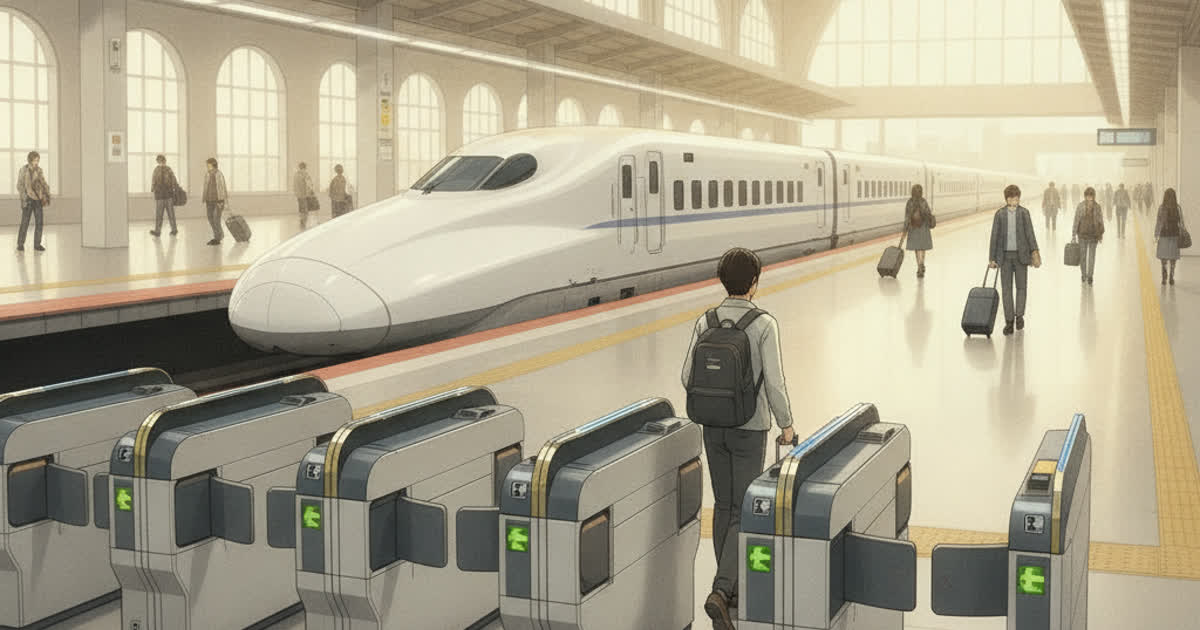
You bought a Shinkansen ticket. The machine handed you two pieces of card. You feed the one that looks most official into the gate, the flaps snap shut, and there is now a queue of commuters behind you with somewhere to be. Nothing has gone wrong and you have not been overcharged — the Shinkansen simply sells one ride as two tickets, and the gate wants both of them at once.
Why does the Shinkansen need two tickets?
Because JR sells the distance and the speed separately. The 乗車券 (jōshaken) is the basic fare ticket: it pays for moving you from A to B across the JR network, and it is the same kind of ticket a slow local train would use. The 特急券 (tokkyūken) is the limited-express ticket — a surcharge for riding a fast train instead of a slow one. The Shinkansen is the fastest limited express in the country, so it always costs both. Tokyo to Kyoto runs roughly ¥14,000 all in, of which about ¥9,000 is the fare ticket and about ¥5,000 is the express ticket. Every JR limited express works this way, not just the bullet train, which is why the difference between local, rapid and express services is worth ten minutes before your first long trip.
What is the difference between a jōshaken and a tokkyūken?
The fare ticket names two stations; the express ticket names one train. Your 乗車券 prints something like 東京 → 京都 with the price and how many days it stays valid. Your 特急券 prints the train name and number, the date, the departure time, the car number (号車, gōsha) and the seat. A reserved ticket is a 指定席特急券 (shiteiseki tokkyūken) and locks you to that exact departure; an unreserved one is a 自由席特急券 (jiyūseki tokkyūken) and lets you take any free seat in the unreserved cars — the reserved versus unreserved decision is its own small art. Green car adds a third slip. For short hops the two are sometimes printed together on a single ticket, so if you only got one piece of card, check whether it says both words before you panic. The reel above shows both tickets side by side, and finding your car number on the platform is the next thing you will need.
How do you put two Shinkansen tickets through the gate?
Stack them and feed them in together. Line the two tickets up one on top of the other, printed side up, and push the whole stack into the slot in a single go — the gate reads both, keeps neither, and pops them back out at the far end. Do not feed them one at a time; that is what triggers the rejection almost every first-timer gets. If you are transferring from an ordinary JR line, the Shinkansen transfer gate (乗換口, norikaeguchi) takes up to three tickets at once: your local fare ticket plus both Shinkansen tickets. It swallows the local one and returns the two you still need. Whatever comes out the other side, take all of it before you walk off — and if you cannot find the right gate, asking which platform your train leaves from gets you there faster than another lap of the concourse.
Do you need two tickets with a Japan Rail Pass?
No — the pass replaces both of them. A Japan Rail Pass covers the fare and the limited-express surcharge together, so there is nothing to stack. Since 2020 the pass has been machine-readable at most automatic gates: put the pass itself through the slot, or show it at the staffed gate at smaller stations that have not been upgraded. Seat reservations are free with the pass — take it to a みどりの窓口 (midori no madoguchi, the JR ticket office) or a reservation machine and they will print you a seat slip, which is a receipt for your seat, not a ticket you feed into anything. The one catch: のぞみ (Nozomi) and みずほ (Mizuho), the fastest services, need a paid supplement on top of the pass, so plan on a ひかり (Hikari) if you would rather not pay twice.
Can you use a Suica or Pasmo on the Shinkansen?
Not with the balance alone. A plain IC card pays local JR and subway fares, and the Shinkansen gate will refuse it every time, because the card has no way to carry the express ticket. There are two workarounds and both need setting up in advance: Smart EX or EX, an online booking service for the Tokaido and Sanyo lines that links your reservation to an IC card so you can tap through; and Touch de Go! Shinkansen, which lets a registered Suica ride unreserved on the Tohoku, Joetsu and Hokuriku lines. Without one of those, buy paper at a machine or a window. And top the card up before you head for the gates anyway — the insufficient-balance beep is a bad sound to hear with a departure in four minutes.
What happens if the Shinkansen gate rejects your ticket?
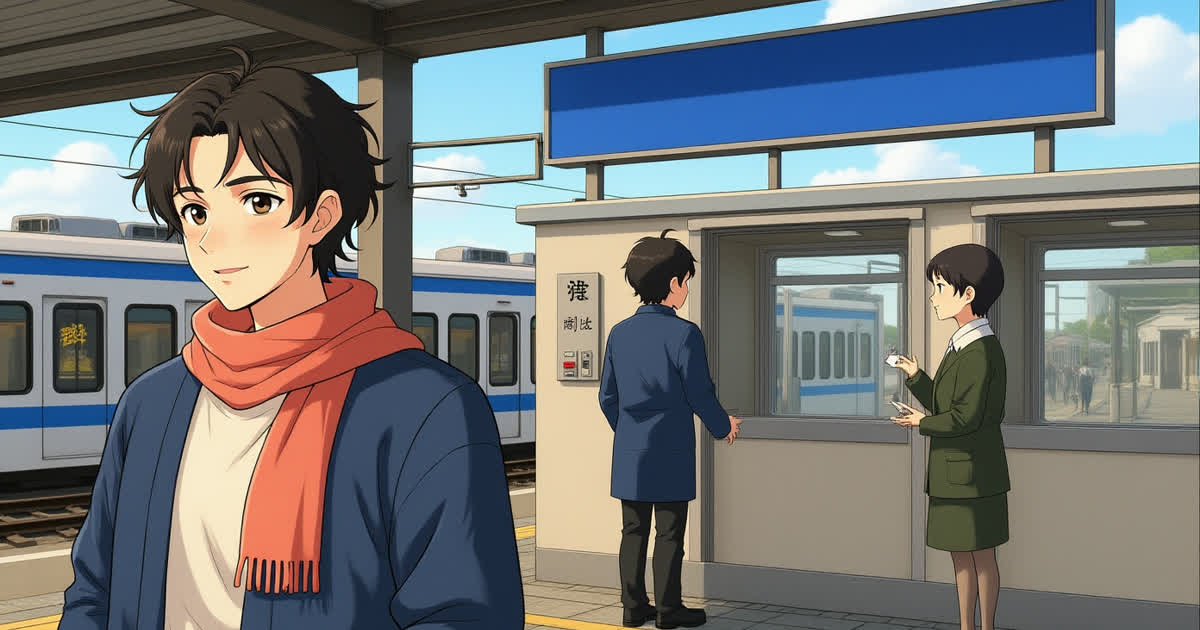
Step aside and go to the staffed window at the end of the gate line — this is a ninety-second problem, not a crisis. Four things cause almost all rejections: you fed one ticket instead of two, you used the ordinary station gate instead of the Shinkansen gate, your ticket is dated for another day, or you never bought a 特急券 at all. The attendant sits in the glass booth beside the barriers and fixes all four. Hand over everything you are holding and say すみません、これで合っていますか (sumimasen, kore de atteimasu ka, "excuse me, is this correct?"). If the express ticket is genuinely missing, buy one at the みどりの窓口 with 特急券を買いたいです (tokkyūken o kaitai desu) — or board and buy it from the conductor, which works but costs more than doing it on the ground. Travelling at peak season makes the queues longer, so an Obon or Golden Week departure deserves an extra twenty minutes.
Do you keep both tickets for the whole ride?
Keep both until you are out through the gate at your destination. The exit gate takes the same stack you put in at the start and keeps it, which is the only time either ticket is surrendered. In between, a conductor may ask to see them, and in the unreserved cars that check is routine. The mistake to avoid is binning the fare ticket once you are seated because the express ticket looks like the important one — without the fare ticket you cannot leave the station, and you will be paying it again at the far end. Pocket both together, keep them somewhere you are not going to sit on, and if you do end up riding past your stop, the staff at the exit gate will sort the difference out.
Two tickets, one slot, both back in your hand — that is the whole trick, and it stops being a thing you think about after the first ride. Buy them together, stack them, keep them, and spend the freed-up attention on the ekiben you are going to eat at 200 km/h instead. For the rest of the station vocabulary, start with the essential words for tourists, read up on how to behave on a Japanese train, and browse all our travel reels.