
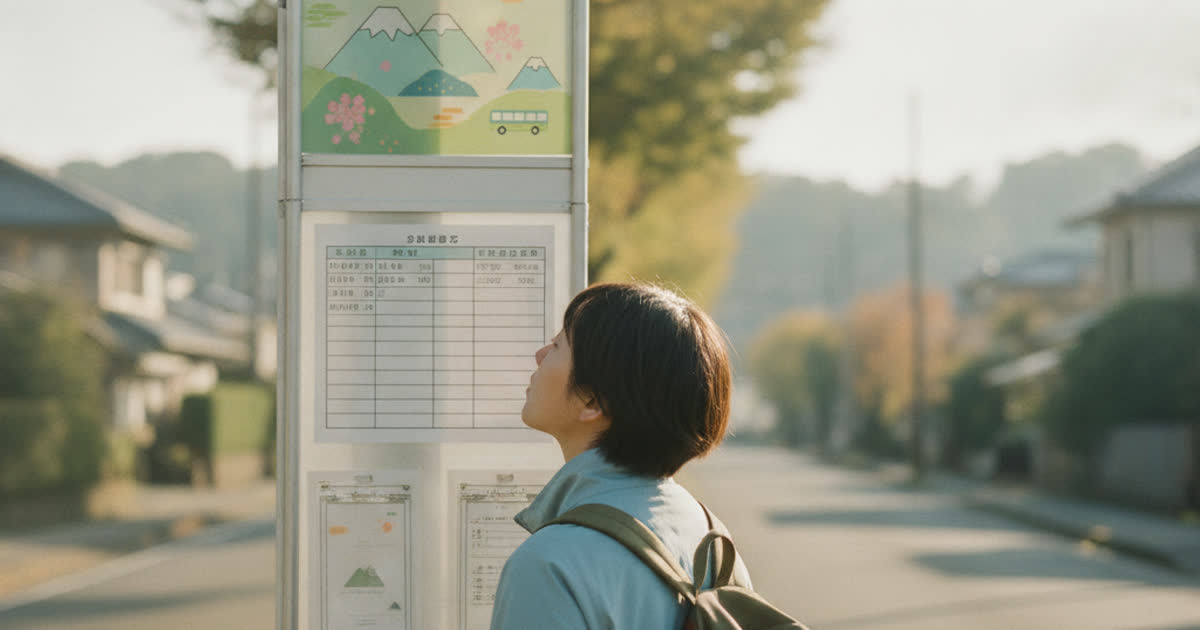
A Japanese timetable is one of the friendliest documents in the country once you know its shape, and one of the most expensive to misread until then. Everything is printed, everything is exact, and the buses genuinely leave at the minute shown. The catch is that a single sheet holds two or three different days at once, side by side, in columns that look identical to someone who cannot read the headers. Read the wrong one and you have not misjudged anything — you have simply been given the times for a day that is not today. On a Tokyo subway platform that costs you four minutes. At a bus pole in the mountains outside Takayama on a public holiday, it costs you the afternoon.
How do you read a Japanese train or bus timetable?
Find your column first, then read the grid — in that order, every time. The sheet is a table: the large figures down the left edge are hours, marked 時 (ji), and the small figures running rightwards from each hour are the minutes past it, marked 分 (fun). An hour row reading 15 followed by 02 19 37 51 means departures at 15:02, 15:19, 15:37 and 15:51. That is the whole mechanic. Nothing on the sheet is a journey time and nothing is a fare — every number is a departure from the exact spot you are standing on. Hours run from about 5 at the top to 23 or 24 at the bottom, and a blank hour row means no service at all in that hour, which on a rural route is a normal sight rather than a printing error.
What do 平日 and 土日祝 mean on a Japanese timetable?
平日 (heijitsu) means weekdays, Monday to Friday, and 土日祝 (donichishuku) means Saturdays, Sundays and public holidays. Those three kanji are the single most useful block on the sheet, and they are the phrase in the reel above: 土 is Saturday, 日 is Sunday, 祝 is a holiday. Some operators split that second column again into 土曜 (doyō, Saturday) and 日曜・祝日 (nichiyō・shukujitsu, Sunday and holidays), because Saturday service is often thinner than a weekday but better than a Sunday. The same two-column split runs far beyond transport: it decides opening hours on a shop door, whether a clinic is taking patients, and whether the cheap set lunch exists today, which is why the card on a restaurant door naming one closed day a week is worth reading with the same care.
Which column applies on a Japanese public holiday?
The 土日祝 column, whatever weekday the holiday happens to fall on. A national holiday on a Tuesday runs the Sunday service, and on a local bus route that can mean half the departures and nothing before eight in the morning. Japan has sixteen public holidays a year, several of them float to a Monday, and two of them create long weekends that most visitors never see coming. Two periods get their own treatment again: mid-August and the New Year, where operators post a special お盆ダイヤ (obon daiya) or 年末年始ダイヤ (nenmatsu nenshi daiya) notice taped beside the regular sheet — a temporary timetable that overrides both columns. If you are travelling in that window, the Obon travel guide covers what else shifts. Weather can override everything as well: operators announce planned suspensions a full day before a typhoon arrives, and no printed column survives that.
What do the symbols and coloured numbers on a Japanese timetable mean?
They mark the departures that do not behave like the rest of the column. A red, bold or boxed number almost always means a faster service — 快 (kai, rapid) or 急 (kyū, express) — which is good news only if it stops where you are going, because an express will pass straight through a small station without slowing. A small mark such as ※ or ★ next to a time points to a footnote at the bottom of the sheet: 学休日運休 (gakkyūbi unkyū) means the run does not operate during school holidays, 運休 (unkyū) alone means cancelled, and a kanji place name attached to a time means that service terminates short of the usual end of the line. Spend thirty seconds on the key. These marks are precisely where the bus you built your morning around quietly stops existing. If the service types themselves are unfamiliar, the guide to local, rapid and express trains explains what each one skips.
Where do you find the timetable at a Japanese station or bus stop?
At a bus stop it is printed on the pole itself, directly under the stop name, and each pole covers one direction only — the stop on the other side of the road has a completely separate sheet, so crossing the street is sometimes the entire fix. At a station, the paper 時刻表 (jikokuhyō) hangs by the stairs on each platform and again near the ticket gate, organised by direction with 〜方面 (hōmen, "towards") plus a major station name rather than by compass point. The overhead digital board is not a substitute: it shows the next two or three departures and nothing further, so anything beyond the next twenty minutes has to come off the paper. If you cannot work out which platform is yours in the first place, finding yourself on the station map comes before reading any timetable at all.
How do you ask about a timetable in Japanese?
One question settles the column: 今日は土日祝ダイヤですか? (kyō wa donichishuku daiya desu ka), "is today on the weekend and holiday timetable?" ダイヤ (daiya) is the word for a timetable pattern, and it is what staff use themselves. To skip the grid entirely, ask 次のバスは何時ですか? (tsugi no basu wa nanji desu ka), "what time is the next bus?" — or swap in 電車 (densha) for a train. When someone walks you through the sheet, expect こちらが平日、こちらが土日祝です。 (kochira ga heijitsu, kochira ga donichishuku desu), "this column is weekdays, this one is Saturdays, Sundays and holidays," delivered while pointing at each one. Late in the day, the question changes: asking what time the last train leaves matters more than the whole rest of the sheet.
Do Japanese bus and train timetables differ?
They share the grid, but they do not share the stakes. A city train line runs every three to six minutes and its timetable is a formality — you turn up and a train comes. A suburban or rural bus may run six times a day, and the gap between two departures can be ninety minutes, which turns one misread column into a rewritten afternoon. Bus sheets also carry far more footnotes, because school runs, seasonal services and journeys that stop halfway along the route are ordinary features of a rural network. The working rule: treat a train timetable as reference and a bus timetable as a commitment. Buses add their own boarding mechanics too, and how paying on a Japanese bus actually works is the other half of getting on one confidently.
Should you use a paper timetable or a route app in Japan?
Plan with the app, confirm with the pole, because they fail in different directions. Google Maps, Jorudan and NAVITIME all handle Japanese holiday timetables correctly and are excellent on rail, where the data comes straight from the operators. Rural bus coverage is where they thin out: routes go missing, and no app tells you that today's 07:40 is marked 学休日運休 and will not be coming because the local school is on holiday. The printed sheet is the operator's own word, replaced whenever the timetable is revised, and it still works with no signal in a valley. Photograph your column when you arrive rather than reading it in a hurry on the way back, and note the last departure while you are there.
Reduced to a habit it is three moves: read the header, find today's column, then read the hour row. Do that before you look at a single number and Japanese timetables turn from a wall of kanji into one of the most dependable things about travelling here — a printed promise that the 15:37 leaves at 15:37. And if you are standing at that pole on a Tuesday that happens to be a national holiday, you now know to look one column right.