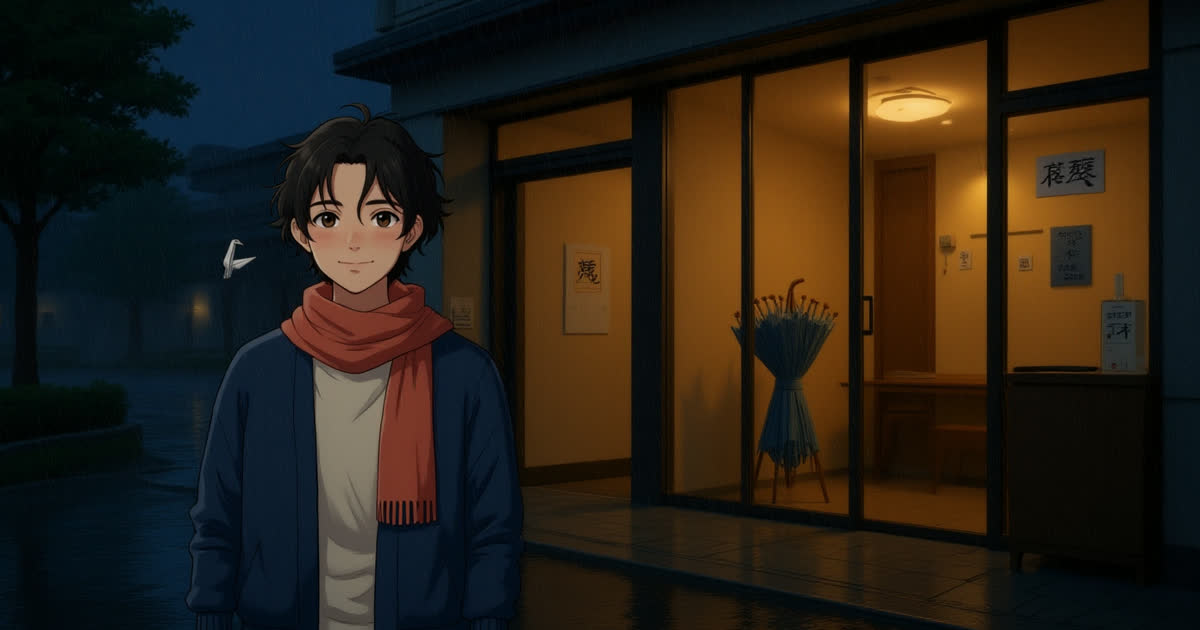
The rain starts between the lobby and the convenience store. You pay ¥700 for a thin vinyl umbrella you will throw away tomorrow. Ten metres behind you, the hotel kept a barrel of free ones. The reel above is that barrel: 貸傘 (kashigasa), umbrellas for loan. This page is how to read the two-kanji sign, how to tell it from the stand of guest umbrellas, the one sentence to ask if the barrel is empty, and when you bring it back.
What does 貸傘 mean at a Japanese hotel?
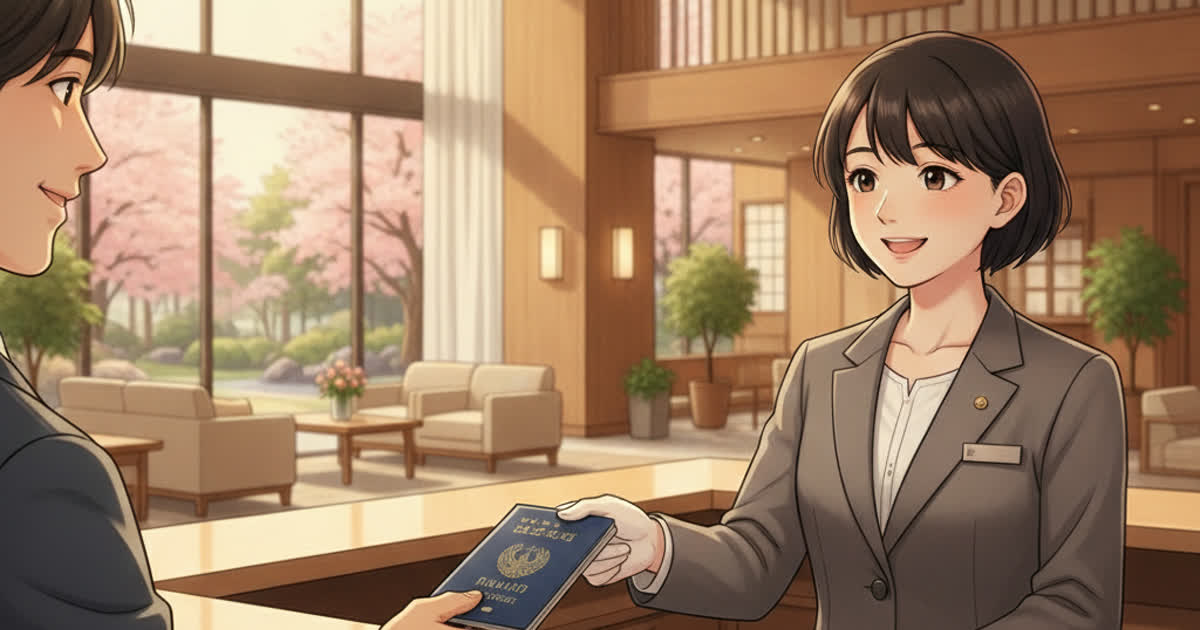
貸傘 (kashigasa) means umbrellas for loan. 貸す (kasu) is "to lend." 傘 (kasa) is "umbrella." Hotels, shops, and some stations keep a barrel or stand of them by the door or the front desk so a guest who did not pack rain gear can still go out. They are free. Take one, use it, bring it back. The label is often just those two kanji, sometimes written 貸し傘 with the extra kana. Same word. Same barrel. The reel is thirty seconds of looking for that sign before you walk to the konbini. The desk you already used for check-in, please is the same desk that will point at the barrel if you miss it.
How do you tell 貸傘 from 置き傘 at the door?
Read the tag. 貸傘 is the hotel's stock, meant for you. 置き傘 (okigasa) is an umbrella someone left: a guest's own, parked in the 傘立て (kasatate, umbrella stand) while they eat or sleep. 置く (oku) is "to put down." Those are not for taking. A loan barrel is a cluster of matching cheap vinyl umbrellas, often with a hotel sticker or a paper sleeve that says ご自由にお使いください (go-jiyū ni o-tsukai kudasai, "please use freely") — the same family of help-yourself sign as ご自由にお取りください on the amenity tray. A guest stand is a mix of colours and brands with no shared label. If you are not sure, leave the mixed stand alone and ask at the desk. Taking a stranger's umbrella is not a loan. It is a theft the lobby camera will remember.
How do you ask for a loan umbrella in Japanese?
Say 貸傘はありますか? (kashigasa wa arimasu ka?), "do you have a loan umbrella?" That is the sentence in the reel, and it is the whole ask. Catch the clerk with すみません (sumimasen) if they are on the phone — the same opener that starts almost every request in Japan. If the word 貸傘 does not come, use the verb: 傘を貸してください (kasa o kashite kudasai), "please lend me an umbrella," the same 貸してください that gets you a raincoat off a shop hook. A yes is a nod toward the door or a vinyl umbrella across the counter. A no is すみません、今はありません (sumimasen, ima wa arimasen), "sorry, we don't have any right now." Do not mime rain over the amenity tray. Ask the two-kanji word.
Do you have to return a 貸傘, and when?
Yes. Bring it back to the same hotel on the same outing, or at least the same stay. Walk it to the barrel or the desk and say お返しします (o-kaeshi shimasu), "I'm returning this." Staff will not invoice you for a ¥500 vinyl umbrella the way a car-rental desk invoices a dent, but the stock is finite: a rainy Friday empties the barrel by dinner, and the next guest is the person who then pays ¥700 next door. If you are checking out in the rain, return it at the desk before you roll the suitcase, or ask この傘、返さなくてもいいですか? (kono kasa, kaesanakute mo ii desu ka?), "is it okay if I don't return this umbrella?" Some business hotels shrug and let a cheap one walk. Some want it back. Ask. Do not "forget" it in a taxi and call it a souvenir. The other hotel habit that looks free until you read the label is downstairs: the laundry that still wants ¥100 coins.
Where else in Japan will you see 貸傘 besides hotels?
Shops, clinics, izakaya, and some station buildings keep a short stand by the door, labelled お客様用 (okyakusama-yō, "for customers") or 貸傘. Use it for the walk between the noren and the bus stop, then put it back when you return to pay. Department stores and office towers sometimes keep a staffed counter. That is still a loan, not a gift. Do not confuse the free barrel with アイカサ (aikasa) and other share-umbrella docks you unlock with an app: those charge by the hour and are a rental, not a hotel courtesy. If a restaurant has only a mixed stand and no label, ask 傘、ここでいいですか? (kasa, koko de ii desu ka?), "is it okay to leave my umbrella here?" — that is the rainy-season sentence for parking your own, not a licence to take one. Inside, wet canopies go in a 傘袋, the plastic sleeve by the door, so the floor stays dry.
Should you buy a convenience-store umbrella instead?
Buy one when the hotel has no barrel, the barrel is empty, or you are not going back. A konbini ビニール傘 (binīru-kasa, vinyl umbrella) is usually ¥500 to ¥800, hanging in a wire rack by the door, and the phrases at that register are the same ones in the convenience-store guide. It is yours. You can trash it, pack it, or keep it as a spare 置き傘 at the next hotel. That is the right spend when you are leaving for the airport in a downpour and will not see this lobby again. It is the wrong spend when you are ducking out for dinner and the barrel is full. Check the door first. Ask the desk second. Walk to 7-Eleven third. The ¥700 mistake in the reel is the order, not the umbrella.
How is 貸傘 different from 日傘 and 傘袋?
貸傘 is a rain umbrella you borrow. 日傘 (higasa) is a sun parasol: same kanji for umbrella, 日 (hi) for sun, used on hot clear days, which the higasa reel unpacks so you do not stare at a dry street full of umbrellas and assume rain. 傘袋 (kasa-bukuro) is not an umbrella at all. It is the thin plastic sleeve at a shop or station door that you pull over a wet canopy so you do not trail water across the floor. Three different objects, three different jobs. A hotel barrel will not be full of parasols. A sleeve machine will not keep you dry outside. If you only learn one rain word for the lobby, make it 貸傘. If you only learn one rain habit for a shop, make it the sleeve. The passport photocopy at check-in is the other lobby surprise; the barrel is the one that saves you a wet walk and a receipt.
Carry three habits into a Japanese lobby when the street is wet. Read 貸傘 as the hotel's umbrellas, not the mixed stand. Ask 貸傘はありますか? before you buy a vinyl one. Bring it back with お返しします. Do that and the rain stops being a ¥700 tax. Watch the thirty-second version of the barrel once, then look at the door. For the rest of the stay — the two-price board, the basement washer, the desk — keep 宿泊 versus 休憩, hotel laundry kanji, and the short list of tourist words on your phone.