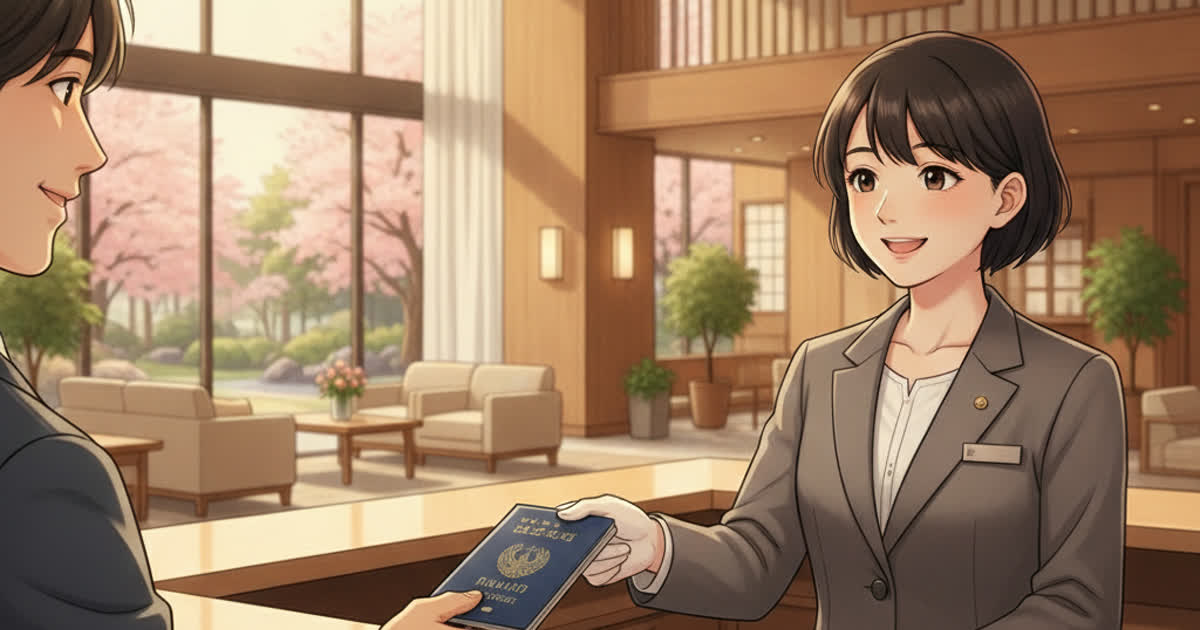
You have given your name at the front desk, the clerk has found your booking, and then there is a pause. They are waiting for something, and it is not your credit card. What comes next is パスポートをお願いします (pasupōto o onegai shimasu) — "your passport, please" — and then, slightly alarmingly the first time, they carry it away from the desk. Nothing has gone wrong. This is the single most predictable moment of any hotel stay in Japan, and it takes about a minute once you know what it is for.
Do Japanese hotels need to see your passport at check-in?
Yes, and no front desk can waive it. Article 6 of the 旅館業法 (ryokan-gyōhō, the Inn and Hotel Business Act) requires every licensed operator to keep a guest register, and the enforcement rules attached to it say that a guest with no address in Japan must record their nationality and passport number and present the passport so the property can copy it. That covers business hotels, ryokan, hostels, capsule hotels and licensed 民泊 (minpaku, private lodging) alike — the private-lodging law carries the same duty, so booking through Airbnb does not skip it. The clerk asking you is not making a judgement call about you; the property's licence depends on that record existing. It is worth remembering the reel above the night before you arrive, because the sentence lands about four seconds after you say "I have a reservation".
Why do Japanese hotels photocopy your passport?
Because the copy is the record, and an inspector can ask to see it. The photocopy requirement was added in 2005: for guests without a Japanese address, the property must file a copy or scan of the passport's photo page alongside the guest register and keep it for three years, where the local health authority or police can request it. That is the entire reason for the walk to the machine behind the desk — there is no separate database, just a paper or scanned file with your photo page in it. Your passport comes back within a minute, usually with a small bow and お待たせしました (omatase shimashita, "sorry to keep you waiting"). Some newer hotels have replaced the copier with a scanner built into the check-in kiosk, which does the same job with a glass plate you lay the passport on.
What if your passport is in your suitcase or the room safe?
You will be going to get it, so plan around that. Check-in cannot be completed without the passport in hand, and the most common version of this problem is self-inflicted: the suitcase with the passport in it has already gone up to the room, or been handed to a bellhop, or left with the luggage desk. Keep the passport in a pocket or day bag from the airport until you are through check-in. If it has already gone astray, say スーツケースの中にあります。すぐ取ってきます (sūtsukēsu no naka ni arimasu, sugu totte kimasu) — "it's in my suitcase, I'll get it right away." Staff will hold your place and finish the paperwork when you come back. If you are arriving before your room is ready and want to drop bags first, asking them to hold your luggage is the right move — just take the passport out before you hand the bag over. The same goes for checking in early.
Will a photo or photocopy of your passport work?
No — the passport itself has to be presented. The wording of the rule is that the guest presents the passport and the operator copies it, so a photo on your phone, a scan in your email, or a photocopy you brought from home will be refused at nearly every front desk in the country. Travellers get caught out by this because a phone photo is enough for so many things back home; in Japan it is not enough for a hotel, and it is not enough for tax-free shopping either, where the register also needs the physical booklet. The rule is real enough that carrying the passport every day is the standard advice for visitors, not just at check-in. If yours has genuinely been lost or stolen, your embassy or consulate issues an emergency travel document, and that document is what you check in with.
Do you show your passport if you live in Japan?
No — residents are exempt, and this is the part that confuses mixed groups. The passport-copy duty applies specifically to guests who have no address in Japan, so a foreign resident writes the same three things a Japanese guest does: name, address and a contact number. Most hotels will still ask to see a 在留カード (zairyū kādo, residence card) to confirm the Japanese address, which takes about five seconds and no copier. If you are travelling with a friend who lives in Japan, the rule splits down the middle of your group at the desk — you get copied, they do not. Only the guests actually staying need to be registered, so a friend seeing you to the lobby is not part of it.
What do you say at a Japanese hotel front desk?
Three short lines carry the whole conversation, and one of them is a single word. Open with チェックインお願いします (chekku-in onegai shimasu, "check-in, please") — the check-in line itself — followed by 予約しています (yoyaku shite imasu, "I have a reservation") and your family name. When パスポートをお願いします arrives, your entire reply is はい、どうぞ (hai, dōzo, "here you go"), which is the most useful word in Japan and works every time you hand anything to anyone. You may also hear コピーを取らせていただきます (kopī o torasete itadakimasu, "we'll take a copy") or 少々お待ちください (shōshō omachi kudasai, "one moment please") — both mean the copier trip is starting. Before you leave the desk, the one thing worth asking is what time check-out is, because in Japan it is often 10am.
So: passport in your pocket, not your suitcase, and はい、どうぞ ready to go. The whole exchange is over in under two minutes, and after the first night it stops registering as an event at all. If you are staying somewhere traditional, read up on when to take your shoes off next — that one catches more visitors out than the passport ever does — and start with the essential words for tourists if you want the short list that covers most of a trip. All our travel reels live here.