Almost every visitor to Japan knows the shoes come off somewhere. What trips people up is the where and the how — the half-second at a doorway when everyone else clearly knows the choreography and you don't. The good news: there's one rule underneath all of it, and once you can spot the cue, the rest is muscle memory. Here's the whole thing, doorway by doorway.
Do you take your shoes off in Japan?
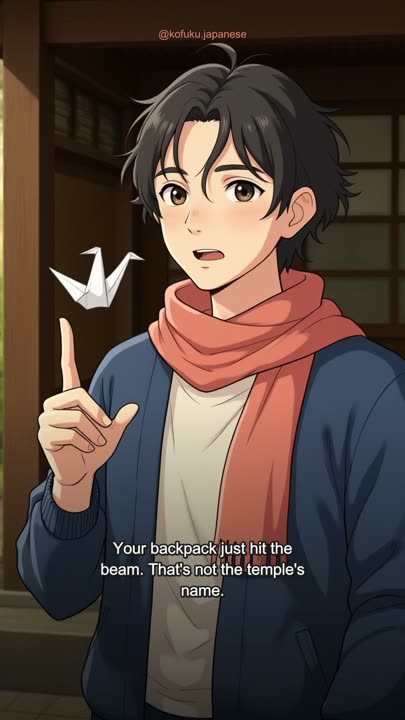
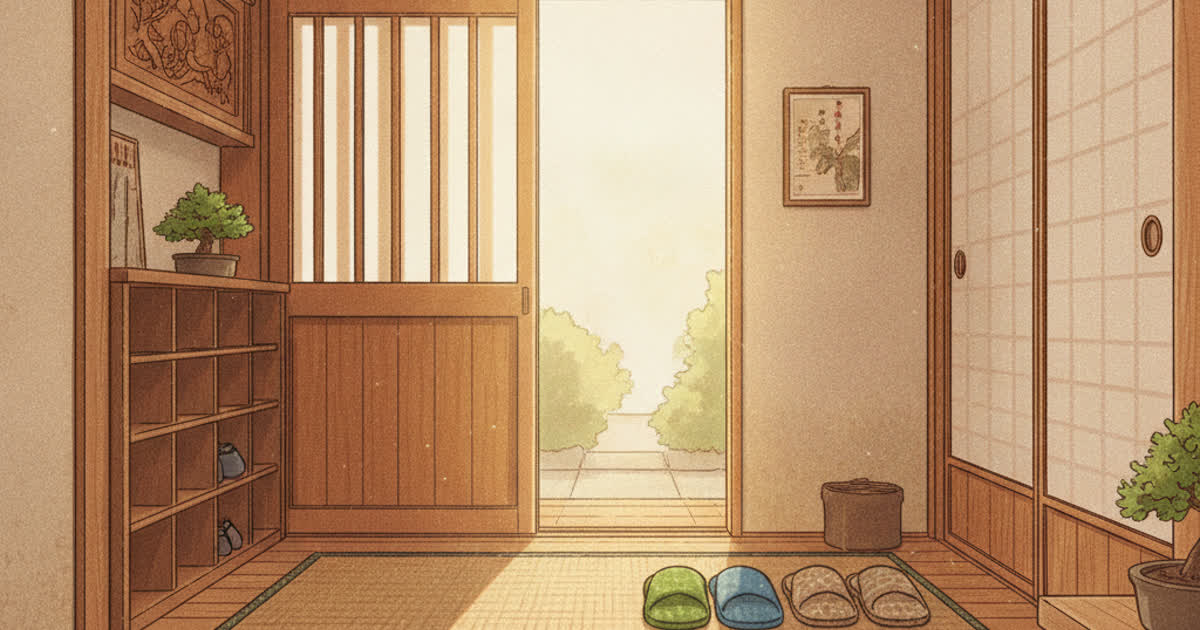
Yes — any time you step from an outdoor-shoe floor onto an indoor one. Japan draws a hard line between 外 (soto, outside) and 内 (uchi, inside), and shoes belong strictly to the outside. That line has a physical location: the 玄関 (genkan), the sunken entry area just inside a doorway where the floor visibly steps up. Shoes stay in the lower part; you go up. It isn't a formality about dirt alone — people sleep, eat, and sit directly on those floors, so the boundary genuinely matters. You can watch the whole move in a few seconds in the short reel above.
Where exactly do you take your shoes off in Japan?
Shoes come off in every private home and apartment, every 旅館 (ryokan) and minshuku, the inside of temple and shrine buildings you're allowed to enter, any room with 畳 (tatami) mat flooring, many traditional restaurants and izakaya with raised or sunken seating, many clinics and dentists, schools, clothing-store fitting rooms, and plenty of castles and historic museums. Shoes stay on in ordinary shops and malls, convenience stores, offices, cafés, Western-style hotel rooms, and on all public transport. Onsen and public baths are their own version of the same rule — shoes off at the entrance, then everything else off in the changing room; we cover that fully in our guide to onsen etiquette.
How do you know when to take your shoes off?
Look for three cues, any one of which is your answer. First, a step up in the floor — even a few centimetres of level change is the boundary. Second, a shoe rack or lockers by the door, called a 下駄箱 (getabako). Third, slippers lined up facing you, toes pointed toward you so you can step straight into them. Some places spell it out with a 土足厳禁 (dosoku genkin) sign, meaning "absolutely no outdoor shoes," or 靴をお脱ぎください (kutsu o o-nugi kudasai, "please remove your shoes"). And if none of that is obvious, just pause and watch the person ahead of you — nobody minds, and it's a lot cheaper than guessing wrong.
How do you take your shoes off politely at a genkan?
Stand in the lower entry area, slip your shoes off, and step directly up onto the raised floor — the one thing to avoid is putting a socked foot down on the genkan floor, which is treated as outside. Then turn around, crouch, and line your shoes up neatly, toes pointing back toward the door, tucked to the side so they're not in anyone's path. Doing it in that order — step up first, then turn and tidy — is what makes it look practiced rather than improvised. In someone's home a host may wave the tidying off, but do it anyway. One practical tip that solves most of the awkwardness: wear slip-ons, loafers, or shoes you can heel off without sitting down and unlacing, because you'll do this several times a day.
Do you have to wear the slippers in Japan?
Wear them on wood and tile, and take them off before you step on tatami. House slippers are offered as a courtesy for hard floors; 畳 (tatami) is walked on in socks or bare feet only, so you leave the slippers at the edge of the mat and pick them up on the way out. If the slippers are three sizes too small for you — extremely common — nobody expects you to force it, and socks alone are completely fine. What is never fine is walking past the genkan in your outdoor shoes, even to grab something you forgot for one second. If you need to, step back down into the entry and put them on properly.
What are toilet slippers in Japan?
They're a separate, usually plastic or vinyl pair kept just inside the bathroom door — トイレのスリッパ (toire no surippa) — and they exist so the bathroom floor never travels into the rest of the house. You step out of your house slippers at the bathroom door, step into the toilet pair, then reverse it on the way out and leave them pointing back into the toilet room for the next person. Wearing them back out into the living room is the most commonly committed mistake in Japan, and everyone will notice instantly and politely say nothing. It happens in ryokan too, so build the habit early — there's a whole reel on the toilet-slipper trap.
Should you wear socks in Japan?
Yes — pack clean, hole-free socks and wear them on any day you might end up in a home, a temple, or a tatami restaurant. Bare feet on someone's floor or on tatami reads as unclean to a lot of hosts, and it's the one detail travellers rarely think about until they're standing at a genkan in sandals. A thin spare pair in your daypack covers you for the temple you decide to visit on a whim, and in winter it's simply warmer, since indoor floors in older buildings get genuinely cold. This same care about how you present yourself at a threshold shows up at shrines too — see how to actually pray at a Japanese shrine.
What do you say when you step into a Japanese home?
Say お邪魔します (ojama shimasu) at the moment you step up out of the genkan. It literally means "I'm intruding," and it's the fixed phrase for entering someone's home — not optional politeness, just what you say, the way "excuse me" is what you say squeezing past someone. On the way out it becomes お邪魔しました (ojama shimashita), past tense. Add a small bow — but hold on to any gift you brought: a 手土産 (temiyage) is handed over after you've been shown into the room and greeted properly, not at the doorway. Do that and you've handled the entire doorway sequence exactly the way a local would. Hear it said naturally in our reel on what to say entering a Japanese home.
None of this is a test you can fail badly — hosts are forgiving with visitors who are clearly trying. But the shoe rule is the one piece of etiquette that comes up several times a day, every day of a trip, so getting it automatic pays off more than almost anything else you can learn. For more small habits that make you blend in, try our guide to Japanese train etiquette or browse all our travel reels.