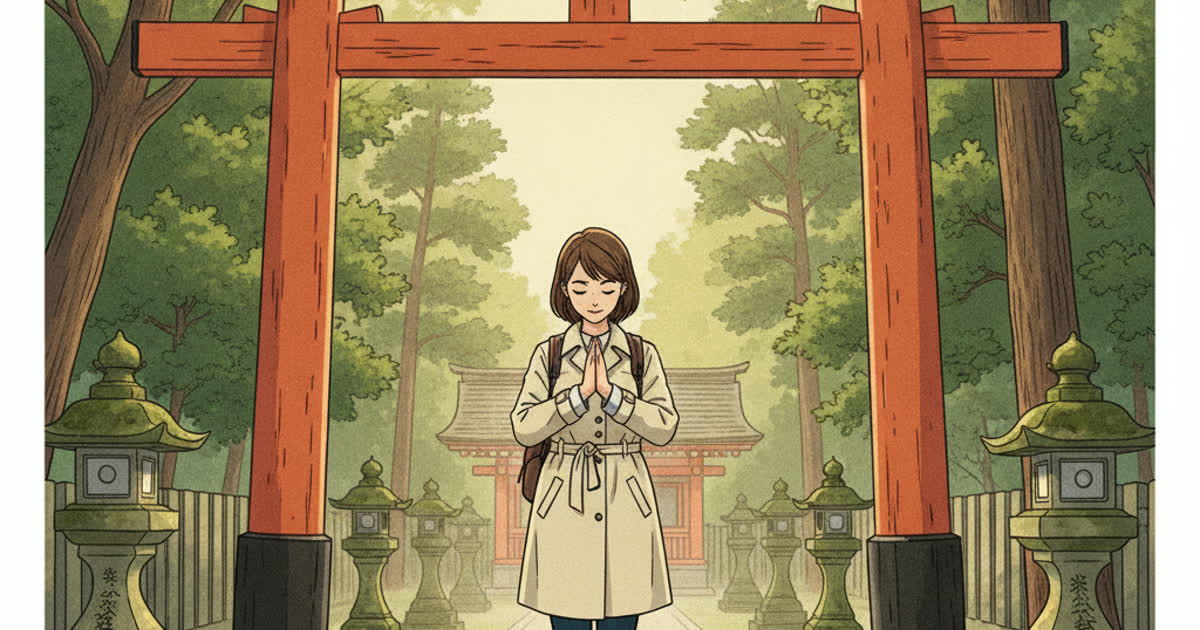
Walk up to almost any Japanese jinja (神社, Shinto shrine) and you'll see visitors bowing, clapping, and pausing in a quiet rhythm — and it looks like something you're supposed to already know. You're not. The whole ritual is short, forgiving, and needs no words, so once you've done it once you can join in anywhere from a tiny neighborhood shrine to Meiji Jingū.
How do you pray at a Japanese shrine?
Purify your hands and mouth at the temizuya (手水舎, water pavilion) near the entrance, walk up to the offering hall, and toss a coin into the box. Then follow the standard rhythm — nirei nihakushu ichirei (二礼二拍手一礼): bow deeply twice, clap twice at chest height, hold your hands together for one quiet wish, and bow deeply once more. Ring the bell first if there is one, and don't worry about saying anything — the prayer is silent, so no Japanese is required to do it respectfully. You can watch the full sequence in the short reel above.
What does "two bows, two claps, one bow" mean?
It's the standard shrine prayer sequence, written nirei nihakushu ichirei (二礼二拍手一礼): two bows, two claps, one bow. Bow from the waist twice, fairly deeply. Then bring your palms together in front of your chest and clap twice — many people slide the right hand down slightly so the fingertips don't quite line up. Keep your hands pressed together, make a single wish or word of thanks in your head, then lower your hands and give one last deep bow. A handful of shrines have their own custom (Izumo Taisha famously uses four claps), but two claps is the nationwide default and always a safe choice.
How do you purify yourself at the temizuya?
Stop at the temizuya (手水舎), the roofed water basin near the entrance, before you approach the hall. Take the ladle in your right hand, scoop water once, and rinse your left hand; switch the ladle to your left hand and rinse your right. Switch back, pour a little water into your cupped left hand, and use that to rinse your mouth quietly — never touch the ladle to your lips and never drink. Rinse your left hand one more time, then tip the ladle upright so the last of the water runs down and cleans the handle for the next person. One scoop of water is meant to cover all of this, so take a full ladle to start.
How much money should you offer at a shrine?
There's no set amount, and a single small coin is completely appropriate — this is a gesture of respect, not an entrance fee. Many people choose a five-yen coin because go-en (五円, five yen) sounds exactly like go-en (ご縁), meaning a good connection or bit of fortune, so it's considered lucky. Drop the coin gently into the saisen-bako (賽銭箱, offering box) rather than throwing it hard. If all you have is a ¥100 coin or nothing at all, that's fine too — the offering is symbolic, and plenty of visitors simply bow and pray.
Do you ring the bell before or after praying?
Before — the bell comes right after your coin and before your bows. If the offering hall has a suzu (鈴, bell) with a thick woven rope hanging in front of it, give the rope a shake to sound it once you've made your offering. It's said to greet the kami (神, the shrine's deity) and mark the start of your prayer. Then move straight into nirei nihakushu ichirei. If there's no bell — many smaller shrines don't have one — just offer your coin and begin the bows.
What's the difference between a Japanese shrine and a temple?
A jinja (神社, shrine) is Shinto and an o-tera (お寺, temple) is Buddhist, and the etiquette is not the same. The big rule: you clap at a shrine but never at a temple — at a temple you press your hands together silently, bow, and skip the clapping entirely. The easiest way to tell which you're at is the entrance. A torii (鳥居) gate — those two uprights with a crossbar, often vermilion — marks a Shinto shrine, where two bows, two claps, one bow applies. Learning a few more of these small customs makes every stop smoother; browse all our travel reels or start with the essential words every traveler should know.