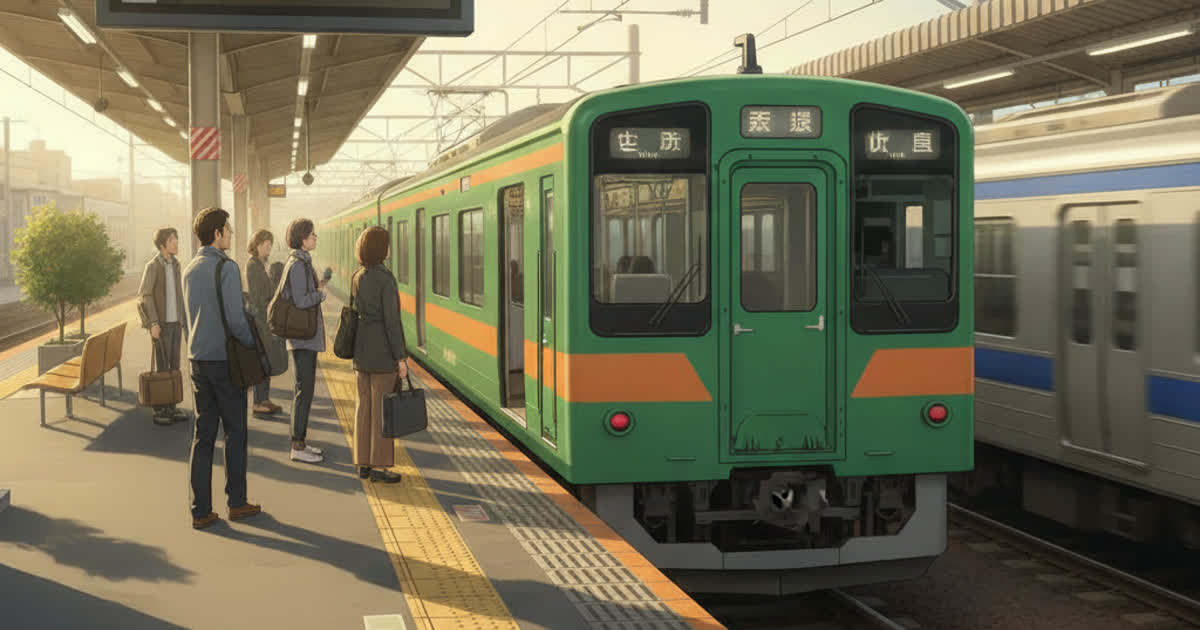
The doors are open, the destination on the front is your station, and the platform clock says you have forty seconds. What almost nobody tells first-time visitors is that in Japan the destination is only half the information. Two trains bound for the same place, on the same platform, ten minutes apart, can have entirely different stopping patterns — one calls at every station, the other passes yours at seventy miles an hour without slowing down. The tiers are printed on every board and every train, and once you can read four words the whole system becomes obvious.
What is the difference between local, rapid and express trains in Japan?
Only one thing: how many stations they skip. They are not different trains on different lines — they share the same rails and usually the same platform, and they differ purely in stopping pattern. 各駅停車 (kakueki teisha, "each-station stop") is the local and calls at every station on the line; many operators label the same service 普通 (futsū, "ordinary"). 快速 (kaisoku) is a rapid, which drops the quiet stations. 急行 (kyūkō) is an express and skips more again. 特急 (tokkyū) is a limited express and stops only at the major hubs. Around those four sit local variants you will meet in the wild — 準急 (junkyū, semi-express), 通勤快速 (tsūkin kaisoku, commuter rapid, which skips different stations at rush hour), and in Kansai the gloriously quick 新快速 (shin-kaisoku, special rapid). They all slot into the same ladder.
Which Japanese trains cost extra to ride?
On JR, only the limited express and the Shinkansen. Both need a 特急券 (tokkyūken, limited express ticket) bought in addition to your base fare, from a ticket machine or the みどりの窓口 (midori no madoguchi, the green-sign ticket office). Everything below that tier — rapid, commuter rapid, special rapid, local — is free with an ordinary ticket or a tap of your IC card, however fast it happens to be. Private railways are where it gets slippery. On Hankyu, Keihan, Keikyū and the Tokyu Toyoko line, the 特急 is a normal commuter train with no surcharge at all; on the Odakyu Romancecar, Kintetsu, Tobu and the Keisei Skyliner, it is a reserved-seat product you must buy a ticket for. If you are unsure, one sentence settles it at the gate: 特急券は必要ですか? (tokkyūken wa hitsuyō desu ka), "do I need a limited express ticket?" Boarding without one is not a disaster — the conductor sells them on board, sometimes at a small premium.
How do you tell which train type is arriving?
Read the type, which always comes before the destination, on both the platform display and the train's own front and side signs. 快速 東京 reads "Rapid, bound for Tokyo," and it is the first word that matters. Nearly every operator colour-codes the tiers as well: local in black or grey, rapid in blue or green, express and limited express in red or orange, so you can usually tell the tier from the far end of the platform before you can read it. Announcements lead with the type too, and the boards cycle through English every few seconds — waiting one full cycle costs you five seconds and removes the guesswork. This is also the moment to catch the one word in the announcement that means stand up now.
How do you check if a train stops at your station?
Look for the stopping-station chart, 停車駅案内 (teishaeki annai), posted on the platform and again above the doors inside every car. It is a simple grid: station names along one axis, train types along the other, a circle where that type stops, and a bar or a blank where it runs through. The word for that is 通過 (tsūka, "pass through") and it is the one to watch for next to your station. Your phone does the same job — Google Maps and Japan Transit Planner both name the train type in the route detail, in the line of small text most people scroll straight past. Read it before you walk down to the platform, because on a busy line the next four departures may be four different tiers.
How do you ask if a train is the local in Japanese?
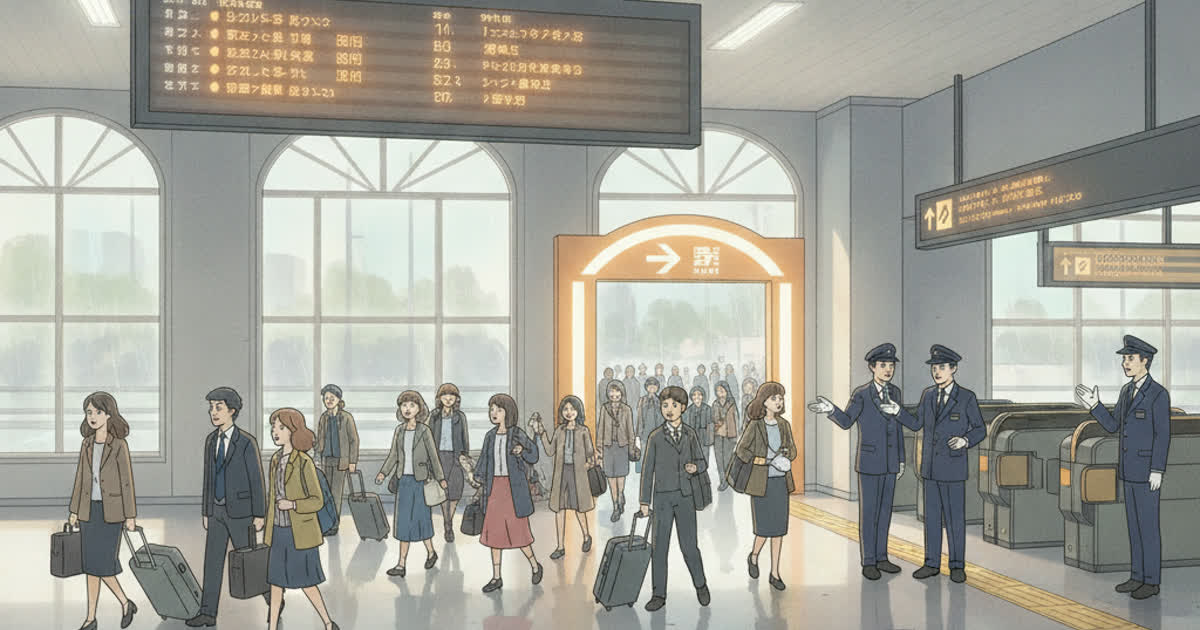
One short question covers it: 各駅停車ですか? (kakueki teisha desu ka), "is this the local?" That is the phrase in the reel above, and pointing at the train while you say これは各駅停車ですか? (kore wa kakueki teisha desu ka) makes it unmissable even in a noisy station. Often the more useful version names your station instead of the train type: 上野に止まりますか? (Ueno ni tomarimasu ka), "does it stop at Ueno?" — swap in wherever you are headed. Platform attendants in white gloves exist precisely to answer this, and the commuter beside you will too. Expect the reply as a nod, a crossed-arms X, or a hand pointing down the platform, so you rarely need to parse a sentence; if you do get a fast one back, the phrase that slows a Japanese speaker down is the follow-up. And if you are still hunting the platform itself, there is a question for that too.
Is the express always faster than the local?
No — an express is only faster if it stops where you are going. A limited express that sails past your station and sets you down two stops beyond it, leaving you to double back on a local, loses you more time than the slow train you let go. The trap runs the other way too: on a long line, taking a rapid to a big interchange and changing to a local for the last few stops routinely beats riding the all-stops train the whole way, sometimes by fifteen or twenty minutes. Let the journey planner decide it, and treat the train type in the result as an instruction rather than trivia. When a transfer is part of the plan, it is worth knowing that a broken line can be re-routed onto a rival railway for free, and that whatever tier you end up on, the same carriage etiquette applies.
Do Shinkansen have local and express types too?
Yes, with their own names instead of numbers. On the Tokaido and Sanyo line running west from Tokyo, のぞみ (Nozomi) is the top tier and stops least, ひかり (Hikari) is the middle, and こだま (Kodama) is the local that calls at every Shinkansen station — the same ladder, dressed differently. The northern lines repeat the pattern with はやぶさ (Hayabusa) at the fast end and なすの (Nasuno) as the all-stops service. If you are travelling on a Japan Rail Pass this matters financially, not just practically: the pass covers Hikari and Kodama outright, while Nozomi and Mizuho require the separate supplement introduced in October 2023. Once you are on board there is a second decision waiting, which is whether to sit in a reserved or an unreserved car.
Boil it down and you carry three habits onto the platform. Read the word in front of the destination, not just the destination. Check the stopping chart, or ask 各駅停車ですか? before the doors close. And remember that the fastest train on the board is only the fastest train for you if it stops at your station. Do that and the tiers stop being an obstacle and start being what they are for people who commute here — the reason a Japanese city can move you across it faster than anywhere else on earth. It pays to know the clock too, since the last train of the night often terminates early, and the local you were counting on may already have finished.