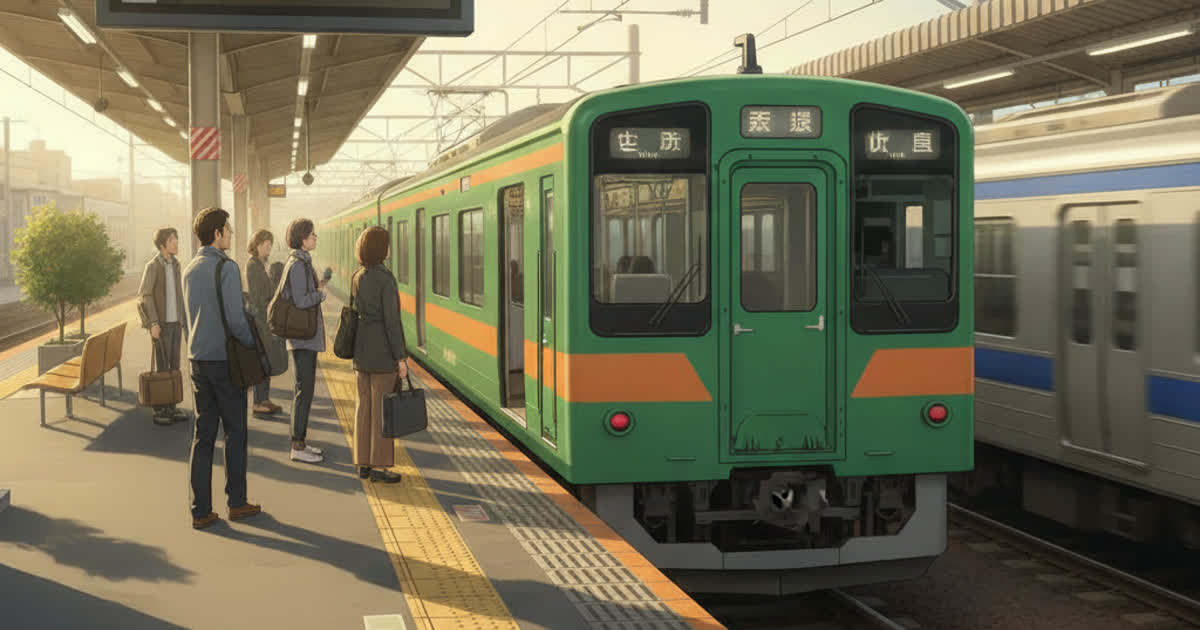

The reel above, published 1 October 2026, stops on the sticker over a local-train door. 半自動 (hanjidō) means semi-automatic. You open this door yourself. The lamp beside the button tells you whether that press will work.
What does 半自動 mean on a Japanese train door?
半自動 (hanjidō) means semi-automatic. 半 (han) is the kanji for half. Shogakukan's Digital Daijisen, on Kotobank, checked 5 October 2026, reads it はん. One sense is one of two parts, half of the whole. Set in front of a noun, it means halfway, or almost in the state that noun names. 自動 (jidō) is that dictionary's word for a machine that moves by its own power, and the example it prints is 自動ドア (jidō doa), an automatic door. The door stays closed until you press. Say it hanjidō, はんじどう, with a long o at the end. The line in the reel is このドアは半自動です。 (kono doa wa hanjidō desu), "this door is semi-automatic." JR Shikoku's customer-voice page calls that operation 半自動扱い (hanjidō atsukai).
What do you do when the lamp by the door is lit?
When the lamp is lit, press the button and the door opens. JR West's passenger page on ドアの手動扱い (doa no shudō atsukai), manual door operation, checked 5 October 2026, states that rule for its button doors. The examples it names are the 221, 223, and 225 series. From the platform, the button sits on the left side of the door. Press it while the lamp is on, then step in. The page adds a caution: watch for a train that is about to move. Inside the car, the open button is on the right, marked 開 (open). Press that one to get off. The same page is blunt about a dark lamp. The door does not open. A lit lamp is the permission. The press is what moves the door.
Why do these trains leave the doors shut until you press?
The closed doors keep the temperature in the car. JR West's page says passengers open and close the doors themselves so the inside stays comfortable. JR Shikoku states the same aim on its customer-voice page, checked 5 October 2026. From 18 March 2023 it set 半自動扱い on every local train that has door buttons, including ワンマン (wanman) trains with only a driver, and on rapid trains, so the heating and the cooling would hold. Limited express trains, and some local trains, stay off that list. The rapid Marine Liner, マリンライナー (marin rainā), uses it at 高松 (Takamatsu) Station only. A train with no button still opens and closes its doors on its own. The sticker is what tells you this car will wait for your hand.
Which button opens the door, and which one closes it?
On a JR West button door the outside button sits to the left, and that press opens it so you can board. Inside, the buttons sit on the right. The one marked 開 opens the door so you can step off. The one marked 閉 (close) shuts it. You cannot close the door from the platform, and you watch the people around you when you close it. JR Shikoku writes a broader line for its own cars: the button inside or outside opens and closes the door, and you confirm that nobody else is getting on or off before you close it. The lamp still has to be lit on the JR West doors. That page also names a manual kind of door beside the button kind. The positions above are for the button kind.
What does a dark lamp mean?
A dark lamp means that door stays shut. JR West's page says the door does not open when the lamp is off. Pushing the panel does not stand in for the button. The reel says the same thing. Lamp off, the door stays shut, and pushing will not help. Use a door whose lamp is lit, and press there. The yellow strip on the platform edge is a different instruction. It tells you where to stand when a train runs through, and the yellow-line page is that line. 半自動 is the sticker on the door, and the lamp is the part you read before you push anything.
How is 半自動 different from a door that opens by itself?
A door that opens by itself needs no button and no lamp. JR Shikoku's change on 18 March 2023 covers trains that have door buttons. Trains with no button still open and close on their own. The sticker 半自動 marks the button kind, and the lamp is the signal to press. 方面 (hōmen) is a separate word, and it sits on the platform, not on the door. It means "in the direction of." The 方面 page is the sign that names a city past your stop. 半自動 tells you who opens the door in front of you.
What do you say if the door will not open?
Say すみません、ドアが開きません。 (sumimasen, doa ga akimasen), "excuse me, the door will not open." Point at the door. If you cannot see a button, ask ボタンはどこですか? (botan wa doko desu ka), "where is the button?" You write は and you say wa. To name the sticker yourself, ask このドアは半自動ですか? (kono doa wa hanjidō desu ka), "is this door semi-automatic?" If the lamp you found is dark, ask どのドアが開きますか? (dono doa ga akimasu ka), "which door opens?" Look for a door with a lit lamp, and press that button.
The sticker is the whole system. 半自動 means semi-automatic, and you open this door. A lit lamp means press the button. A dark lamp means that door stays shut.