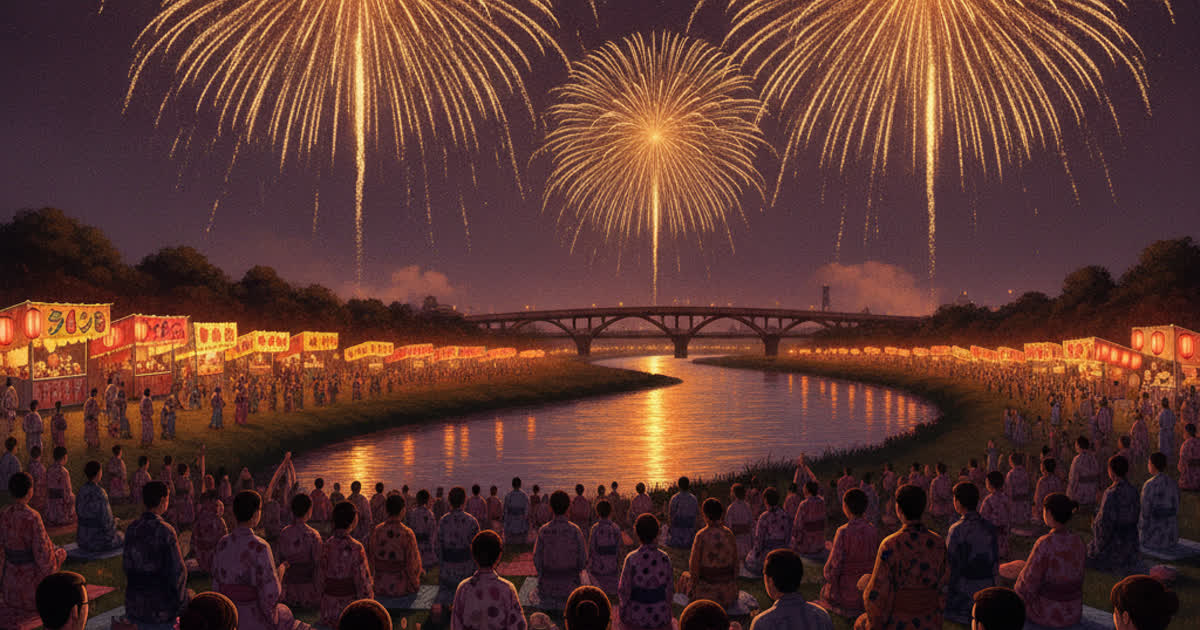
A Japanese fireworks festival is not a fifteen-minute flourish at the end of an evening. The big ones fire twenty thousand shells across two hours, over a river, to an audience of several hundred thousand people sitting on the ground eating grilled noodles. The word is 花火大会 (hanabi taikai, literally "fireworks grand meeting"), and between late July and late August there is one somewhere in Japan almost every night. None of it requires a ticket, a tour, or a word of Japanese. What separates a wonderful night from a sweaty, hungry, three-hour-queue night is about five decisions, and you make all of them before the first shell goes up.
How do you get into a Japanese fireworks festival?
You walk up — nearly every 花火大会 is free to watch from public ground, and most of the crowd has paid nothing. The launch site is usually a riverbank, a bay or a lake, and the banks, bridges, parks and streets around it are open to anyone. The alternative is a 有料観覧席 (yūryō kanranseki, paid viewing seat), sold weeks in advance through the festival's own site, a convenience-store ticket machine or the city tourism office, for roughly ¥3,000 to ¥20,000. You are not buying a better view so much as a guaranteed one: a marked-out block on the best bank, plus toilets, staff and a managed exit. If you go free, you go early and you do 場所取り (basho-tori, "spot-taking") — laying down a レジャーシート (rejā shīto, the ¥100-shop picnic tarp everyone uses) to claim your patch of grass. Read the festival's rules first: many now forbid sheets before a stated hour and send staff to remove anything laid down early.
What time should you arrive at a hanabi taikai?
Three hours before the first shell for a famous city festival, one hour for a small local one. The poster and website give a 打ち上げ開始 (uchiage kaishi, launch start) time, typically 19:00 or 19:30, and at a headline event like Sumida or Nagaoka the good free ground is gone by mid-afternoon. Trains fill up long before that, so treat the stated start time as the end of your journey, not the beginning. Bring more water than you think you need and something to sit on, because you will be outdoors in the worst of the Japanese summer for hours — this is exactly the setting where visitors get into trouble, and it is worth knowing what heatstroke looks like and what to say about it before you are the one feeling it. Convenience stores near the venue sell out of drinks and ice by early evening; buy at the station you leave from.
Do you need to wear a yukata to a fireworks festival?
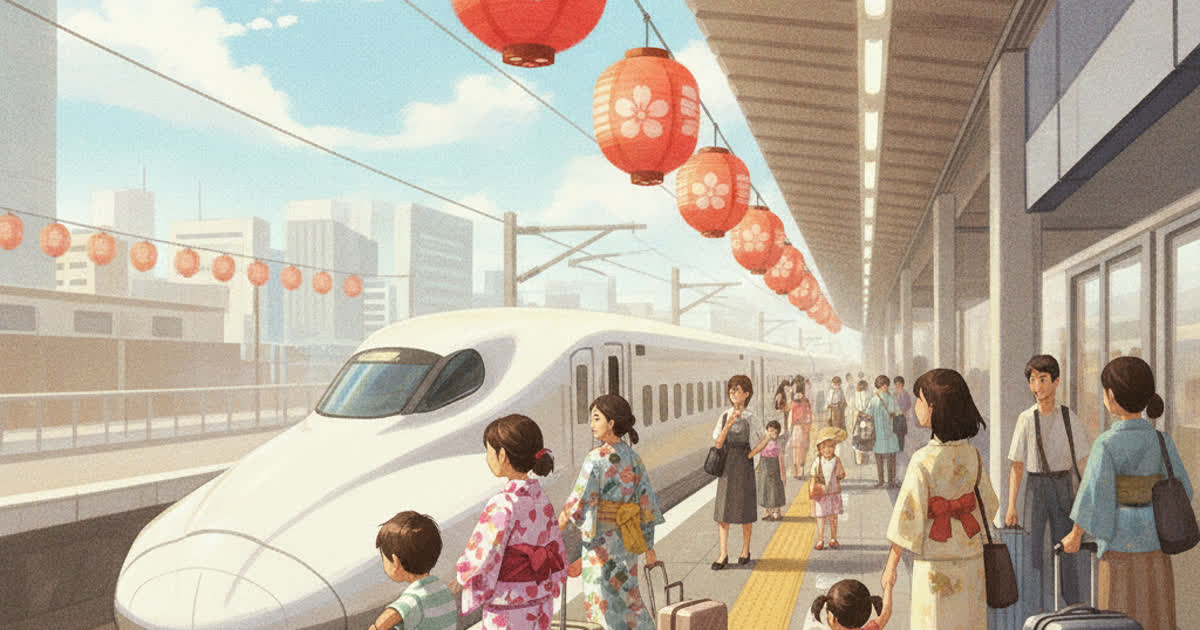
No. Jeans and a t-shirt are completely normal and nobody will look twice. But a good share of the crowd, Japanese and foreign, turns up in a 浴衣 (yukata), the light cotton summer kimono tied with an 帯 (obi), and hanabi night is the single best occasion in the year to wear one. Rental shops in Tokyo, Kyoto and Osaka do the whole thing — garment, obi, hair, dressing — for around ¥3,000 to ¥8,000, and you return it the same evening. One warning worth more than it sounds: the traditional 下駄 (geta) wooden sandals will destroy your feet over a two-kilometre walk, so pack blister plasters or ask the shop for softer footwear. The reel on what to wear and what to say about it covers the compliment you will hear all night.
What should you eat at a fireworks festival?
Buy from the 屋台 (yatai, food stalls) before you sit down, not during the show. The stalls line the approach roads and the festival ground, and the classics barely change from town to town: 焼きそば (yakisoba, fried noodles), たこ焼き (takoyaki, octopus dumplings), 焼きとうもろこし (yaki-tōmorokoshi, soy-grilled corn), りんご飴 (ringo-ame, toffee apple) and かき氷 (kakigōri, shaved ice). Bring cash in small notes and coins — a good number of yatai still take nothing else. Three short phrases do all the work here: asking where the stalls are with 屋台はどこですか? (yatai wa doko desu ka), ordering shaved ice with かき氷ください (kakigōri kudasai), and finding out where a queue actually starts when two stalls share one shapeless crowd. The full stall menu is worth a look before you go.
What does the crowd shout at Japanese fireworks?
Two names: たまや! (Tamaya) and かぎや! (Kagiya). They were rival Edo-period fireworks houses — 鍵屋 founded in 1659, 玉屋 split off from it in 1810 — and spectators on the Sumida river would shout for whichever one had just fired. Tamaya burned down its own neighbourhood in 1843 and was banished from Edo, which means that for nearly two centuries Japanese crowds have been cheering the name of a shop that no longer exists. That story is the one behind the shout. The other thing you will hear, constantly, is きれい (kirei) — "beautiful" — often stretched out as きれい〜!, and it is the safest single word to say out loud all evening. Say either one and you are doing exactly what everyone around you is doing.
How do you get home after a fireworks festival?
Do not go straight to the station. When two hundred thousand people finish watching at the same moment, the nearest station goes into 規制退場 (kisei taijō, controlled exit): staff with megaphones hold the crowd in blocks and release it slowly, and the surrounding streets are switched to 一方通行 (ippō tsūkō, one-way pedestrian flow) so you physically cannot walk back the way you came. The move locals make is to sit on their sheet for another thirty to sixty minutes, or to walk twenty minutes to the next station up the line and board there. Either beats ninety minutes shuffling in a queue. Take your rubbish with you — bins at these events fill within the hour, and carrying it home is the norm. Watch the clock as well, since the last train leaves earlier than most visitors expect, and once you are on board the usual quiet-carriage etiquette still applies, festival night or not.
What happens if it rains on the day of a fireworks festival?
Light rain almost never stops it. Posters and websites state the policy in three set phrases: 小雨決行 (kosame kekkō) means it goes ahead in light rain, 荒天中止 (kōten chūshi) means storms cancel it outright, and 順延 (jun'en) — often 翌日順延 (yokujitsu jun'en) — means it is pushed to the next day instead. Wind and lightning, not rain, are what actually cancel a show, since shells cannot be fired safely across a crowd in a gale. The decision is usually announced between noon and mid-afternoon on the festival's official website and X account, so check on the day rather than the night before. If it is postponed, paid seats normally carry over to the new date; if it is cancelled outright, refund rules vary by festival and are printed on the ticket.
Everything else is just being there. If the hanabi is bolted onto a wider 祭り (matsuri) — and many are — there will be a drum tower and a ring of dancers before the shells start, and you are genuinely allowed to join the circle; there may also be a portable shrine going past at speed. Note the date, too: fireworks season overlaps the Obon travel week, when the whole country moves at once and every train and hotel prices accordingly. Turn up early, sit down, eat something off a stick, shout たまや! when the big one opens, and wait out the crowd afterwards. That is the entire method, and it is one of the best nights Japan gives away for free.