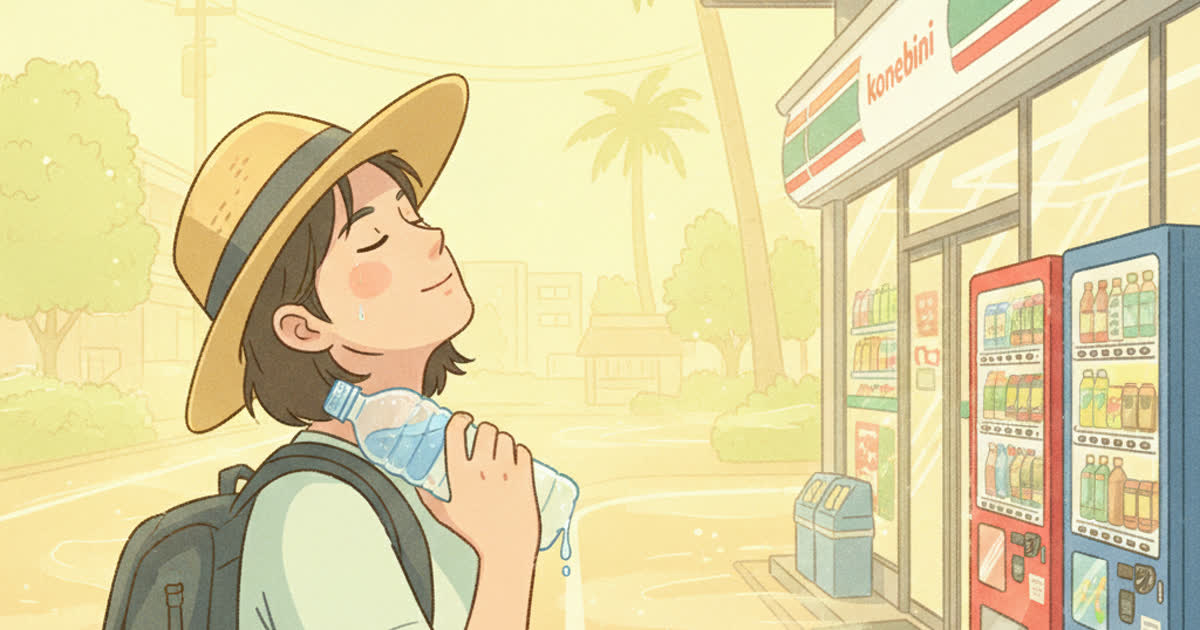
Japan's summer is not just hot — it's humid in a way that catches a lot of visitors off guard. By mid-July the temperature climbs past 35°C and your body struggles to cool itself, so heatstroke (熱中症, netchūshō) can go from "a bit dizzy" to a genuine emergency in minutes. The good news is that the response is simple, and a handful of Japanese phrases will get you help fast. Here's what to do the moment you feel it, and exactly what to say.
What should you do if you get heatstroke in Japan?
Get out of the heat, cool your body, and rehydrate — in that order, and start the second you feel off. Move into shade or, better, an air-conditioned convenience store or train station, then loosen any tight clothing and sit or lie down. Cool the big blood vessels near the surface: press something cold against your neck, armpits, and groin, since that drops your core temperature fastest. Then sip water with salt or an oral-rehydration drink like OS-1 (経口補水液, keikō hosuieki) rather than gulping plain water, which can actually thin your salt levels further. A salt candy (塩飴, shio-ame) from any konbini does the same job — locals swear by them, and our short reel on why locals eat salt candy in summer shows how common they are. If the person is confused, can't drink, or has stopped sweating, skip the self-care and call an ambulance.
What are the symptoms of heatstroke?
The early warning signs are dizziness, a heavy headache, nausea, muscle cramps, and sudden heavy sweating — that's your cue to stop and cool down immediately. It becomes dangerous when the sweating abruptly stops, the skin turns hot and dry, or the person grows confused, faints, or vomits; those signal that the body has lost its ability to regulate its own temperature. In Japan's humidity, sweat doesn't evaporate well, so your core heats up much faster than the dry heat you might be used to at home. Don't try to "push through" a headache and dizziness in the midday sun — that's exactly how a manageable moment turns into a hospital trip. Treat the early stage seriously and you'll almost always avoid the dangerous one.
How do you tell someone in Japanese that you feel sick from the heat?
Say 気分が悪いです (kibun ga warui desu), "I feel sick" — it's the single most useful line, and staff will react at once. Add めまいがします (memai ga shimasu), "I'm dizzy," or 頭が痛いです (atama ga itai desu), "I have a headache," to be specific about what's wrong. If it's urgent and you need someone to step in, say 助けてください (tasukete kudasai), "please help me." Lead with すみません (sumimasen) to get attention first, then the phrase — a shop clerk or passer-by will usually guide you to a seat and air conditioning right away. For the full breakdown of asking for help when you feel unwell, watch our reel on what to say when you feel sick in the heat.
How do you call an ambulance in Japan?
Dial 119 — it's free from any phone, nationwide, and covers both fire and ambulance. The operator's first question is 火事ですか、救急ですか (kaji desu ka, kyūkyū desu ka?), "fire or medical?"; answer 救急です (kyūkyū desu), "medical emergency." Then say 救急車をお願いします (kyūkyūsha o onegai shimasu), "an ambulance, please," and give your location — a nearby station name, konbini, or landmark works if you don't have the address. If you need a bystander to make the call for you, say 救急車を呼んでください (kyūkyūsha o yonde kudasai), "please call an ambulance." The ambulance itself is free, and English-speaking dispatchers or interpreters can often be looped in. If you want just one emergency sentence committed to memory before your trip, our reel on the one emergency sentence to know in Japan is the one to save.
How do you prevent heatstroke in Japan's summer heat?
Drink before you're thirsty and keep salt coming in — prevention is far easier than recovery. Avoid the harshest sun between roughly 11am and 3pm, and plan indoor stops (a museum, a department store, a café) for the middle of the day instead of long walks. Carry water and top it up constantly; vending machines and konbini are on nearly every corner. Keep salt in the mix with a salt candy or an OS-1 drink so you're replacing what you sweat out, not just the water. A hat, light and loose clothing, and a cooling towel or cold bottle held against your neck all buy real relief, and you'll hear locals swap the word "mushiatsui" (hot and humid) all summer — it's a fair warning to pace yourself. Build your day around shade and hydration and heatstroke rarely gets a foothold.
Where can you cool down fast in Japan?
The nearest convenience store is your fastest refuge — konbini are everywhere, strongly air-conditioned, and open 24 hours, so ducking in for a cold drink doubles as a cool-down. Train stations, department stores, shopping arcades, and public libraries are reliably cool too, and no one minds if you sit for a few minutes to recover. During official heat warnings, many cities open designated cooling shelters (クーリングシェルター, kūringu sherutā) in libraries, community centers, and city halls where anyone can rest for free. If you want something colder than the AC, you can always ask for more ice — our reel on asking for extra ice covers the exact phrase. The rule of thumb: never wait it out in the sun when a cool room is a short walk away.
Heatstroke in Japan is common but almost always preventable — act at the very first sign, keep water and salt on hand, and don't hesitate to say 気分が悪いです or dial 119 if it turns serious. A few words at the right moment are all it takes. For more survival phrases that make a Japanese summer easier, browse all our travel reels.