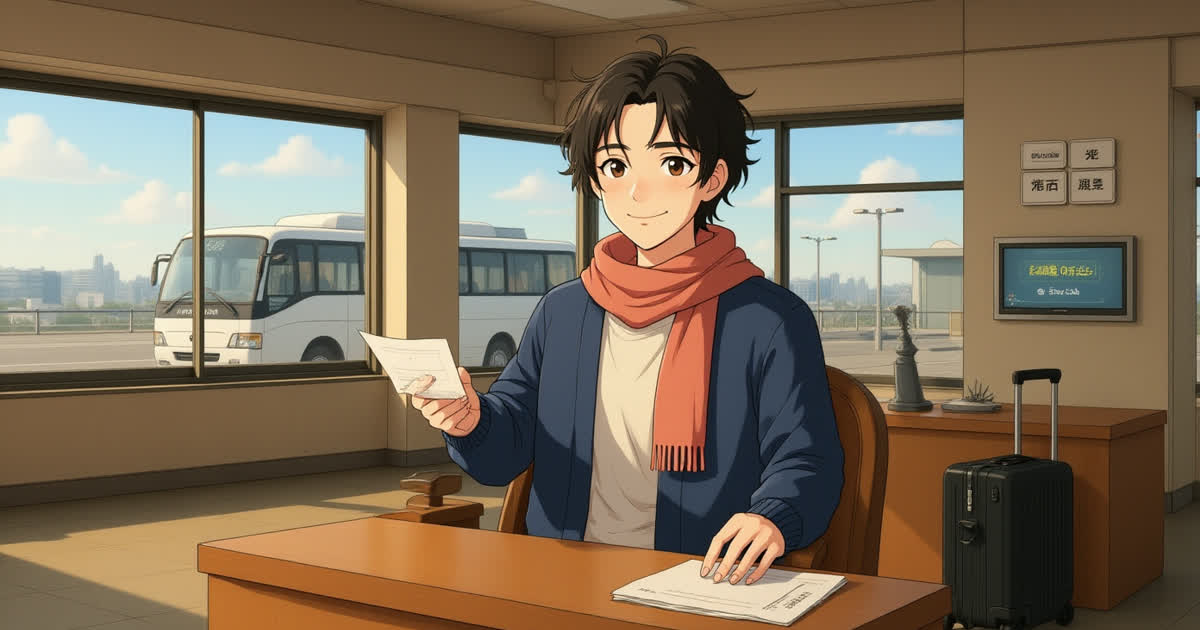
The counter in the reel above, published 23 October 2026, is an airport bus ticket window. The clerk says 往復. A nod buys the ride back. The line that keeps the ticket one way is 片道でお願いします. This page is that sentence: what a one-way ticket is, why the nod buys both directions, and what to say before you pay.
What does 片道でお願いします mean at a Japanese airport bus counter?
片道でお願いします (katamichi de onegai shimasu) means "one way, please." Digital Daijisen, on Kotobank, checked 26 October 2026, defines 片道 as one direction only, the going or the return. The example in that entry is 片道の電車賃, the train fare for one direction. A second sense in the same entry is an act done from one side only, as in 片道貿易 (katamichi bōeki), one-way trade. At this counter the first sense is the one on the ticket. で marks the condition: make it one way. お願いします is the polite request. The three pieces name the direction, then the condition, then the ask. The reel's English is the same claim: one way, please. You say it to the clerk, before the ticket is printed. It is a request, not a question, so there is no か on the end. The clerk had asked 往復ですか. This line is the answer that picks one direction.
How do you pronounce 片道でお願いします?
Say ka-ta-mi-chi de o-ne-ga-i-shi-ma-su, twelve beats. 片道 is four short beats: か, た, み, ち. Read 片 as kata, not hen, and 道 as michi, not dō. None of those vowels is long. A long "kaa" is not this word. で is the particle de, one beat. It is not です. お願いします is seven beats: お, ね, が, い, し, ま, す. The い is its own beat. The す is its own beat. There is no small っ, and there is no か, because the line asks for one direction. It does not ask a yes-or-no question. The full line in the reel is 片道でお願いします。 (Katamichi de onegai shimasu.)
What is a one-way ticket?
A one-way ticket pays for the ride in one direction only. You go from the airport to the city, or from the city to the airport, and the ride stops there. The ride back is not on that ticket. The ride back is a second ticket, bought when you leave, or it is the return half of a round-trip ticket. When the ride you paid for ends, the ticket is used up. It does not sit in your pocket until the day you fly home. The Seisen edition of the Nihon Kokugo Daijiten, on Kotobank, checked 26 October 2026, defines 片道乗車券 (katamichi jōshaken) as one kind of ordinary ticket. It is valid once, on one section, in one direction. The same entry gives 片道切符 (katamichi kippu) as another name for it. So the paper in your hand is a single ride, one way. It is not a day pass, and it is not a ticket that brings you home. English also uses "one way" on a street sign. That sign is a different word. The ticket word is 片道.
What does 往復 mean at the same counter?
往復 (ōfuku) means going and coming back. Digital Daijisen, checked 26 October 2026, defines it as the going and the return, 行きと帰り, and as the act of going and then coming back. The example in that entry is 往復乗車券 (ōfuku jōshaken), a round-trip ticket. Shogakukan's Progressive Japanese-English Dictionary, fourth edition, glosses 往復切符 (ōfuku kippu) as a round-trip ticket in American English and a return ticket in British English. Say o-u-fu-ku, four beats: お, う, ふ, く. The おう is a long ō, two beats. A short "ofuku" drops a beat. 往復ですか (ōfuku desu ka) means "Round trip?" The か is what makes it a question. A nod answers yes. Yes means both directions: the ride there, and the ride back. Tokyo Airport Transport's Limousine and Subway Pass page, checked 26 October 2026, still lists a 片道 bus ticket and a 往復 bus ticket as different products, on the Haneda routes and on the Narita routes. The clerk is offering that second product. If you are not riding the bus back, the return half is the ride you will not use. A JR ticket window is a different counter. JR Group's release of 8 October 2025, checked 26 October 2026, sets 13 March 2026 as the last day of sale for 往復乗車券. From 14 March 2026 a JR window sells two 片道乗車券 for a trip out and back. The old 往復割引 (ōfuku waribiki), 10 percent off each way when one direction was 601 kilometers or more, ended with that round-trip ticket. The airport bus counter did not make that change. 往復 is still one choice the clerk can print.
How is 片道 different from 一方通行?
片道 is the ticket. 一方通行 (ippō tsūkō) is the street. Digital Daijisen, checked 26 October 2026, defines 一方通行 as allowing vehicles to use a road in one direction only. The other name in that entry is 一方交通 (ippō kōtsū). Shogakukan's Progressive Japanese-English Dictionary, fourth edition, glosses the sign as one-way traffic, and the sentence この道は一方通行だ (kono michi wa ippō tsūkō da) as "This is a one-way street." Say i-p-po-o tsu-u-ko-o, eight beats. 一方 has a small っ, so the ぽ is held, and the おう is a long ō. 通行 has a long ū and a long ō. None of that is 片道. 片道 is four short beats and names a fare. 一方通行 names a road. Pointing at a one-way sign does not tell the clerk which ticket you want. Say 片道でお願いします.
What do you do if you already nodded?
Say the one-way line before you pay, while the ticket is still on the counter. Start with すみません (sumimasen), then 片道でお願いします. The reel stops on that second try. The nod had answered 往復ですか, so the paper in the clerk's hand covers the ride back too. The second try names one direction. The bus-fare page covers the other bus. A local 路線バス (rosen basu) takes the money on board, and an airport limousine sells the ticket at this counter before you board. The welcome-card page is a different airport problem, the gate, not this window. If the ticket is already paid and in your bag, this page does not set a refund. Tokyo Airport Transport's same pass page says a change or a cancel on the customer's side is not available for that pass, and a change of departure time on the limousine bus stays open until five minutes before the bus leaves. That note is for that pass. Ask this clerk while the paper is still on their side of the glass.
片道でお願いします means one way, please. A one-way ticket is the ride in one direction. 往復 is the ride out and the ride back. A nod at 往復ですか buys both. The street sign 一方通行 is not the ticket.