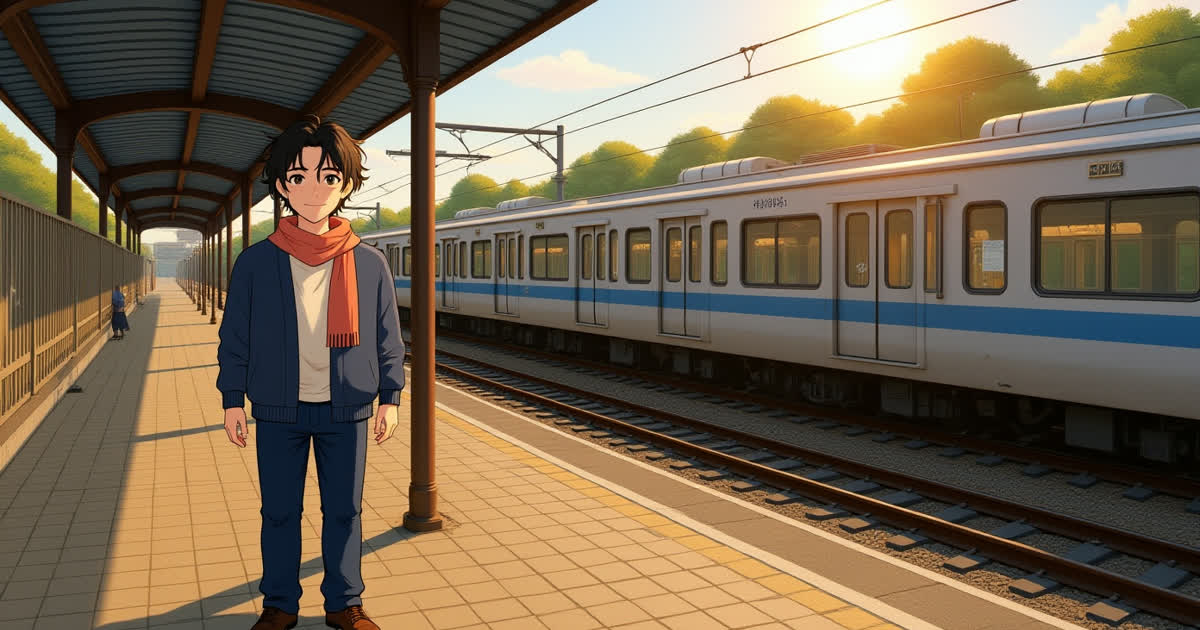
The reel above, published 2 October 2026, stops at Narita with a Welcome Suica in hand and the gates a few steps ahead. これで乗れますか (kore de noremasu ka) means "Can I get on with this?" Hold the card or the paper ticket up, and ask before you step into the gate.
What does これで乗れますか mean at a Japanese train gate?
これで乗れますか (kore de noremasu ka) means "Can I get on with this?" これ (kore) is this, the thing in your hand. A Welcome Suica fits. So does another IC card, or a paper ticket. で (de) marks the means, so the sentence is "by means of this." 乗れます (noremasu) is the polite "can ride," from 乗る (noru), to board a train or a bus. か (ka) makes it a question. Say kore de noremasu ka. The line in the reel is これで乗れますか? JR East's Welcome Suica page, checked 5 October 2026, is why you ask. On an ordinary ride you tap the card at the gate, the fare comes off the money stored on it, and you do not buy a separate paper ticket for that ride. The sentence asks a person to look at the object in your hand and say whether this gate will take it.
When do you say これで乗れますか, and where do you stand?
Say it before you reach the gate, a step off to the side, with the card held up where the person can see it. That is the reel's instruction. Catch staff before the gate. A window beside the machines, or a JR employee standing back from them, is the place. Open with すみません (sumimasen), "excuse me," and then the question: すみません、これで乗れますか。 (sumimasen, kore de noremasu ka). In other sentences you write は and you say wa. This question uses で. これで names the card as the means. これは乗れますか would ask whether "this" itself can ride. Hold the card up. Ask beside the gate.
What does a yes from station staff sound like?
The yes in the reel is はい、これで入れます。どうぞ。 (hai, kore de hairemasu. dōzo), "Yes, you can go through with this. Go ahead." はい (hai) is yes. 入れます (hairemasu) is "can enter," from 入る (hairu), to go in. The same spelling is also read iremasu, the polite "put it in," from 入れる (ireru). "Can put it in" is 入れられます (ireraremasu). Here the reading is hairemasu, and the staff member means you can enter through the gate. どうぞ (dōzo) means please go ahead. You may also hear はい、大丈夫です (hai, daijōbu desu), "yes, it is fine," or a repeat of 乗れます. A limited express (特急, tokkyū), an express (急行, kyūkō), or a Green Car (グリーン車, gurīn-sha) is a further step. JR East's Welcome Suica page says to buy each of those tickets beforehand. Listen for 特急券 (tokkyūken), the limited-express ticket. The Narita Express is a limited express, so that rule meets you at the airport. Buy that ticket before you board, and hold it with the card when you ask.
Which rides can a Welcome Suica tap, and which need a ticket first?
An ordinary train, subway, or bus in a covered area is a tap. On a bus you tap when you board and when you get off. JR East's Welcome Suica page, checked 5 October 2026, names rail, subway, and buses in the Tokyo area, the Tokyo Monorail between Haneda Airport and the city, and the Sendai, Niigata, Aomori, Morioka, and Akita areas, plus parts of Hokkaido, Tokai, West Japan, and Kyushu. The marks it lists are the nationwide mutual-use mark, Suica, Kitaca, PASMO, manaca, TOICA, ICOCA, Hayakaken, nimoca, and SUGOCA. Stores in the PiTaPa area do not take the card. A ride starts and ends in the same area. The page's example is Tokyo area to Sendai: the card cannot make that trip. Outside the usable area, buy a ticket first. A limited express, an express, or a Green Car needs its own ticket before you board. The bullet train is a separate gate. The two-ticket page covers that pair of tickets.
How long does a Welcome Suica work, and what is GOOD THRU?
The short-stay card works for 28 days, counting the day you buy it. JR East's purchase page, checked 5 October 2026, says it stops working on the 29th day. The GOOD THRU date on the back is a different date. That page says the printed date is not the travel window. The 28 days sit on the reference paper from the purchase, which is separate from the card face. Carry that paper, and show it if a staff member asks. A ticket machine in the Suica area, or staff there, can reprint it. During the 28 days you can add cash up to ¥20,000 at a ticket machine, a のりこし精算機 (norikoshi seisanki, fare-adjustment machine), or a Seven Bank ATM. A credit card will not add the money. There is no deposit, the balance is not refunded, a lost card is not reissued, and in principle one card is sold to each person. At the airports, the purchase page lists counters and machines at 成田空港駅 (Narita-kūkō-eki, Narita Airport), 空港第2ビル駅 (Kūkō-daini-biru-eki, Airport Terminal 2), and 羽田空港第3ターミナル駅 (Haneda-kūkō-daisan-tāminaru-eki, Haneda Airport Terminal 3). The same Welcome Suica page lists a long-stay card, usable for up to six months. The reel's card is the 28-day one.
What if the card is accepted and the gate still shuts?
A gate that shuts after it has accepted the card is a short balance, and it is a different problem. JR East's Welcome Suica page says that when you ride past the fare the balance covers, you add money or settle at the のりこし精算機 (norikoshi seisanki). The short-balance page walks through that machine and the sentence for the window. これで乗れますか is the question you ask before you know whether this object works at this gate. Use it when the card is new, when the next train is a limited express, or when you cannot tell whether this station sits inside the card's area. Once staff have said the card is valid here and the gate still stays shut, you are on the short-balance page.
How is これで乗れますか different from choosing a one-day pass?
A one-day pass and this sentence answer two questions. The day-pass page is which product to buy before you ride. これで乗れますか is what you say when the card or the ticket is already in your hand and you want a person to look at it. A yes means go ahead and tap, or go ahead with the paper you are holding. When the answer is that you still need a ticket, ask どの切符が必要ですか。 (dono kippu ga hitsuyō desu ka), "which ticket do I need?" When the missing piece is the limited express, ask 特急券はどこで買えますか。 (tokkyūken wa doko de kaemasu ka), "where can I buy the limited-express ticket?" You write は and you say wa.
Hold the card where the person can see it. Ask これで乗れますか before the gate. A yes on an ordinary train means tap. A limited express, an express, or a Green Car still needs its own ticket first.