Japan's trains are the easy part: a gate, a tap, a platform number. Buses are where visitors freeze, because the country runs two different bus systems that look identical from the curb. One wants your money the second you step on. The other wants it when you step off, and quietly hands you a numbered slip on the way in that decides what you owe. Board the wrong door on the wrong bus and you'll end up standing next to the driver, holding a 一万円 (ichiman-en, ¥10,000) note, with fifteen people waiting behind you. Here's the whole system in one page.
How do you pay on a bus in Japan?
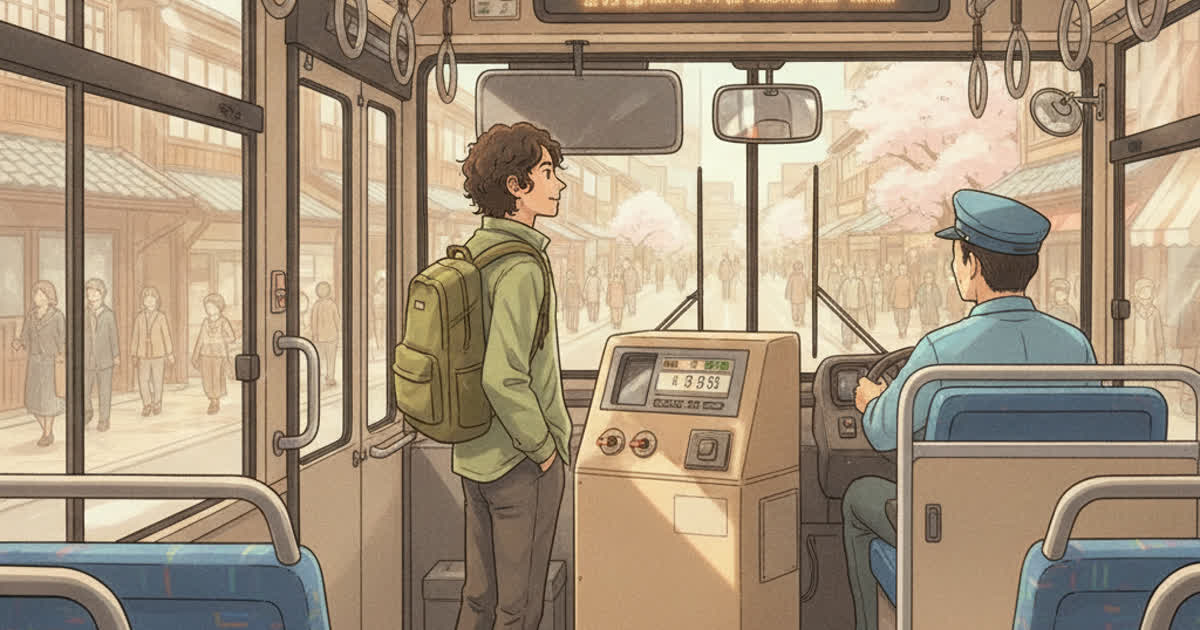
You pay once — either as you board or as you get off — and which one depends on whether the route charges a flat fare or a distance fare. On a flat-fare bus, common in central Tokyo, Osaka, and Nagoya, you board at the front door, pay immediately, and leave by the middle or rear door. On a distance-fare bus, which is most of the rest of Japan, you board at the rear or middle door, take a numbered ticket called a 整理券 (seiriken) or tap an IC card, then pay at the front as you get off. Either way you pay the driver directly through a machine called the 運賃箱 (unchinbako, fare box). There are no ticket gates, no conductor, and no ticket to buy before you board.
Do you get on a Japanese bus at the front or the back door?
Read the door, not the city — every bus has the answer written on it. Front-boarding buses are marked 前乗り (mae-nori, board at the front) and 先払い (saki-barai, pay first). Rear-boarding buses say 後ろ乗り (ushiro-nori) and 後払い (ato-barai, pay later). The faster physical test: if there's a small dispenser spitting out paper tickets at the door in front of you, it's a distance-fare bus and you take one. If there's a fare box beside the driver and the people ahead of you are paying on the way in, it's flat fare. Kyoto is the classic exception worth knowing — a flat fare in the city centre, but historically boarded at the rear and paid at the front, and the city has been converting its busiest tourist routes to front-door boarding to speed things up. When in doubt, watch the person in front of you.
What is a seiriken and what do you do with it?
A 整理券 (seiriken) is a small numbered paper ticket that records where you got on, and you hand it in with your fare when you get off. Take one from the dispenser as you board the rear door — it's free, and it prints a number like 7. Above the driver, a lit display lists those numbers in a row with a yen amount under each. Watch your number: the fare beneath it climbs as the bus travels. When your stop comes, look at the amount under your number, drop the seiriken and that exact amount into the fare box, and step off. No seiriken means the driver has no way to know where you boarded, and you'll be charged from the start of the route — so grab one even for a two-stop ride.
Can you use a Suica or IC card on Japanese buses?
Yes, on almost every city bus and many regional ones — and it removes the whole seiriken problem. Suica, Pasmo, ICOCA, and the other nationwide IC cards are interchangeable, so a card bought in Tokyo works on a bus in Fukuoka. On a flat-fare bus you tap once, on the reader by the driver as you board. On a distance-fare bus you tap twice: once on the reader at the rear door when you board, and again at the front reader as you get off, which calculates the fare automatically. If you tap on, don't take a seiriken — the tap replaces it. Two cautions: rural community buses and some private operators are still cash-only, and a handful of regions have gone the other way, with Kumamoto's bus and streetcar companies dropping nationwide IC cards in favour of contactless credit cards. If you're weighing what to carry on a trip, our guide to paying by card versus cash in Japan covers the wider picture.
What if you only have a ¥10,000 note on a Japanese bus?
Change it in the fare box's built-in changer before your stop — but a ¥10,000 note usually won't fit. The 両替 (ryōgae, money change) slot on the fare box takes coins and ¥1,000 notes only on the overwhelming majority of buses; ¥5,000 and ¥10,000 notes are not accepted, and the driver cannot break them from a till. The fare slot itself gives no change, so you must feed in the exact amount. Do the changing while the bus is stopped at an earlier stop, not when you're already at the door with a queue behind you. If you're stuck, say 両替できますか (ryōgae dekimasu ka, "can I get change?") and the driver will tell you what's possible. Most buses also let you top up an IC card on board with cash — チャージ (chāji) — which is the easiest fix of all.
How do you know when to get off a Japanese bus?
Press the stop button, and press it as soon as you hear your stop announced — not as the bus arrives. Every seat back and pole has a 降車ボタン (kōsha botan, stop button); one press lights it up and the driver announces 次、止まります (tsugi, tomarimasu, "stopping next"). Pressing again does nothing, so there's no need to race anyone. Announcements run as 次は〜 (tsugi wa ~, "next is ~"), and city buses in tourist areas repeat them in English with the stop number on the front display. Stay seated until the bus has fully stopped — drivers will actually ask you to over the speaker — then walk to the door. If you can't tell where you are, hearing how Japanese numbers and prices actually sound out loud makes the fare display far easier to follow.
What do you say on a bus in Japan?
Five short phrases cover nearly every bus situation. To check the route before boarding, ask the driver 〜に行きますか (~ ni ikimasu ka, "does this go to ~?") with the place name in front. To check the cost, 〜まで、いくらですか (~ made, ikura desu ka, "how much to ~?"). For change, 両替できますか (ryōgae dekimasu ka). To ask whether your card works, ICカード、使えますか (IC kādo, tsukaemasu ka). And if you're stuck behind people at your stop, すみません、降ります (sumimasen, orimasu, "excuse me, I'm getting off") clears a path instantly. Lead with すみません (sumimasen) every time. The ask-for-directions pattern works on a bus driver exactly as it does at a station window.
Are airport buses and highway buses different?
Yes — those you buy before boarding, and the fare box plays no part. Airport limousine buses and long-distance 高速バス (kōsoku basu, highway buses) sell a ticket at a counter or machine in the terminal, often with a reserved seat number, and you hand or show it to the crew as you board. Large suitcases go into the luggage bay underneath, where a staff member tags your bag and gives you the matching stub — keep it, because you'll need it to claim the bag at the other end. Seats can and do sell out on popular airport runs and overnight routes, so book ahead in high season. The pay-as-you-ride rules on this page apply to 路線バス (rosen basu, local route buses) only.
Once the door and the fare box stop being a mystery, buses turn into the most useful thing in your trip: they reach the temples, trailheads, and neighbourhoods that trains don't. Watch the 60-second version of the seiriken rule before your first ride, and if the bus isn't going your way after all, telling a taxi where to stop is the two-word backup plan.