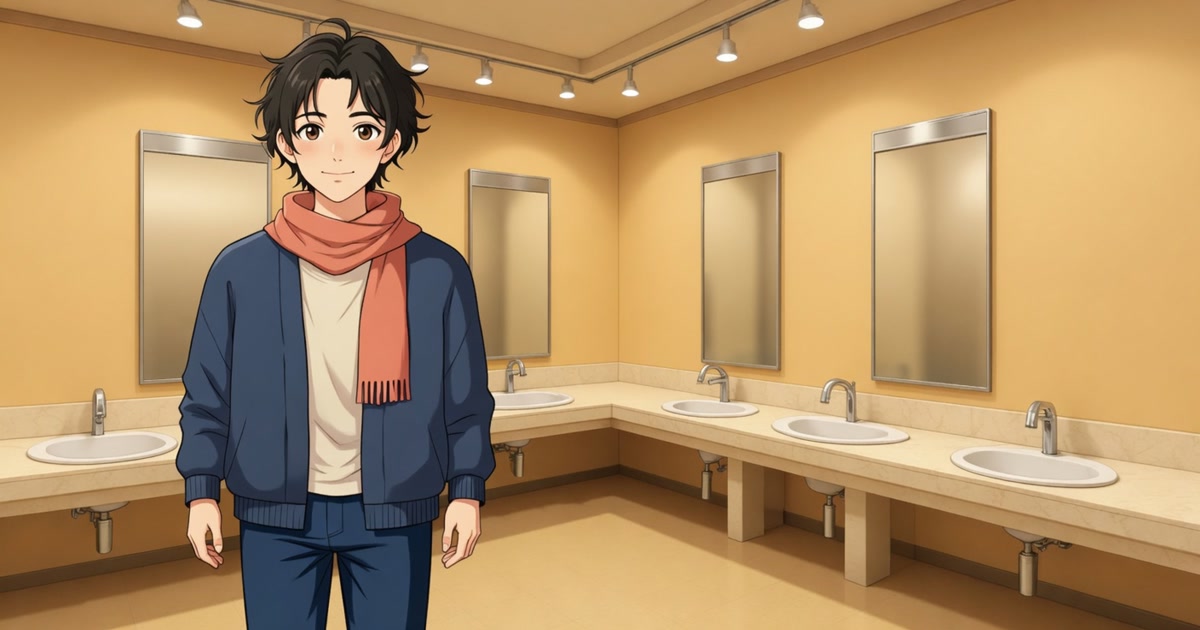
The reel above, published 28 September 2026, is a department-store hallway. The sign on the wall reads 化粧室. This page is that sign: what the three kanji name, how to say them, and why they are not the cosmetics counter.
What does 化粧室 mean on a Japanese sign?
化粧室 (keshōshitsu) on a Japanese sign means the restroom. Shogakukan's Digital Daijisen, on Kotobank, checked 22 October 2026, reads the headword けしょう‐しつ〔ケシヤウ‐〕 and gives two senses. The first is a room for makeup and for getting yourself ready. The second is a washroom or a toilet: 洗面所 (senmenjo) and 便所 (benjo). On a floor directory the second sense is the one in use. The three kanji point you to the bathroom. They do not point you to the counter that sells lipstick. The goods on that counter are 化粧品 (keshōhin). Daijisen, checked the same day, defines 化粧品 as the goods used for makeup: foundation, lipstick, mascara, eyeshadow, and skincare. The last character is the split. 室 (shitsu) is a room. 品 (hin) is goods. Walk past the goods. Follow the room.
How do you pronounce 化粧室?
Say ke-sho-o-shi-tsu, five beats: け, しょ, う, し, つ. Daijisen prints the old spelling in brackets, ケシヤウ. シヤウ is the old spelling of the しょう in 化粧, so the う is its own beat. Drop that beat and the word shrinks to four. Do not stretch the し into a long vowel. 室 in this word is しつ: one beat for し and one beat for つ, and neither vowel is long. The kun reading むろ is not the reading on this sign. 化 here is け, not か. The three kanji on the sign are not a question. There is no か on the end. The reel's second line is the question, 化粧室はどこですか (keshōshitsu wa doko desu ka). Count eleven beats. は is wa. The final か is what makes it a question.
Why does the sign say makeup room when it is the bathroom?
The sign says makeup room because that is what the kanji spell, and the toilet is the second dictionary sense. 化粧 (keshō) is makeup. 室 is a room. Sense 1 of Daijisen is a room where someone puts makeup on and tidies up. Sense 2 is the washroom and the toilet. The Seisen edition of the Nihon Kokugo Daijiten, on the same Kotobank page, splits the word the same way. Its early example of the toilet sense is a line from the Hochi Shimbun of 14 March 1900: 通路の左側に化粧室あり, a 化粧室 on the left side of the corridor. Nipponica's entry for 便所, checked 22 October 2026, says people now often call that place トイレ, お手洗い, or 化粧室. The reel is the department-store case. The directory had already named the room.
How is 化粧室 different from トイレ and お手洗い?
トイレ (toire) is the word you say out loud. Daijisen, checked 22 October 2026, calls it a shortening of トイレット and トイレットルーム, and its first sense is 化粧室, a place to wash your hands, and a toilet. お手洗い (otearai) is the polite name built on 手洗い (tearai). Daijisen's second sense of 手洗い is the toilet. That sense prints お手洗い, and the example is 手洗いに行く, to go to the toilet. Same room, three labels. A station sign may use トイレ. A restaurant door may use お手洗い. The department-store directory in the reel uses 化粧室. Read the word that is printed. If you have to ask, トイレはどこですか (toire wa doko desu ka) is still understood. The directions guide is that spoken pattern, with the everyday word in the blank.
What else is written on the same restroom door?
化粧室 names the room. It does not tell you what is inside the stall. 和式しかありません (washiki shika arimasen) means the only fixture is a squat pan, and the squat-toilet page is that sentence. A door marked 洋式 (yōshiki) is the stall with a seat. A red plate that reads 使用中 (shiyōchū) means the stall is occupied. That plate is the little window on the door. 多目的トイレ (tamokuteki toire) is the accessible stall, a different sign from the three kanji on the directory, and the accessible-toilet reel is that sign. The shoes by the entrance are a different rule. You change into them at the door and change back when you leave. None of those words is the cosmetics counter. 品 on the end is goods for sale. 室 on the end is the room you walk into.
How is this different from asking where the bathroom is?
This page reads a sign. The directions page asks a question. The reel's second line, 化粧室はどこですか, sets the three kanji into はどこですか. The directions guide teaches the same frame with the word people say: トイレはどこですか. Lead with すみません (sumimasen) when you stop someone, and the sumimasen page is that opener. You do not need the question when the directory is already in front of you. The three kanji are the answer on the wall. The basement food hall is a different part of the same store. Its name is デパ地下 (depachika), and the depachika reel is that floor. The restroom can sit on the floor you are already standing on.
化粧室 on a directory is the restroom. Say ke-sho-o-shi-tsu. The makeup for sale is 化粧品. The short reel is the sign in the hallway.