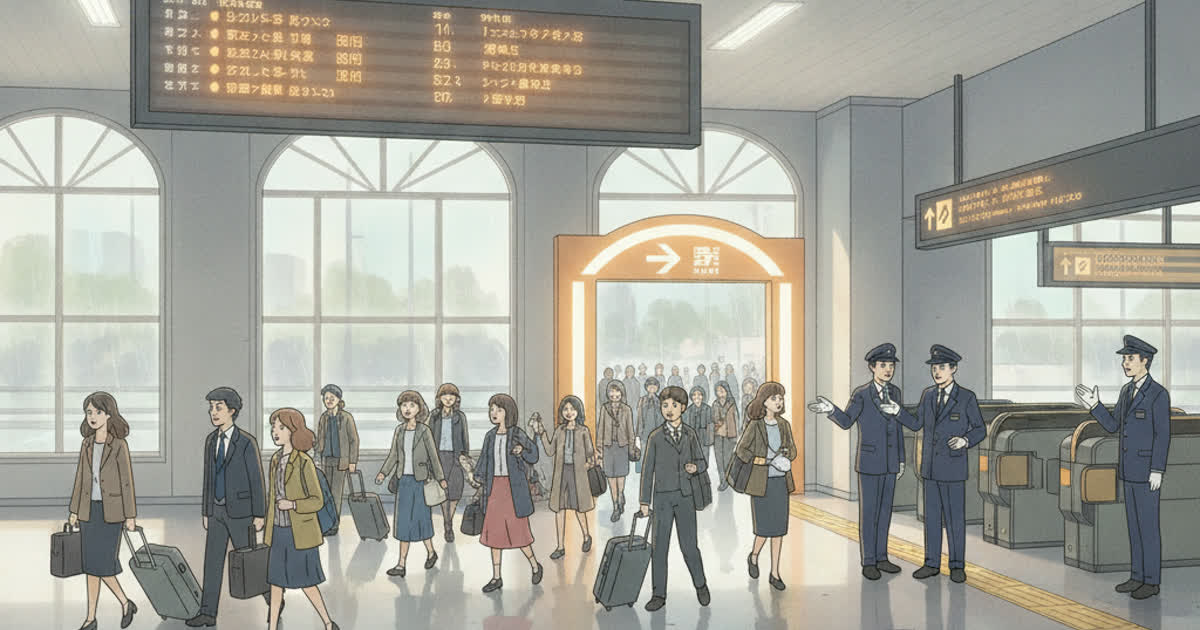
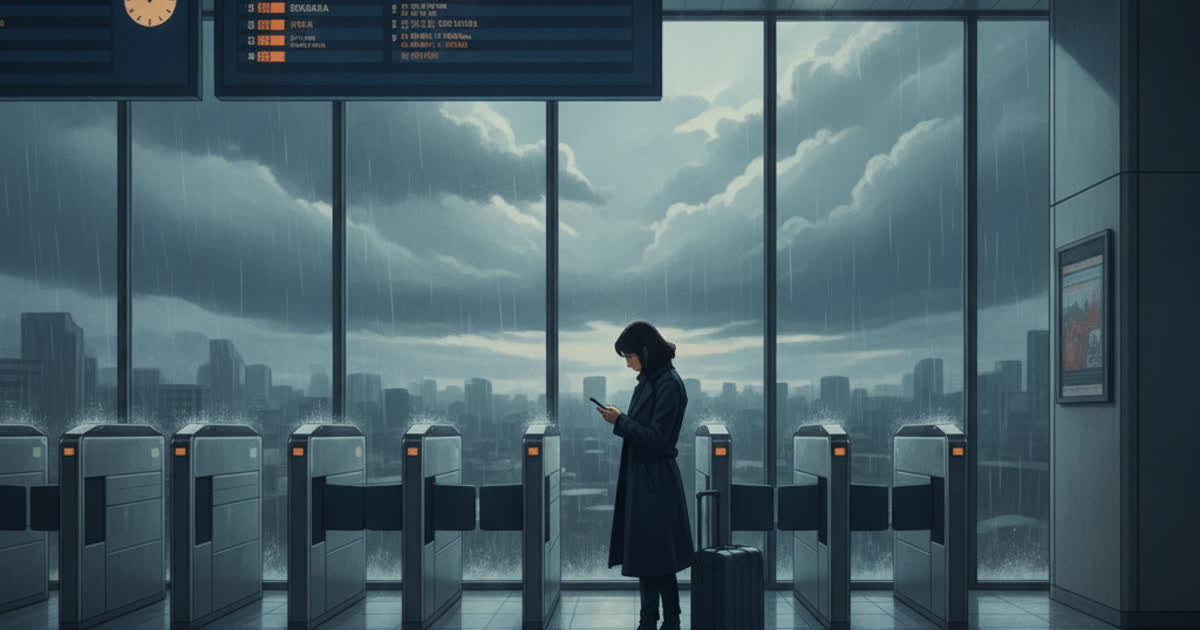
The strange thing about a typhoon in Japan is how quietly the railway gives up. There is no chaos on the concourse, no crowd surging at a barrier. A day before the storm arrives, the operator posts a notice, the departure boards start filling with the same two characters, and by early afternoon a station that moves two million people a day is dark and shuttered with a security guard standing politely in front of the gates. Nothing about that scene is an emergency — it is a plan, decided in advance, and it is called 計画運休 (keikaku unkyū). Knowing it exists, and knowing where to look it up, turns the most disruptive weather in Japan into a rearranged afternoon.
Do Japanese trains stop during a typhoon?
Yes, and they stop on purpose, usually before the worst of the weather actually arrives. Japanese railways run on published safety limits rather than a driver's judgement: when sustained wind on a conventional line reaches roughly 25 metres per second — about 90 km/h — or when rainfall totals cross a set threshold for that stretch of track, services are suspended. Rather than let that happen train by train and strand thousands of people in stations overnight, operators now announce a full shutdown window ahead of time. So the answer for a traveller is not "trains might be delayed." It is "on the day of a direct hit, assume large parts of the network will be closed, and plan around the day, not the hour."
What is keikaku unkyu, Japan's planned suspension?
計画運休 (keikaku unkyū) is a pre-announced, scheduled suspension of train service — literally "planned no-service." JR West ran the first major one in 2014, and after the punishing typhoons of 2018 and 2019 it became standard practice for every big operator in the country. The announcement names the lines affected and the hours: service thins from mid-morning, stops entirely by a stated time, and resumes only after crews have walked the track. Two words tell you which situation you are in. 運休 (unkyū) means the train is cancelled. 運転見合わせ (unten miawase) means service is halted for now, restart time unknown — that is the unplanned version, and it is the worse one to be caught in.
How much warning do you get before the trains stop?
Roughly a day, and often two. Under national transport guidelines, operators flag the possibility of a suspension about 48 hours out and confirm the detailed schedule — which lines, from what time — about 24 hours before the first train is pulled. In practice that means the decision for tomorrow lands in the late afternoon or evening of the day before, which is exactly when you should be checking. If a typhoon is forecast to pass anywhere near your route, look at the operator's site the night before rather than the morning of. By the time you are standing at the station with a suitcase, the plan has been public for half a day and every hotel near you already knows about it.
Where can you check whether your train is running?
Go straight to the operator, not to a search engine. JR East publishes English service status at traininfo.jreast.co.jp and posts planned suspensions there first; JR Central, JR West and JR Kyushu each run their own equivalent page for their Shinkansen and local lines. The free JR East app pushes real-time notifications for delays and cancellations, and the Japan Transit Planner and NAVITIME apps flag a disrupted route before they route you onto it. Private lines — Keisei, Odakyu, Kintetsu, Nankai — announce separately, so if your route mixes JR and a private railway, you have two pages to check, and the reel above shows the spoken version of that same question for when you are already at the gate.
How do you ask at the station if the train is still running?
One sentence covers it: 電車、動いてますか? (densha, ugoitemasu ka) — "are the trains running?" It works at a ticket window, at the gate, or with any uniformed member of staff, and it is the phrase that gets you a straight answer fastest. Two follow-ups are worth having ready. 何時まで動いてますか? (nanji made ugoitemasu ka) asks how long service will keep going, which is the question that actually matters on a suspension day. 再開はいつですか? (saikai wa itsu desu ka) asks when it will restart. If you are relying on the announcements instead, one word in them tells you to move, and everything else is noise.
Do Shinkansen and airport trains stop too?
They do, and the airport connections tend to go first. The Tokaido Shinkansen has suspended whole sections between Tokyo and Shin-Osaka for typhoons, sometimes announced the previous evening; the Narita Express, Keisei Skyliner, Tokyo Monorail and the Kansai Airport lines all stop when wind on their exposed viaducts and bridges crosses the limit. Kansai Airport sits on an artificial island reached by a single bridge, which is why a bad storm can cut it off entirely. If a typhoon is forecast within a day of your flight, move to the airport area early and sleep there rather than gambling on a morning train — and if you already hold a seat, the reserved versus unreserved rules change nothing here: a cancelled train is cancelled for everyone.
Do you get a refund if your train is cancelled?
Yes, in full, and with no cancellation fee. When a service is cancelled, JR refunds the fare and the limited-express or Shinkansen charge; if you are already mid-journey, you are refunded for the portion you did not travel. Even a train that merely arrives two hours or more late gets its express surcharge refunded. Take the unused ticket to a みどりの窓口 (Midori no Madoguchi, the JR ticket office) — you have up to a year, so there is no need to queue in the storm. Tickets bought online are refunded through the same site. The one exception is a Japan Rail Pass: once activated, it is not refunded for weather disruption, so an unusable travel day is simply lost.
What should you do if you are stuck when the trains stop?
Stay put and book a room early. Hotels near major stations sell out within hours of a suspension being announced, so the moment you see one confirmed, secure a bed for that night before you do anything else. Do not try to beat the shutdown on the last train out; that is how people end up stranded at an intermediate station with no staff and no taxis. Convenience stores near stations run out of food and water fast on the day itself, so buy in the morning. If you need a car, ask the front desk to call one rather than waiting at a rank. And if your phone shrieks in Japanese, that is the national alert system, not your alarm — here is what it is telling you. Typhoons pass quickly: most lines are running again by the following morning once track inspections are done.
Typhoon season runs from roughly July into early October, with August and September the busiest months — which overlaps neatly with the Obon travel week, when the trains are full even in perfect weather. None of it is a reason to move a trip. The practical version fits in a line: check the operator's page the night before, keep one flexible day in the itinerary rather than a tight airport connection, and carry the one phrase that gets you a real answer from a real person. If the station staff switch to rapid Japanese in reply, the phrasing that slows the conversation down works just as well in a storm as it does on an ordinary Tuesday.