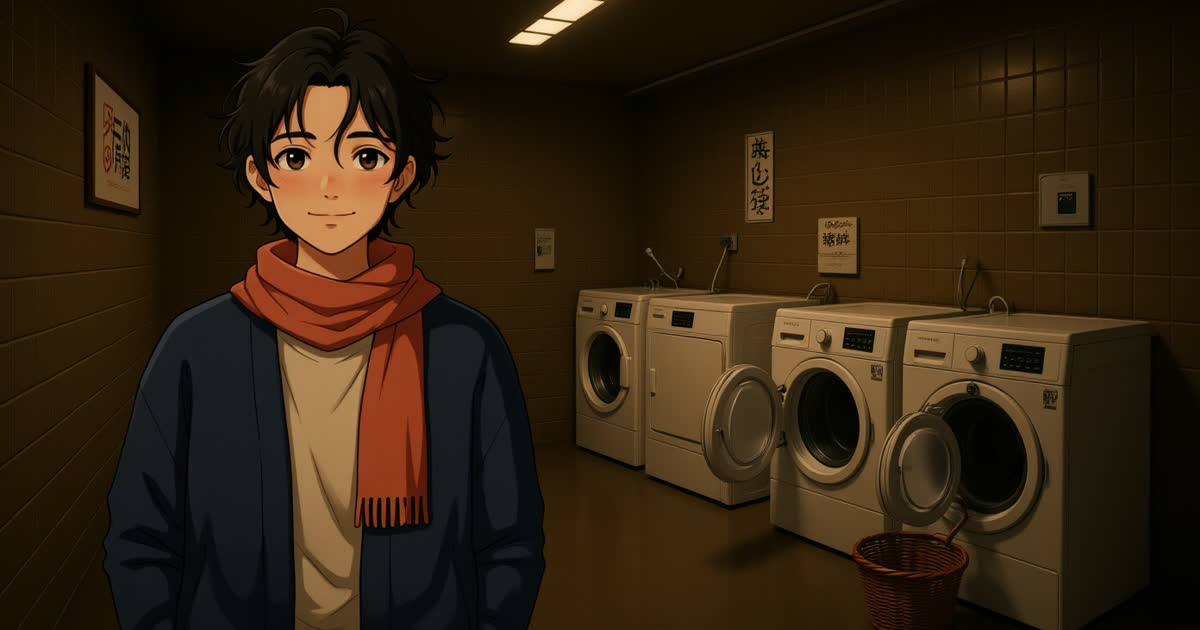
It is eleven at night in a Japanese business-hotel basement. Everything you packed is damp, checkout is in the morning, and the machine in front of you has six buttons and not one word of English. You only need two of them. The reel above teaches 洗濯 (sentaku), wash, and 乾燥 (kansō), dry. Put them together as 洗濯乾燥 (sentaku kansō) and the machine does both in one run. This page is those two kanji, the one button that is a trap, the coins, and the three sentences to say at the front desk.
How do you use a Japanese hotel laundry machine when every button is kanji?
Read two words, pick one course, then press start. 洗濯 is wash, 乾燥 is dry, and 洗濯乾燥 does both in one run without you coming back. Open the drum, load it loosely — Japanese drums are smaller than North American ones, so a stuffed bag is two loads — add 洗剤 (senzai, detergent) in the drawer if the machine does not dose it, close the door until it clicks, and press スタート (sutāto). Some panels want 電源 (dengen, power) first. That is the whole loop. Ignore 予約 (yoyaku): on a washer that is a delay timer, not a way to hold the machine. The rest of the kanji is noise until you need a special cycle.
What do 洗濯 and 乾燥 mean on a Japanese washing machine?
洗濯 (sentaku) means wash. 乾燥 (kansō) means dry. Memorise those two before you go downstairs. A standalone washer is a 洗濯機 (sentakuki); a standalone dryer is a 乾燥機 (kansōki), often a second box that sells you minutes rather than a finished cycle. On a combo machine the same drum does both jobs, which is why the two labels sit next to each other on one panel. If you can read only one word, make it 乾燥 — that is the one that gets you dry socks by morning, and it is the word the reel tells you to keep. Same trick as reading a use-by stamp on a bento lid: two kanji, one job, the rest of the panel can wait.
What is 洗濯乾燥 and should you use the combo course?
洗濯乾燥 (sentaku kansō) is the wash-and-dry combo: one load, one start, dry clothes at the end. Use it when you will not come back for two or three hours, especially overnight in a business hotel where the laundry room empties after ten. It is slower than washing on one machine and moving the load to a dryer, and a packed drum may still come out a little damp, because Japanese dryers run cooler to save energy and avoid shrinkage. That is still better than wet shirts on the chair. Skip the combo if you are in a hurry and a separate 乾燥機 is free — wash, move, feed the dryer coins. If checkout is early, start the combo before you sleep, not at seven in the morning; Japanese hotel checkout is often 10 a.m..
Why shouldn't you press ドライ if you want dry clothes?
ドライ (dorai) is a gentle wash for delicates, not the dryer. It borrows the English word "dry" for a course that treats clothes as if they were going to a dry cleaner, so the drum fills with water and the spin stays soft. Press it by accident and you wait out a whole cycle to get soaking laundry. Dry is 乾燥. If the panel has both words, ignore ドライ unless you actually packed wool or silk. The same mix-up happens with 脱水 (dassui, spin only) and すすぎ (susugi, rinse): useful when you know you want them, disasters when you guess. When you are tired, press the two-kanji combo or the word 標準 (hyōjun, standard) and walk away.
How much does hotel laundry cost in Japan?
Hotel coin laundry is usually ¥100 to ¥300 for a wash and ¥100 per ten minutes in the dryer. A full wet load quietly wants three or four dryer coins, which is the trap in the reel: the dryer sells time, not a finished cycle, so one ¥100 piece is a taste, not a result. Machines take ¥100 coins. If you only have notes, ask the front desk 百円玉に両替できますか (hyaku-en-dama ni ryōgae dekimasu ka), "can you change this into 100-yen coins?" Some business hotels include guest laundry in the stay; look for a sign that says the machines are free before you feed the slot. Street コインランドリー (koin randorī) next door uses the same kanji and the same coins, often with a small detergent vending box on the wall.
How do you ask if the hotel has a dryer in Japanese?
Say 乾燥機はありますか (kansōki wa arimasu ka), "is there a dryer?" That is the sentence in the reel, and it is the one that matters, because a washer with no dryer leaves you hanging wet clothes in a six-tatami room. To find the room, ランドリーはどこですか (randorī wa doko desu ka), "where is the laundry?" For soap, 洗剤はありますか (senzai wa arimasu ka), "do you have detergent?" All three get a yes-or-no or a pointing answer; you do not need more grammar than that. Catch the clerk with すみません (sumimasen) if the desk is busy — the same word that opens almost every ask in Japan. Ask at check-in, not at eleven, so you know whether tonight's plan is the basement or a walk to the coin laundry.
Where is the laundry room in a Japanese hotel?
In a business hotel it is almost always in the basement or on the second floor, signed ランドリー (randorī) or コインランドリー. Ask at check-in; the clerk will point or hand you a floor map. Capsule hotels and many ryokan have no guest laundry at all, so confirm before you pack a week's worth of shirts. If the hotel has no machine, the same ランドリーはどこですか gets you the nearest street coin laundry, which runs on the same two kanji. A long trip is also when sending a bag ahead with takkyubin beats washing every night: ship the dirty load to your last hotel and travel light. The passport photocopy at check-in is the other basement-level hotel surprise; laundry is the one you can solve with two words.
Two kanji, one trap, and a pocket of ¥100 coins. 洗濯 washes, 乾燥 dries, 洗濯乾燥 does both, and ドライ is not the dryer. Watch the 30-second version on the panel before you go downstairs, and keep the essential tourist words for the desk conversation around it.