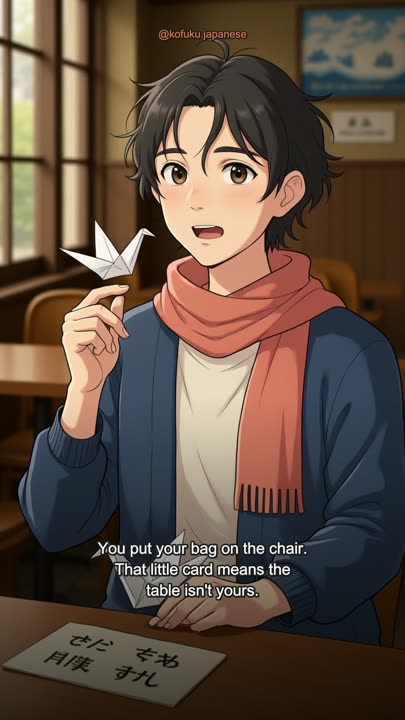

You are standing in a 7-Eleven at nine at night holding a half-price bento whose lid has a row of tiny digits and two kanji you have never seen. One of those stamps is a safety deadline. The other is only a flavour clock. Mix them up and you either throw away good food or eat past a hard stop. The reel above teaches 消費期限 (shōhi kigen), the use-by date. This page expands that into both stamps, the year-month-day print order, and the one question to ask when you cannot read the lid.
What is the difference between 消費期限 and 賞味期限?
Japanese packaged food prints exactly one of two date labels, never both. 消費期限 (shōhi kigen) is the use-by date: the last day, and often the last hour, that the food is safe to eat. 賞味期限 (shōmi kigen) is the best-before date: the last day the maker promises peak flavour, not the last day it is edible. They sit one kana apart, しょうひ versus しょうみ, 費 ("consume") versus 味 ("taste"), which is why a tired traveller reads the wrong one off a discounted おにぎり (onigiri). Perishable food (bento, sandwiches, fresh noodles, cake, prepared dishes) carries 消費期限. Longer-keeping food (snacks, cup noodles, cans, PET bottles, most milk) carries 賞味期限. Both dates only apply if the pack is still sealed and stored the way the 保存方法 (hozon hōhō, storage method) line says.
What does 消費期限 mean on Japanese food?
It means "eat this by this date, for safety." 消費 is consumption, 期限 is a deadline, so the compound is the deadline for eating it. The sentence in the reel is the official gloss: 消費期限は、安全に食べられる期限です (shōhi kigen wa, anzen ni taberareru kigen desu), "the use-by date is the deadline for eating it safely." Japan's food-labelling rules put this stamp on food that spoils fast, roughly anything that goes off within about five days: convenience-store bento, onigiri, sandwiches, 惣菜 (sōzai, prepared side dishes), fresh noodles, cream cakes, raw meat and sashimi. Shops may not sell the item after that stamp. You should not eat it after that stamp either. On a bento the stamp often includes a time, such as 26.8.30 20:00, because a rice box sitting out in August is a clock, not a calendar.
What does 賞味期限 mean on Japanese food?
It means "best before this date," a quality promise, not a safety stop. 賞味 blends 賞 ("appreciate") with 味 ("taste"): the date until the food should taste the way the maker intended. Past it, an unopened bag of rice crackers or a PET tea is usually still fine if it was stored as labelled; the texture or flavour may have faded, and the maker no longer guarantees it. Japan's rules put this stamp on food that keeps: snacks, instant noodles, canned goods, bottled drinks, cheese, and typically milk. If the best-before is more than three months from manufacture, the label may print only the year and month, such as 2026.11, with no day. Once you open the pack the printed date no longer applies; look for 開封後 (kaifūgo, after opening) and eat it sooner.
How do you read the date printed on a Japanese food label?
Read it year, then month, then day. 26.8.30 and 2026.8.30 and 2026年8月30日 are all 30 August 2026. That order is the trap for visitors used to month-first dates: the first number is the year, not the month. Dots, slashes and the kanji 年 / 月 / 日 are all normal. A time after the date, common on bento and sushi packs, is a 24-hour clock: 20:00 is 8 p.m. that day. If you only see two numbers plus a time, such as 8.30 20:00, that is month and day of this year: 30 August at 8 p.m. Same-day bento often skip the year. Some long-life 賞味期限 labels drop the day and print only 2026.8, which means the end of August 2026. A few packs still use the imperial year: 令和8年 is 2026 (Reiwa 1 was 2019). Ignore lot codes and tiny factory numbers next to the date; the words 消費期限 or 賞味期限 sit immediately before the figures that matter. If the date is printed away from those words, the label will say 枠外 (wakugai, outside the box) and point to a corner.
Can you eat Japanese food after the best-before date?
Yes for 賞味期限, if the pack is unopened, stored as labelled, and looks and smells normal; no for 消費期限. Past a best-before date the quality may have dropped (stale snacks, flatter drinks) but the food is not automatically unsafe. Past a use-by date, skip it: that stamp exists because the item can spoil in a way you cannot always see. Both dates assume the printed 保存方法 was followed. 要冷蔵 (yōreizō) means keep refrigerated, often 10°C or below; 要冷凍 (yōreitō) means keep frozen; 常温 (jōon) means room temperature. A bento that spent two hours in a rucksack in August is already past its real life, whatever the lid says. After opening, the printed date is void. If you are unsure, smell, look, and when it is someone else's food, ask. The same lid sometimes lists allergens; how to say you have a food allergy in Japanese covers that panel.
What do you say to ask if food is still good in Japanese?
Ask まだ食べられますか? (mada taberaremasu ka?), "can I still eat this?" It works at a konbini counter, a supermarket information desk, and a hotel breakfast when you find yesterday's milk. To name the stamp, ask 消費期限はいつですか? (shōhi kigen wa itsu desu ka?) or 賞味期限はいつですか? (shōmi kigen wa itsu desu ka?), "when is the use-by / best-before date?" A shorter check is これ、まだ大丈夫ですか? (kore, mada daijōbu desu ka?), "is this still okay?" If you want the blunt version: 期限切れですか? (kigen-gire desu ka?), "is it expired?" Staff will usually point at the lid and say 今日中 (kyōjū, by the end of today) or 大丈夫です (daijōbu desu, it's fine). Pair this with the counter script in Japanese phrases for convenience stores if you are buying, not inspecting.
Why do Japanese convenience stores discount food at night?
They are racing the 消費期限, not running a sale. A konbini bento, onigiri or sandwich cannot legally be sold after its use-by stamp, so branches sticker 半額 (hangaku, half price) or another markdown an hour or two before that time, often after 7 or 8 p.m. The yellow or orange sticker is a clock, not a coupon: the food is still inside its safety window, which is why locals time a cheap dinner around it. Once the stamp passes, the item comes off the shelf. 賞味期限 snacks are almost never in that evening pile. If you want the discounted bento, check that the kanji on the lid is 消費期限 and that the time has not already gone.
Two kanji, one kana apart, and the date in year-month-day order. 消費期限 is the deadline; 賞味期限 is the flavour clock. Learn しょうひ versus しょうみ and a half-price bento stops being a guess. Watch the 33-second version on the lid before the next konbini run, and if the rest of the box is a kanji grid, reading a Japanese medicine panel uses the same "find the framed line" trick.