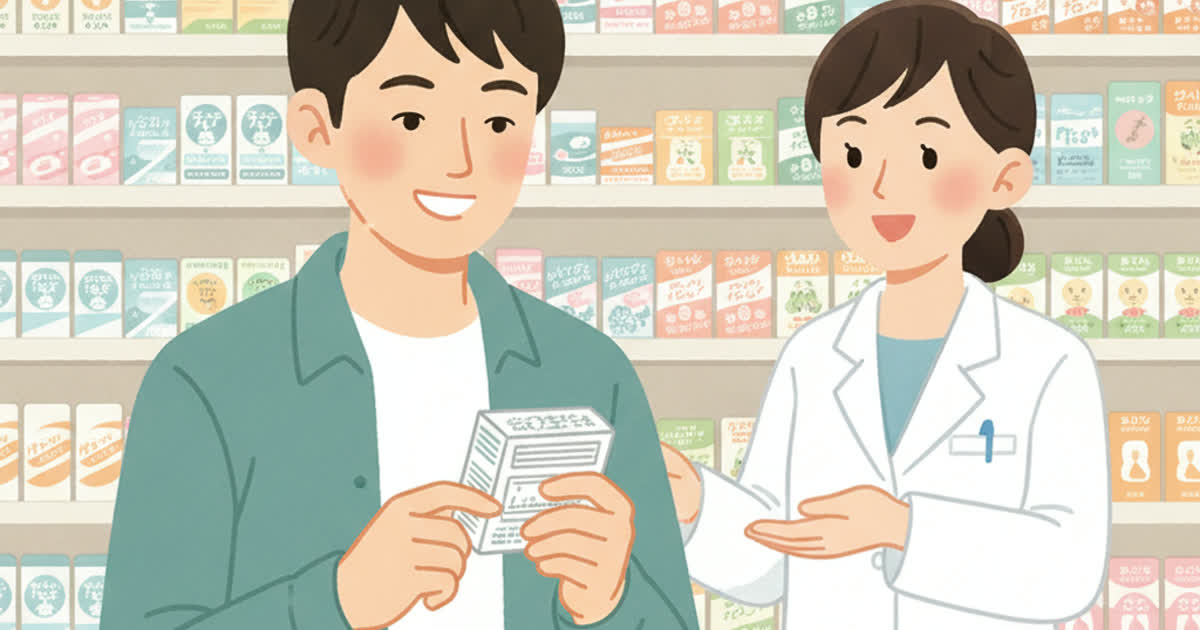
You are standing in a Japanese drugstore at ten at night holding a small white box with a picture of a relieved-looking cartoon person on it. Somebody told you it was the good cold medicine. The back of the box is a solid grid of kanji, and the only thing you know for certain is that taking the wrong amount of something you cannot read is a bad way to end a trip. The good news: that grid is the same grid on almost every box in the country, it has only three real answers in it, and one question at the counter gets all three out loud.
How do you read the dosage panel on a Japanese medicine box?
Find the box headed 用法・用量 (yōhō yōryō, "usage and dosage") — it is the framed table on the back or side of every Japanese medicine package, and it answers three things in a fixed order: how many times a day, when to take it, and how much per dose. The line above the table usually reads 次の量を服用してください (tsugi no ryō o fukuyō shite kudasai, "please take the following amount"), where 服用 (fukuyō) is the formal verb for taking medicine that you will see everywhere on the packaging but almost never hear in conversation. Everything else on the box — the ingredient list, the warnings, the cartoon — is supporting material. Read the table and you have what you need.
What does 1日3回 食後 mean?
It means "three times a day, after meals", and it is the single most common instruction printed in Japan. 1日3回 (ichinichi sankai) is the frequency: 1日 is "one day", 回 (kai) is the counter for times, so 1日2回 is twice a day and 1日1回 is once. 食後 (shokugo) is the timing — after eating, usually within 30 minutes. The other timings you will meet are 食前 (shokuzen, before eating), 食間 (shokkan, which does not mean during the meal but about two hours after one, on an empty stomach), and 就寝前 (shūshin mae, before bed). Plenty of boxes are twice a day rather than three times, so never assume — the frame is worth learning precisely because the number inside it changes.
How do you know how many tablets to take per dose?
Look for 1回 (ikkai, "one time") followed by a number and a counter: 1回2錠 (ikkai nijō) is two tablets per dose. 錠 (jō) counts tablets, カプセル (kapuseru) counts capsules, and 包 (hō) counts the paper sachets that Japanese powdered medicine comes in — a genuinely common format that surprises first-time visitors. So a full instruction reads 1日3回、1回2錠、食後: three times a day, two tablets each time, after food. You will often also see 服用間隔は4時間以上おいてください (fukuyō kankaku wa yojikan ijō oite kudasai), "leave at least four hours between doses" — that is the real limit if your meals are irregular, and it matters more than the meal timing does.
What do the age rows on a Japanese medicine box mean?
The dosage table has one row per age band, and you must read across your own row rather than the first one. The adult row is 成人(15才以上) (seijin, jūgo-sai ijō) — "adult, 15 years and over" — and Japanese packaging counts an adult from 15, not 18. Below it you will see bands like 7才以上15才未満 (nana-sai ijō jūgo-sai miman), "7 and over, under 15", with a smaller dose. The two kanji doing all the work are 以上 (ijō, "and above") and 未満 (miman, "under"). The bottom row is often 服用しないこと (fukuyō shinai koto), "do not take" — a flat prohibition for young children, not a smaller dose. If you are buying for a child, that row is the one to point at when you ask.
What do you say to ask a Japanese pharmacist about the dose?
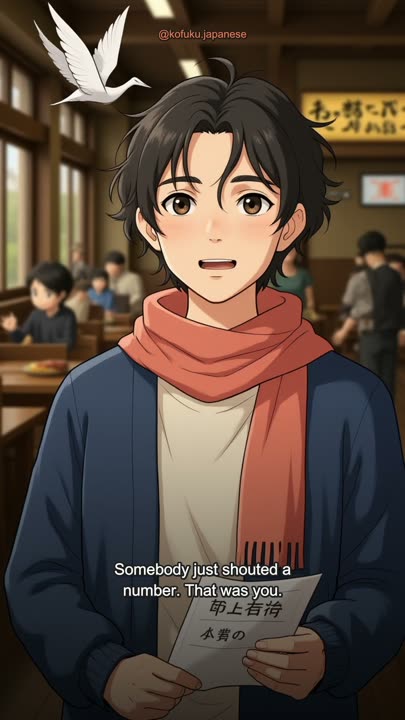
One question covers it: これ、一日何回飲めばいいですか? (kore, ichinichi nankai nomeba ii desu ka?), "how many times a day should I take this?" — the phrase in our reel on the all-kanji cold medicine box. 何回 (nankai) is simply "how many times", so the frame swaps cleanly: 1回何錠ですか? (ikkai nanjō desu ka?), "how many tablets per dose?", and 食前ですか、食後ですか? (shokuzen desu ka, shokugo desu ka?), "before food or after?" Three more are worth having ready: 眠くなりますか? (nemuku narimasu ka?), "will it make me drowsy?" — many Japanese cold and allergy medicines will; 今、他の薬を飲んでいます (ima, hoka no kusuri o nonde imasu), "I am taking other medicine right now"; and 英語の説明書はありますか? (eigo no setsumeisho wa arimasu ka?), "is there an English leaflet?" Staff will usually hold up fingers for the number, which settles it even if the rest goes past you. On the way out you will hear "odaiji ni" — "take care of yourself", not goodbye.
Who can actually answer your questions in a Japanese drugstore?
It depends on the class printed on the box, which is also why some medicine sits behind the counter. 第1類医薬品 (dai-ichirui iyakuhin, "class 1") can only be handed over by a 薬剤師 (yakuzaishi, a licensed pharmacist), so it is kept out of reach and there may not be one on duty late at night. 第2類 and 第3類 — which covers most cold, fever and stomach medicine — can be sold by a 登録販売者 (tōroku hanbaisha, a registered seller), and that badge is who you will usually be talking to. Ask 薬剤師さんはいますか? (yakuzaishi-san wa imasu ka?), "is there a pharmacist here?", if you have a real medical question rather than a dosage one. For anything beyond a cold, a clinic is the better call, and the first question reception asks is not your name.
Which Japanese medicines can't you take home?
Check the ingredient list before you pack leftovers, because standard Japanese cold medicine contains things that are controlled elsewhere. Many popular brands list ジヒドロコデインリン酸塩 (dihydrocodeine phosphate, a codeine derivative) and dl-メチルエフェドリン塩酸塩 (methylephedrine); nasal and allergy products may list プソイドエフェドリン塩酸塩 (pseudoephedrine). Codeine-containing medicine is prescription-only in Australia and much of Europe, and both codeine and pseudoephedrine are tightly restricted in places like Singapore and the UAE — so a half-used box in your suitcase can become a customs conversation. The rule runs the other way too: Japan bans bringing in pseudoephedrine products such as Sudafed and Vicks inhalers, along with amphetamine-based ADHD medication, and a prescription supply beyond about a month needs a 薬監証明 (yakkan shōmei) import certificate arranged in advance. Buy what you need in Japan, finish it in Japan, and check your own country's rules before anything crosses a border.
The panel on the box is not really a reading test — it is three numbers in a fixed order, and 1日3回、1回2錠、食後 covers most of what a visitor will ever buy. Learn 一日何回 and 食後 and you can decode the box yourself; ask the counter when you cannot, because that is exactly what the person in the badge is there for. If you need to get to the shelf in the first place, start with how to ask where the pharmacy is and the phrase that gets you cold medicine. For a fever, "netsu ga arimasu" is the sentence; for the morning after, the hangover shelf is a Japanese speciality. If it is the heat rather than a virus, read what to do about heatstroke in Japan, and if it turns serious, the numbers to call are worth knowing before you need them.