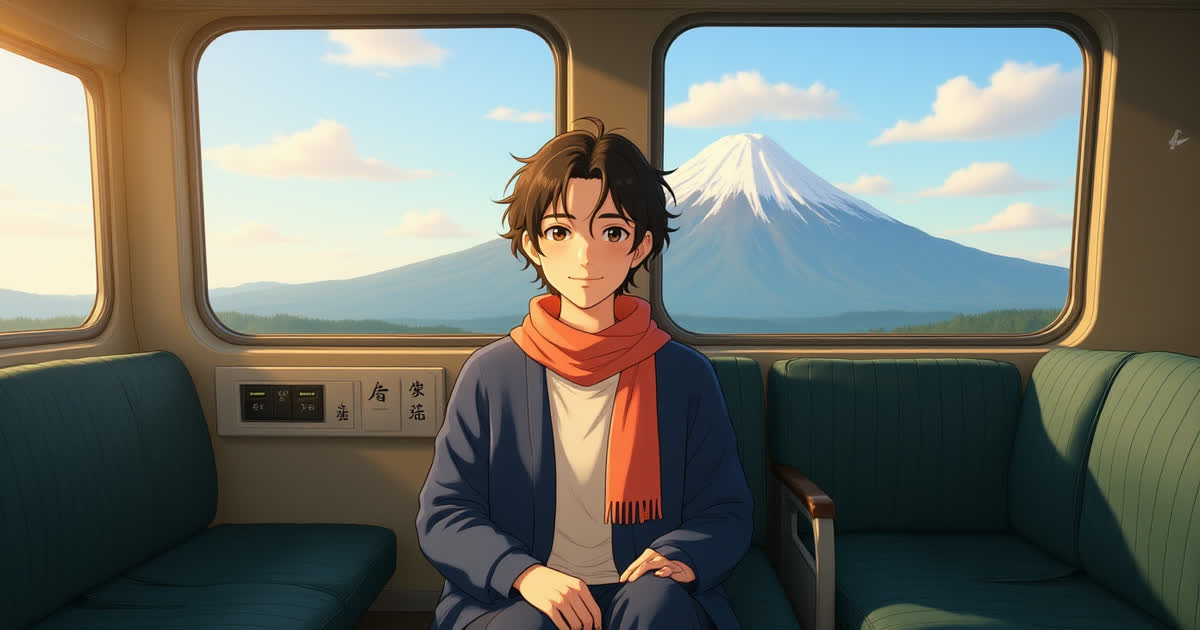
Same train, same fare, and one of your seats can see Mount Fuji while the other stares at a wall. On the Tōkaidō Shinkansen the rails run west of the mountain, so the view is not a lucky seat — it is a fixed side of the train, and you can ask for it at the counter in one short phrase. This is where the window side is, how to book it in Japanese, and what your odds actually are on any given day.
Which side of the Shinkansen has the Mount Fuji view?
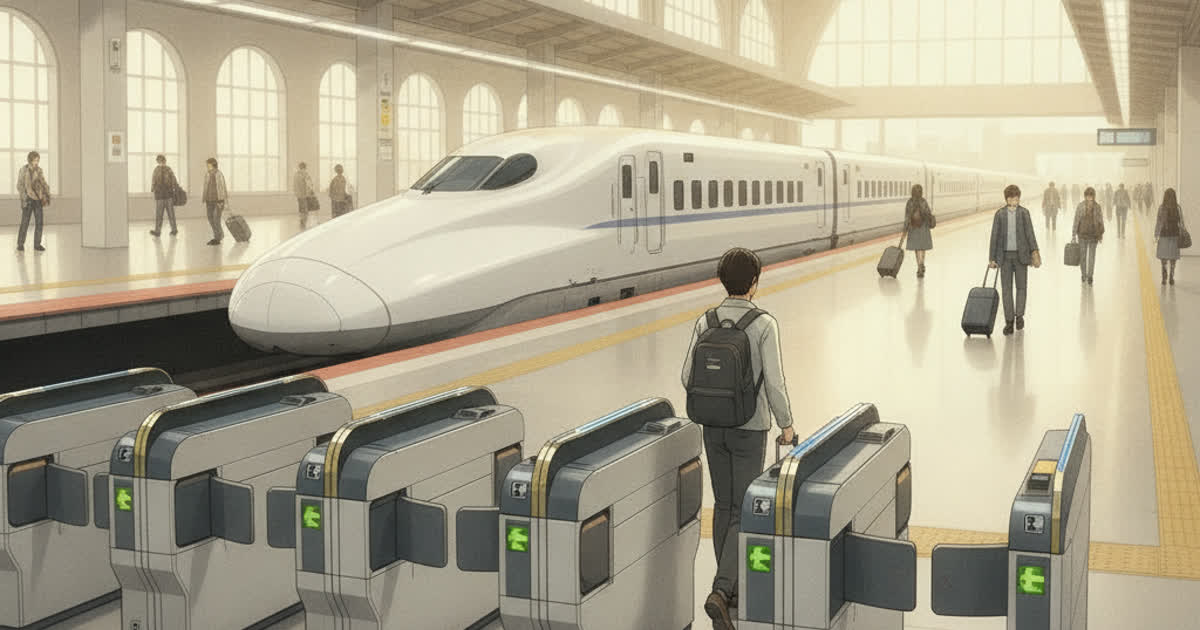
The right side of the train when you ride from Tokyo toward Osaka, and the left side when you travel back the other way. The Tōkaidō Shinkansen keeps the mountain on one side of the car for most of the run, so outbound the Fuji-side seats are the ones on the right — D and E, with the window seat E — and returning, the left side, with the window at A. Pick the right-side window going to Osaka and left-side going home and you are on the 富士山側 (Fujisan-gawa, the Mount Fuji side) whenever the sky is clear.
How do you ask for a window seat in Japanese?
One short polite phrase gets you the window: 窓側でお願いします (madogawa de onegai shimasu), literally "at the window side, please." You name where you want to sit first, then the polite request ending お願いします (onegai shimasu). Swap 窓側 (madogawa) for 通路側 (tsūrogawa) and the same sentence asks for the aisle instead. Staff at the Shinkansen counter hear this from tourists all day, so you do not need a full sentence — naming the side plus the polite ending is enough to be understood and acted on.
Which seat letters are the window seats on a Shinkansen?
The window seat is the letter at the far end of each row: E on the right side and A on the left. A Shinkansen row letters its seats so one always sits against the window on each side of the aisle — A on the left window, B beside it, then the aisle, then D and E on the right with E at the window. So on the Tokyo-to-Osaka leg you want the right-side window (seat E), and on the return leg the left-side window (seat A). If you are not fussed about the window itself, the aisle-side letter of the same pair (B or D) still rides the Fuji side of the car.
How do you book a reserved window seat on the Shinkansen?
Ask for it when you book, and the seat is yours. At the green-signed ticket office — みどりの窓口 (midori no madoguchi, the "green window") — give your destination and add 窓側でお願いします (madogawa de onegai shimasu), and the clerk will assign a window seat if one is free on that train. The green ticket machines switch to English and several let you pick the exact seat; when a machine will not give you the side you want, the counter phrase settles it. You need a reserved seat (指定席, shiteiseki) to fix a specific side — an unreserved ticket (自由席, jiyūseki) just lets you take whatever happens to be free at boarding.
When can you actually see Mount Fuji from the Shinkansen?
On clear days, and your odds are best in autumn and winter. Mount Fuji's summit is most reliably visible on cold, dry mornings when the air is clear; the view is worst in the humid summer haze and in the days after rain. Early departures help, because the morning air is usually clearer before the day heats up. Even in good season it is not a guarantee — a cloudy afternoon can hide the whole mountain — so treat the right-side seat as your lottery ticket for the view, not a promise. When it does appear, it is unmistakable and worth the seat selection.
Where on the route is the Mount Fuji view best?
Roughly the middle stretch of the run, where the line swings closest to the mountain and the right side opens out. Expect Mount Fuji to appear once the train clears the Tokyo metro clutter, then stay in view across a long open stretch until the approach to Osaka starts closing in the right-hand side again. Keep your eyes on the right-side window from about the midpoint onward and you should catch the clearest sight of the trip. The view is the whole point of the route — it is why travelers ask for the window at all — and getting the seat right is the difference between watching it and watching a wall.
Tip: when you book, you can combine the window seat with any other request in the same sentence — add a car by asking 指定席をお願いします (shiteiseki o onegai shimasu) for a reserved spot, or swap in 禁煙席 (kinenseki, non-smoking) exactly the same way. One polite ending covers the whole booking.
Once your seat is sorted, the ride itself is straightforward: a platform bento eaten before boarding is a Shinkansen tradition worth keeping, and if your tickets come back as separate rows, the two-ticket seat mixup is a common first ride. The wider story, on when a reserved seat is worth the extra cost, is the same decision every tourist makes at the window — and now you can make it with the view in mind.