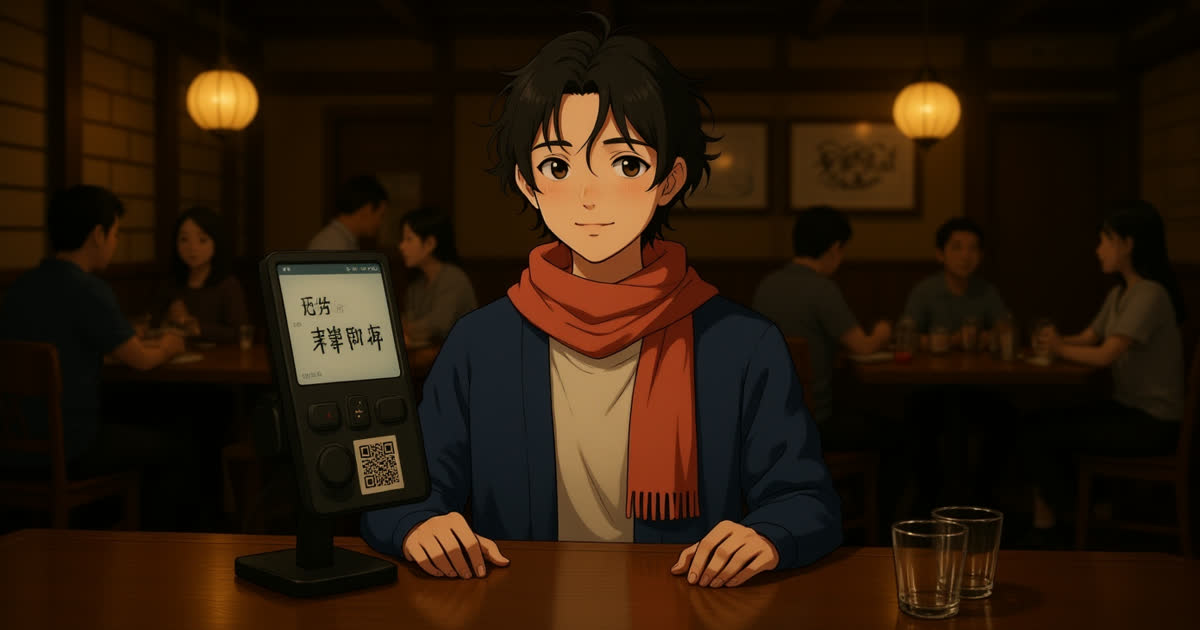
You have been sitting for eleven minutes. You have made eye contact with three different staff. Nobody is coming. You are not being ignored. Look at the table. That little sticker with the QR code is not the wifi. It is the menu. The reel above is the short version; below is how to spot which ordering system you are in, and the one sentence that covers all of them.
How do you order at a Japanese izakaya when nobody comes to your table?
Stop waiting and look for the system the shop actually uses. Most casual izakaya and family restaurants in Japan have moved off waiter-at-the-table. You will usually find one of four things: a tablet on a stand, a QR-code sticker on the table, a ticket machine just inside the door, or a counter you walk up to. The catch-all sentence is 注文はどうすればいいですか (chūmon wa dō sureba ii desu ka), "how should I order?" Say it to any staff member and they will point at the tablet, the sticker, the machine, or they will take the order themselves. It is the one phrase that works even when you cannot tell which system you are in.
What does 注文はどうすればいいですか mean?
It means "how should I order?" Break it in two. 注文 (chūmon) is your order. どうすればいいですか (dō sureba ii desu ka) is "what should I do / how should I go about it?" Together they ask which system this shop runs, without naming one. That is the point: you do not need to know whether this place uses a QR code, a tablet, or a person, because the sentence does not guess. Pair it with すみません (sumimasen) at the front — すみません、注文はどうすればいいですか — and you have the full, polite version from the reel. The usual reply is a finger pointed at the table, or こちらでお願いします (kochira de onegaishimasu, "please do it here") as they tap the tablet awake. For the range of that first word, read what sumimasen actually means.
How do you tell if an izakaya uses a tablet, a QR code, or a waiter?
Spend ten seconds scanning the table before you sit down expecting service. A tablet on a stand, often with a stylus on a string, is the waiter. A square sticker with a QR code, sometimes labelled モバイルオーダー or セルフオーダー, is also the waiter — and it is not the shop wifi. A small plastic button labelled 呼出 (yobidashi) or a bell icon is the table call button, which means staff will come once you press it. No tablet, no sticker, no button: look toward the door for a 食券機 (shokkenki, ticket machine) — more common in ramen than izakaya, but some standing bars have one — or walk to the counter. A paper menu and a staff member already at the table means you are in the old system; order out loud.
How do you order on a Japanese restaurant tablet or QR code?
Scan or tap, switch the language, tap dishes, send. On a tablet, the home screen usually has a flag or the word 言語 (gengo, "language") in a corner; tap it and pick English if you want it, or stay in Japanese and use the pictures. Add items to the cart, then tap 注文する (chūmon suru, "place order") — nothing leaves the cart until you hit that button, so you can browse. A QR sticker opens the same menu in your phone browser; allow the camera, wait for the page, then order the same way. Drinks often sit on a separate tab from food. Send the first round as soon as you know the drink — a 生ビール (nama bīru, draft beer) is the classic opener, and the reel on ordering one covers the spoken version if you would rather say it. The kitchen gets the ticket instantly; nobody comes to confirm. If the pictures fail you, ask for the Japanese menu as well as English — the English one is often the short list.
What do モバイルオーダー and セルフオーダー mean?
They mean the same thing: order from your own phone. モバイルオーダー (mobairu ōdā, "mobile order") and セルフオーダー (serufu ōdā, "self order") are the two katakana labels shops print on the table sticker. You will also see タッチパネル (tacchi paneru) for a physical tablet. None of these is wifi. Scanning the code opens a web menu tied to your table number, so the food arrives at the right seat. If the page asks for a table number and you cannot find it, look at the sticker again, the little stand, or a number plate on the wall of the booth. If the camera will not open, ask 注文はどうすればいいですか rather than guessing at a neighbouring table's code.
When should you walk up to the counter instead of waiting?
When there is no tablet, no sticker, and no call button, and the staff are standing behind a counter, not circulating. Small neighbourhood izakaya, standing bars (立ち飲み, tachinomi), and many counter-only shops expect you to order at the pass, the same way you would at a sushi counter. Walk up, say すみません, and either read the board or point: これお願いします (kore onegaishimasu, "this one please") is the whole move — the reel on ordering by pointing is the ten-second version. A first drink plus a small plate is the normal opening; the unasked bowl that then lands is お通し (otōshi), the per-person seat charge, which we cover in what otoshi is. Do not sit down in a standing bar and wait: there is no table service.
What if you still cannot figure out how to order?
Ask the sentence. Raise a hand, say すみません、注文はどうすればいいですか at a volume that carries, and wait for the point. If they take the order themselves, have the first drink ready and close with 以上です (ijō desu, "that's everything") — the reel on saying that's all. If they wake the tablet for you, they will often switch it to English without being asked. A ticket machine by the door is a different trap, covered in how a ramen ticket machine works. And if you cannot read the menu at all, おすすめはありますか (osusume wa arimasu ka, "do you have a recommendation?") gets you the house plate — that phrase in the reel. None of this is a test. The staff would rather show you the sticker than watch you sit for eleven minutes.
The short version is the one in the reel: you are not being ignored. Look at the table. Ask 注文はどうすればいいですか if you still cannot tell. For the rest of the evening — calling staff, the otoshi charge, paying — read how to call a waiter in Japan, what otoshi is, and how to ask for the bill, or browse all our travel reels.