You've found the ramen shop, the queue looks right, and then you get inside and there's a metal box covered in forty unlabelled buttons where the host stand should be. This stops more first-time visitors in Japan than any menu ever has. The good news: once you know the sequence, ramen becomes the fastest, least stressful meal of your trip — no ordering out loud, no bill at the end, no tipping.
How do you use a ramen ticket machine in Japan?
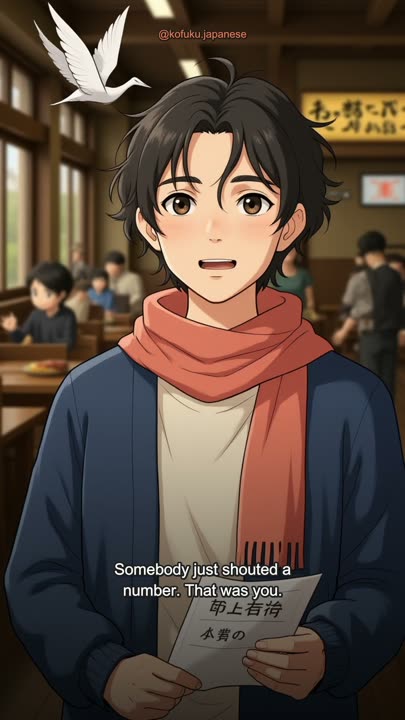
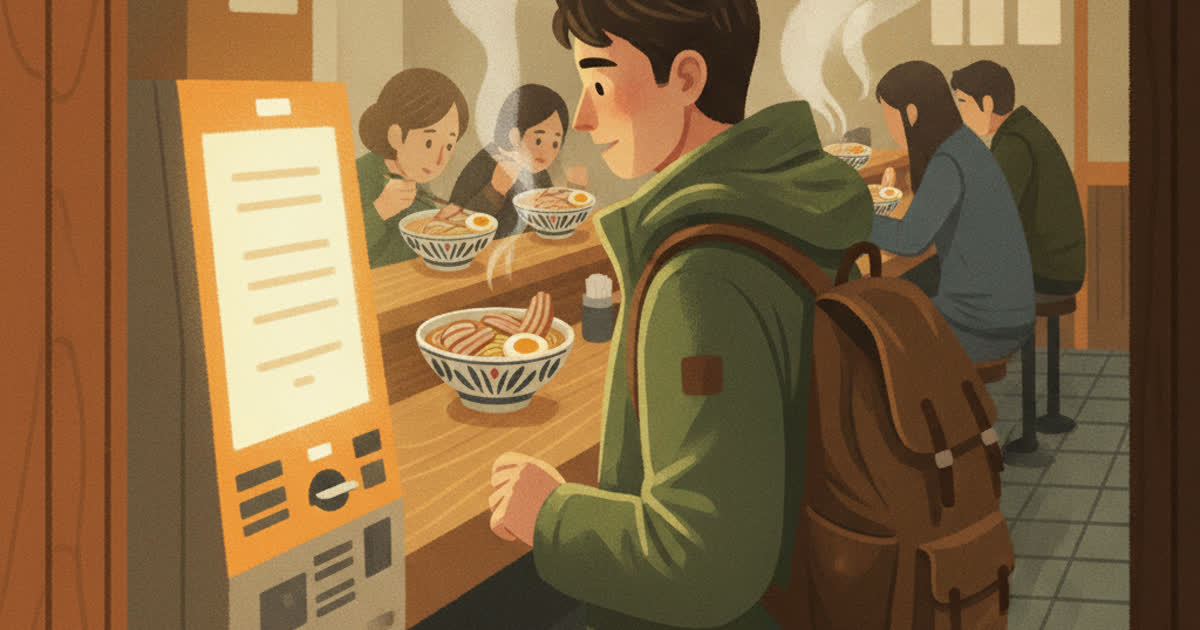
Money first, button second — that's the whole trick, and it's the step visitors miss. Feed coins or a note into the slot before you touch anything; on most machines the buttons stay dark until they detect enough cash, which is why people stand there jabbing at a dead panel. Then press the button for your bowl, plus a separate button for each topping you want. The machine prints small paper tickets — one per button — into a tray at the bottom. Take them, then press or pull the change lever to collect your coins. Now sit down. The 食券機 (shokkenki, "meal ticket machine") has already taken your order and your money, so the rest of the meal is just eating. You can watch the whole sequence run in about thirty seconds in the reel above.
Where is the ticket machine in a ramen shop?
Just inside the entrance, nearly always immediately to your left or right as you push through the door. It sits before the seating on purpose: in a shop with twelve counter stools and a queue outside, the machine is what keeps the line moving. Some shops put it outside, under the 暖簾 (noren, the split curtain over the door), so the queue can buy while it waits — if you see people in line holding little paper slips, that's your cue to buy now rather than at the front. A few newer places have replaced it with a tablet or a QR code at the seat. Look for the machine first; if there isn't one within two steps of the door, you're ordering at the table.
Can you pay by card at a ramen ticket machine?
Often not — assume cash and be pleasantly surprised. A large share of ticket machines, especially in the small owner-run shops with the best bowls, take coins and 千円札 (sen-en satsu, ¥1,000 notes) and nothing else. Newer machines accept IC cards like Suica and PASMO — tap the reader after selecting — and some take QR payments, but ¥5,000 and ¥10,000 notes are commonly rejected even by machines that read notes at all. The practical fix is to keep three or four ¥1,000 notes on you for the whole trip; a bowl of ramen usually lands between ¥800 and ¥1,300, so one note per person is close to right. If all you have is a big bill, ask the staff to break it. Japan is still much more cash-dependent than most visitors expect, which we cover fully in can you pay by card in Japan.
How do you read the buttons if you can't read Japanese?
Start at the top-left corner and stop thinking. Ticket machines are laid out by popularity, so the top-left button is the shop's signature bowl — the thing they're known for and the thing most customers order — with variations and cheaper items spreading right and downward. Pressing it is never a wrong answer. If you want to steer, the broth is usually named on the button: 醤油 (shōyu, soy sauce), 味噌 (miso), 塩 (shio, salt), and 豚骨 (tonkotsu, rich pork bone). つけ麺 (tsukemen) means noodles served dry with dipping broth on the side, and 大盛 (ōmori) means a large portion. A button that's dark, covered, or lit with 売切 (urikire) is sold out. One caution: ramen broth very often contains pork and wheat noodles contain gluten, and a button gives you no way to ask — if you have a restriction, read how to say food allergy in Japanese before you press anything.
What do you do with the ticket after you buy it?
Hand it to the staff as you sit, or lay it face-up on the counter in front of you — don't pocket it and wait to be asked. In a busy shop the cook will reach over and take it without a word, and that silence is normal, not rudeness. Water is self-serve at almost every ramen counter, and you may get one question back — how firm you want the noodles. ふつう (futsū, normal) is always a safe answer, かため (katame) means firmer. When you're done, you stand up and leave; the ticket was the bill. If you can't finish, asking whether you can take it away is the phrase you want, though most ramen shops will say no.
How do you order extra noodles or toppings from the machine?
Buy a separate ticket for each extra, at the same time as your bowl. Toppings get their own buttons, usually in a block below or to the right of the main bowls: 味玉 (ajitama, a marinated soft-boiled egg — the single best ¥120 in Japan), チャーシュー (chāshū, extra braised pork), 海苔 (nori, seaweed sheets), and ネギ (negi, spring onion). The exception is 替え玉 (kaedama), a second helping of noodles dropped into your remaining broth — a tonkotsu-shop tradition from Hakata. You can buy that ticket mid-meal: eat two thirds of your noodles, go back to the machine, and hand the ticket over while there's still broth left. Ordering it is a small signal that you know what you're doing.
What if you press the wrong button on a ramen ticket machine?
Nothing bad happens, and there's no cancel button to hunt for. Take the ticket to the staff and say すみません、間違えました (sumimasen, machigaemashita — "sorry, I made a mistake"); in practice they will swap it for the right one or refund you from the till. If the machine simply ate your money, look for the 返却レバー (henkyaku rebā), the coin-return lever or knob at the bottom, usually on the left — press or pull it and your change drops into the tray. That same lever is what you use for ordinary change, and forgetting it is how people walk off having tipped a vending machine ¥700. If the machine won't take your note, smooth it flat and try again; if it still refuses, ask 両替できますか (ryōgae dekimasu ka — "can you break a bill?").
What Japanese phrases help at a ramen ticket machine?
Four phrases cover essentially every situation at the machine. すみません、使い方を教えてください (sumimasen, tsukaikata o oshiete kudasai) means "excuse me, please show me how to use this" — say it to any staff member and they'll walk over and press the buttons with you. おすすめはどれですか (osusume wa dore desu ka) means "which one do you recommend?" and gets you the bowl the shop is proud of. 両替できますか (ryōgae dekimasu ka) breaks a large note. And カードは使えますか (kādo wa tsukaemasu ka) asks whether a card will work. If the queue outside looks long before you commit, asking how long the wait is is worth having ready too.
Ticket machines feel like a barrier from the doorway and like a gift by the second time you use one: no language required, no waiting for a bill, no working out a tip. Feed it a note, press the top-left button, take your ticket, sit down. For more of the phrases that make eating in Japan easy, try our guide to Japanese for foodies visiting Osaka, or browse all our travel reels.