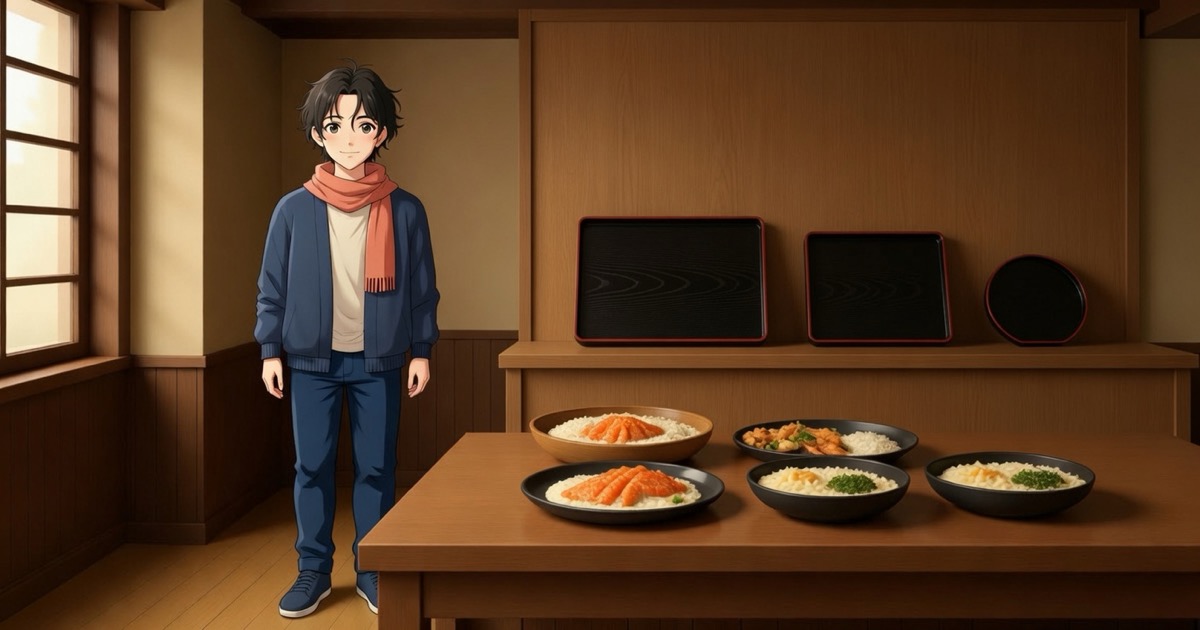
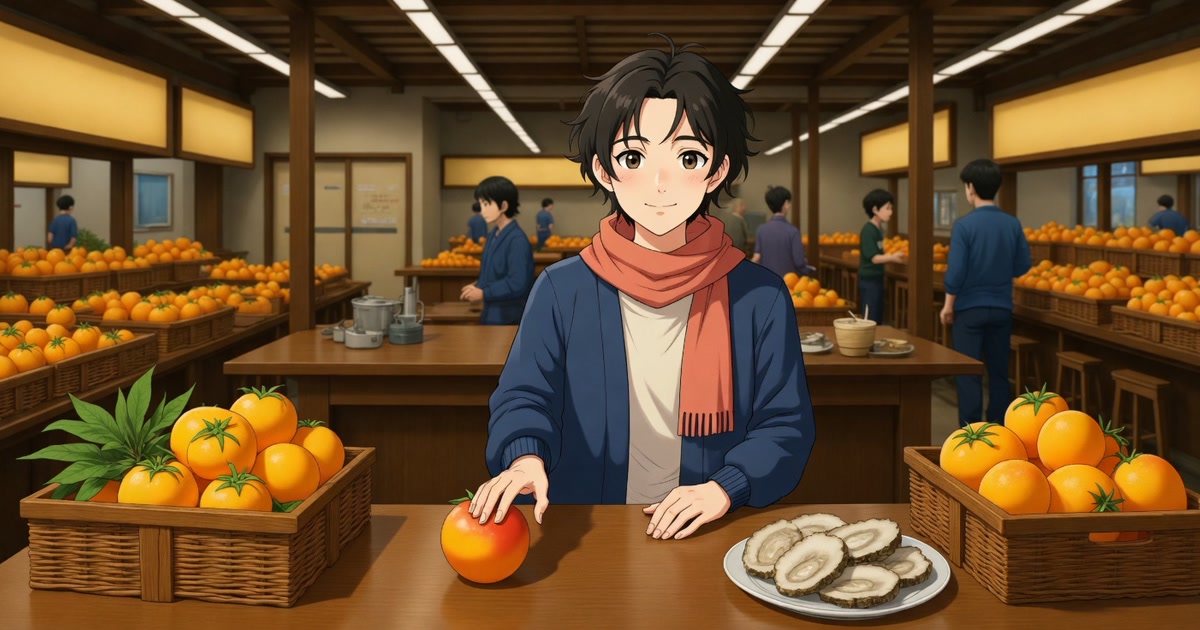
The counter in the reel above, published 7 October 2026, sells both. You said かき. The bag that came back was the shellfish. The rescue line is 果物の柿をください. This page is that one sentence: what a persimmon is, why the oyster shares the sound, and what to say on the next try.
What does 果物の柿をください mean at a Japanese market?
果物の柿をください (kudamono no kaki o kudasai) means "the fruit persimmon, please." Digital Daijisen, on Kotobank, checked 26 October 2026, defines 果物 as the juicy, usually sweet fruit of a tree or a plant that you eat, and it glosses that sense as fruit. The same entry says the く is the old word for tree, 木, and the だ is an old "of." 柿, in that dictionary, is the persimmon tree and its fruit. をください asks the person to give you that thing. The three pieces name the fruit, then the persimmon, then the request. The reel's English is the same claim: the fruit persimmon, please. You say it at a market counter. It is a request, not a question, so there is no か on the end. Bare かき is the word that fetched the shellfish. 果物の is the part the stall can hear.
How do you pronounce 果物の柿をください?
Say ku-da-mo-no no ka-ki o ku-da-sa-i, twelve beats. 果物 is four short beats: く, だ, も, の. None of those vowels is long. The next の is the particle, so you hear "no" twice in a row: the last beat of the noun, then the particle. 柿 is か and き, both short. A long "kaaki" is not this word. を is the particle o. Do not say wo. ください is four beats: く, だ, さ, い. The い is its own beat. There is no small っ, and there is no か, because the line asks for the fruit. It does not ask a yes-or-no question. The full line in the reel is 果物の柿をください。 (Kudamono no kaki o kudasai.)
What is a persimmon?
A persimmon is a fruit. It is the fruit of the persimmon tree, and it is not a shellfish. Digital Daijisen, checked 26 October 2026, defines 柿 as a deciduous tree in the persimmon family, and as the fruit of that tree. The fruit turns yellow-red in autumn, and the calyx stays attached. That calyx, 萼 (gaku), is the cap left from the flower. You eat the fruit fresh, or you eat it dried. The fresh sweet kind is 甘柿 (amagaki). Daijisen names 富有 (fuyū), 次郎 (jirō), and 御所 (gosho) as sweet varieties. The puckering kind is 渋柿 (shibugaki). The same entry names 平核無 (hiratanenashi) and 西条 (saijō) there. The Seisen edition of the Nihon Kokugo Daijiten, checked the same day, says a sweet persimmon is already sweet while the flesh is still firm, so you eat it as it is, and an astringent one is treated to take the pucker out, or dried into 干し柿 (hoshigaki). 日本大百科全書 (Nipponica), on Kotobank, in the 22 March 2021 text, checked 26 October 2026, says the skin turns yellow to yellow-red from late September through November. October, the month of the reel, sits in that window. かき氷 (kakigōri) is shaved ice. The long ō is a different word.
Why does かき also mean oyster?
かき is also the oyster. Digital Daijisen's entry for 牡蠣, checked 26 October 2026, defines it as the general name for shellfish in the oyster family, the ones that fasten onto rocks in the sea. The shell is uneven. One shell bulges. The other is flatter. The dictionary's gloss is oyster, and the season mark is winter. A note there says people call it 海のミルク (umi no miruku), milk of the sea, for the milky color and the nutrition. 柿 and 牡蠣 are both read かき, two short beats. On a sign, the kanji splits them. In your mouth, a bare かき fits both. Daijisen marks the fruit as an autumn season word and the oyster as a winter season word. The reel is an October counter that sells both, so the bag can go either way. Saying the bare word again does not pick the fruit. The staff are not the joke. The homophone is.
How do you ask for the oyster instead?
牡蠣をください (kaki o kudasai) is the shellfish request written with the oyster kanji, and it uses the same sounds as 柿をください (kaki o kudasai). The kanji helps on a sign. It does not help once you are speaking. Point at the shell if it is on the counter. If you need a word the ear can split from the fruit, say 生牡蠣をください (nama-gaki o kudasai), raw oyster, please. The Seisen Nihon Kokugo Daijiten, checked 26 October 2026, reads 生牡蠣 as なまがき and defines it as an oyster that has not been boiled or grilled. The か of 牡蠣 voices to が, so the word is nama-gaki, not nama-kaki. That が is not the fruit. For the fruit, go back to 果物の柿をください. 果物 is the fruit you eat. An oyster is a shellfish with two shells. The extra word is what the stall can hear.
What do you do if they already brought the oyster?
Say the fruit line before you pay, while the bag is still on the counter. Start with すみません (sumimasen), then 果物の柿をください. The reel stops on that second try. The first bag was the oyster because bare かき fits both. The second try names the fruit. The pork-bun page is the same kind of miss at a hot case: the pork bun and the sweet-bean bun sit together, and the name you pick is the one you get. The saury page is one named autumn fish, grilled whole, with the head still on. This page is the fruit that shares a sound with a shellfish. If you already walked off with the oyster, use the fruit line at the next stall. This page does not set a swap or a refund.
果物の柿をください means the fruit persimmon, please. A persimmon is the yellow-red autumn fruit of the persimmon tree. 牡蠣 is the oyster. The word 果物の is what the stall can hear.