You bought a coffee, a rice ball and a bottle of tea, and now you are three blocks from the shop holding all the packaging with nowhere to put it. Japan is famously spotless and famously short of public bins, which feels like a contradiction until you work out where the bins actually went. They are not gone — they are indoors, attached to the places that sold you the thing, and labelled in kanji that sorts your rubbish into three or four streams. Learn the four labels and the day stops involving a plastic bag in your pocket.
Where can you actually throw away trash in Japan?
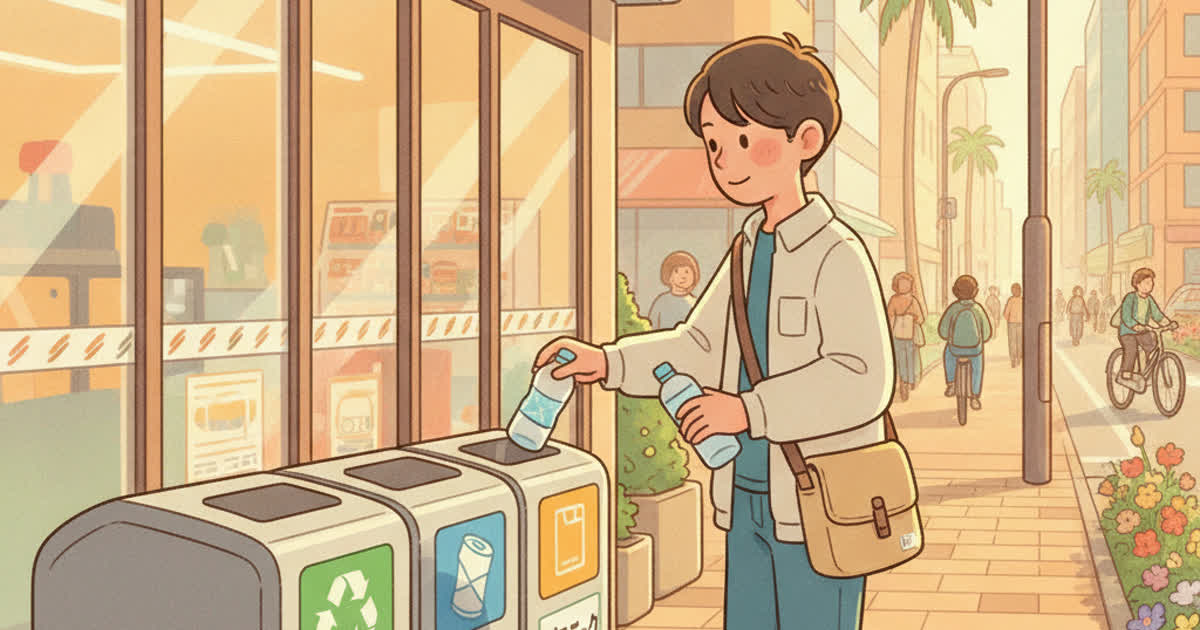
Bins exist, but they belong to businesses rather than the street: your reliable options are convenience stores, station platforms and concourses, the recycling box beside a vending machine, food courts and fast-food counters, department-store basements, and your own hotel room. A コンビニ (konbini) is the single best bet — every branch has a bank of bins either just inside the door or outside by the parking spaces, and they are open all night. Stations are second: look near the kiosk, the ticket gates or the end of the platform, though many smaller stations removed theirs. Parks, temples and festival grounds usually have none at all. The working rule for a visitor is simple: throw things away at the moment you finish them, in the building that sold them to you, because the street will not offer you a second chance.
Why are there no trash cans in Japan?
The bins were removed for security and never came back. After the 1995 sarin gas attack on the Tokyo subway, public bins in stations were treated as a hiding place for devices and were taken out en masse; the same logic emptied streets again around later summits and the Olympics, and the Tokaido Shinkansen pulled the bins from its trains in 2023. On top of that sits an older habit: ごみは持ち帰り (gomi wa mochikaeri), "take your rubbish home", is taught in Japanese schools and printed on signs at parks and festivals. Municipal collection is also paid for by household, ward by ward, so a public bin is somewhere people dump home rubbish to avoid the rules. The result is a country with almost no street bins and almost no litter, because everyone is quietly carrying their own.
What do the labels on Japanese bins mean?
Four labels cover nearly everything you will hold as a tourist. 燃えるゴミ (moeru gomi) is burnable: wrappers, tissues, paper cups, chopsticks, food scraps — this is the one you will use most, and some wards write it 燃やすごみ (moyasu gomi) or 可燃ごみ (kanen gomi), all the same bin. 燃えないゴミ (moenai gomi), also written 不燃ごみ (funen gomi), is non-burnable: small metal, ceramics, umbrellas. カン・ビン (kan, bin) is cans and glass bottles, often one slot with two round holes. ペットボトル (petto botoru) is plastic drink bottles only. If a bin has just two slots, they are almost always burnable and bottles-and-cans. When you cannot read the worn-off label, ask the question from our reel on Japan's judgemental bins: 燃えるゴミはどれですか? (moeru gomi wa dore desu ka?), "which one is the burnable?"
How do you sort a plastic bottle in Japan?
Take the cap and the label off, drink or tip out whatever is left, and put the three parts in different places. The bottle goes in the ペットボトル slot; the cap and the plastic label are プラ (pura, plastics) and in practice go into the burnable bin when no plastics slot exists. Vending machines carry their own リサイクルボックス (risaikuru bokkusu) bolted to the side, and the signs on newer ones say キャップとラベルを外してください (kyappu to raberu o hazushite kudasai), "please remove the cap and label". That box is for drink containers from that machine, not for your lunch wrapper — putting burnable rubbish in it is the single most common tourist mistake, and it is why some machines now have a narrow bottle-shaped slot you physically cannot post a bag through. Cans and glass go in the same box unless the slots are separate.
Can you use a convenience store bin for your own trash?
Yes for what you bought or ate there, and for a small amount of ordinary trash you are carrying; no for a bag of hotel or household rubbish. Konbini bins are private property, paid for and emptied by the shop, which is why so many chains moved them inside where staff can see them and why you will see 家庭ごみの持ち込みはご遠慮ください (katei gomi no mochikomi wa go-enryo kudasai), "please refrain from bringing household rubbish". Nobody will challenge a visitor dropping in a coffee cup and a wrapper. The polite version is to buy something, or at least to sort properly into the labelled slots rather than stuffing everything into one. If the bins are behind the counter, hand the item over with これ、お願いします (kore, onegai shimasu) — the same phrase that does the work at the counter in our konbini hot-food reel and in the full guide to Japanese phrases for convenience stores.
What do you say to ask where to throw something away?
One question solves it: ごみ箱はどこですか? (gomi-bako wa doko desu ka?), "where is the trash can?" — the phrase in our trash can reel, and it works in a shop, a station or a hotel lobby. When you are holding the thing and standing at the bin, これ、捨ててもいいですか? (kore, sutete mo ii desu ka?) means "may I throw this away here?" and is the more useful sentence, because it asks permission rather than directions. Two more are worth having: どれに捨てますか? (dore ni sutemasu ka?), "which one do I put it in?", and 袋をもらえますか? (fukuro o moraemasu ka?), "could I have a bag?", for carrying rubbish until you find a bin. Staff will usually just point, which settles it without any more Japanese.
What should you do when there is no bin at all?
Carry it, in a bag, the way everyone around you is doing. Keep one konbini bag folded in a pocket at the start of the day and it becomes the portable bin the streets do not provide; this is standard practice in Japan, not a workaround. Your hotel room is the reliable end point — room bins are emptied daily, and larger hotels have sorted bins by the lift or the vending machines. Two places that will not take it: train seat pockets and shrine grounds. Eating on the move creates most of this problem in the first place, which is part of why eating while walking is frowned on in Japan — the expected move is to eat at the counter or beside the stall and bin the packaging before you leave. The same instinct governs how people behave on trains: leave no trace of yourself behind.
Japan's missing bins are not a design flaw, they are a policy with a workaround everyone already knows: finish things where you bought them, keep a bag for what is left, and sort by the four labels when you find a bank of slots. 燃えるゴミ takes nearly everything a visitor holds, ペットボトル takes the bottle once the cap and label are off, and ごみ箱はどこですか? covers the rest. If you are at the konbini counter anyway, "fukuro wa irimasen" is the phrase for refusing the bag you are about to carry rubbish in — though on a long walking day, take it.