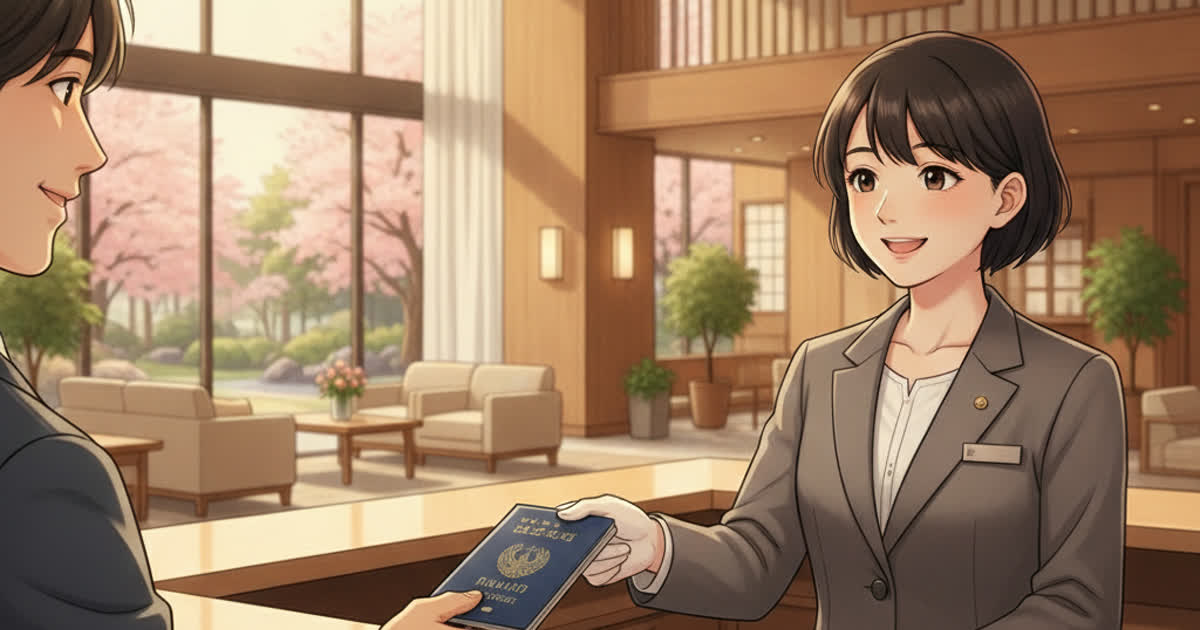
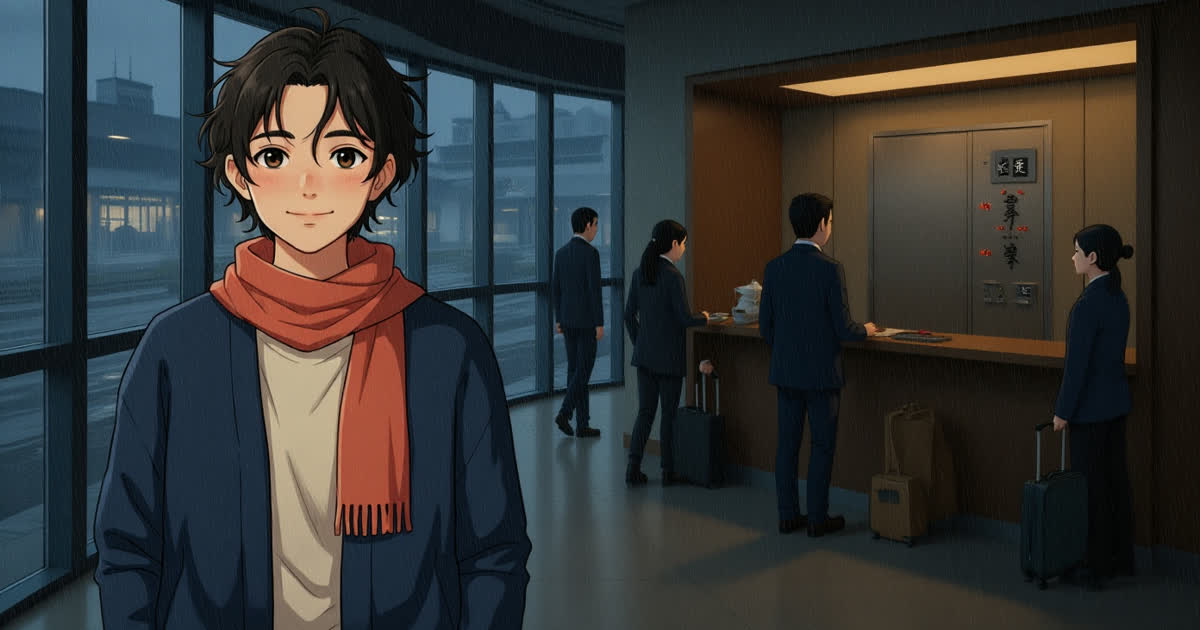
The typhoon cancelled your flight, checkout is in forty minutes, and the lobby is filling with other people who just got the same email. This is the moment the phrase in the reel above earns its keep. Walk to the front desk and ask もう一泊できますか? (mō ippaku dekimasu ka), "can I stay one more night?" Japanese hotels will extend a stay if a room is free, but they will not hold one unless you ask, and they will not guess that you need it.
How do you ask to stay one more night in Japanese?
Say もう一泊できますか? (mō ippaku dekimasu ka) at the front desk — that is the whole sentence, and it is the one in the reel above. Catch their attention with すみません (sumimasen) if they are busy, then the phrase. It works at a business hotel, a ryokan, a hostel and a capsule hotel: 一泊 (ippaku) is the hotel word for one overnight stay, and できますか (dekimasu ka) turns it into a polite yes-or-no. Add the reason in the same breath if you can: 台風でフライトがキャンセルになりました (taifū de furaito ga kyanseru ni narimashita), "the flight was cancelled because of the typhoon." Staff hear that line all through August and September, and it tells them you are not shopping for a cheaper extra night.
What does もう一泊できますか mean?
Word by word it is "one more" + "one overnight stay" + "is it possible?" もう (mō) here means "one more," not "already." 一泊 (ippaku) is one night as a stay — the same 泊 you will see on booking sites and on the little calendar at the desk. できますか (dekimasu ka) is the polite "can it be done?" ending, so the whole line is a request, not a demand. Textbooks sometimes teach 泊まれますか (tomaremasu ka), from the verb 泊まる (tomaru), "to stay overnight." That is grammatical, but hotel staff think in nights, not in the verb, so もう一泊できますか? is the line they actually expect. Match the reel: one sentence, then wait.
How do you count extra nights in Japanese?
Nights of a hotel stay are counted with 泊 (haku / paku), not with 日 (nichi, calendar days). One night is 一泊 (ippaku), two is 二泊 (nihaku), three is 三泊 (sanpaku). If the clerk asks 何泊ですか? (nanpaku desu ka), "how many nights?", answer もう一泊お願いします (mō ippaku onegai shimasu) for one extra night, or 二泊お願いします (nihaku onegai shimasu) if the airport is closed for two. The sound changes on a few numbers — one becomes ip-paku, three becomes san-paku — but you do not need the whole table. One, two and 何泊 cover almost every typhoon extension. Do not mix this with 一日 (ichinichi), which is "one calendar day" and will confuse the booking.
What is the softer polite way to ask for another night?
Swap できますか for お願いできますか and the same request gets gentler: もう一泊お願いできますか? (mō ippaku onegai dekimasu ka), "could I ask for one more night?" Use this when the lobby is tense, when you are asking close to checkout, or when the clerk already looks busy with a line of cancelled flights. お願い (onegai) is the "please" that turns a capability question into a request. You can also say 延長したいです (enchō shitai desu), "I would like to extend," which names the action without counting nights — useful if you already said 一泊 once and they are typing. Keep the extra-stiff よろしいでしょうか (yoroshii deshō ka) for a quiet ryokan desk; a busy city business hotel wants the shorter line.
What does the hotel clerk say back?
The first thing you will usually hear is 少々お待ちください (shōshō omachi kudasai), "please wait a moment," while they check the computer. A yes is はい、大丈夫です (hai, daijōbu desu), "yes, that's fine," or 空いております (aite orimasu), "we have a room." They may then tell you the extra-night price; if they do not, ask 一泊いくらですか? (ippaku ikura desu ka), "how much is one night?" A no is 満室です (manshitsu desu), "fully booked," often wrapped in 申し訳ございません (mōshiwake gozaimasen), "I am very sorry." When it is a yes they may ask to see your passport again — that is the same check-in photocopy rule, not a new problem. Pay the extra night at the desk before you go back upstairs; Japanese hotels usually settle the extension on the spot. Before you leave the desk, confirm what time checkout is for the new night, because in Japan it is often 10 a.m.
What if the hotel is fully booked during a typhoon?
Treat 満室です as final and ask for a referral immediately: 近くのホテルはありますか? (chikaku no hoteru wa arimasu ka), "is there a nearby hotel?" Front desks in Japan will often call a neighbouring property for you, especially on a weather night. If trains are already in a planned typhoon suspension, do not try to move across the city — stay in the same neighbourhood even if the room is a capsule. Book the first yes you get; typhoon nights sell out in hours, not days. Then deal with the flight: most airlines rebook a cancelled typhoon flight at no extra fare, and you can move a reservation date the same way if you are still holding later nights.
%>The whole exchange fits in two sentences: 台風でフライトがキャンセルになりました。もう一泊できますか? Ask as soon as the cancellation lands, before checkout and before the lobby fills. If the trains have already stopped, what to do when your train is suspended is the next page to read, and what time the last train is is the one to know before the next storm. Typhoon season runs from July into early October and overlaps the Obon travel week, when rooms are tight even in clear weather — which is exactly why this one phrase is worth having in your pocket before you land.