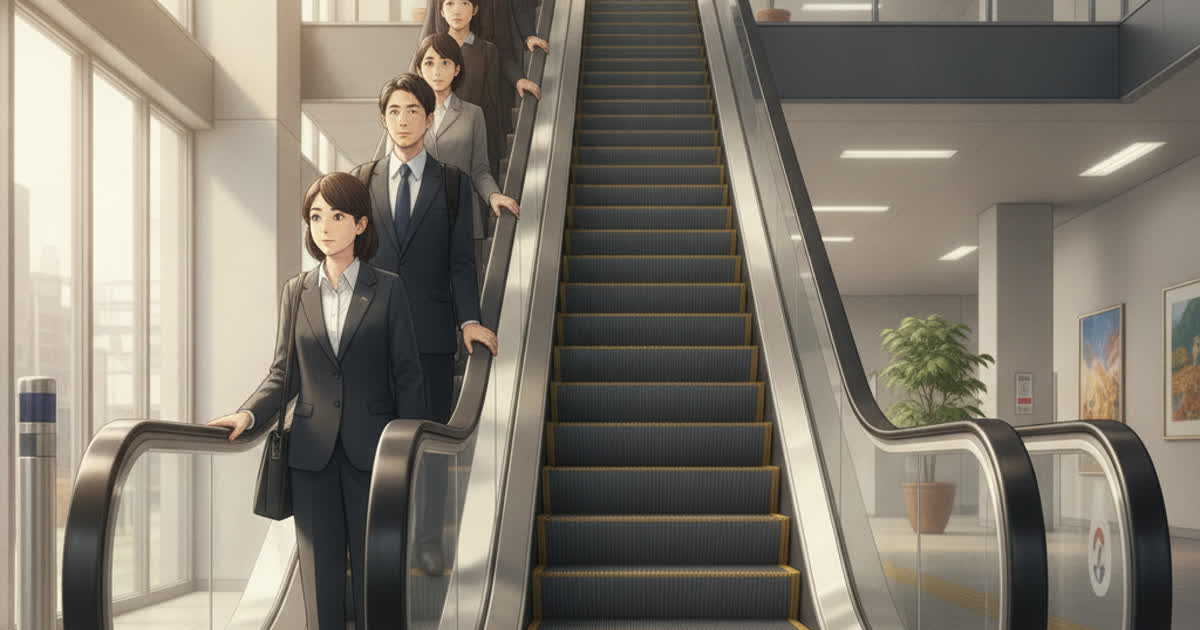
You step onto an escalator at a Japanese station and something is instantly, visibly off. Everyone is packed into one half of the step, shoulder to shoulder, and the other half is empty all the way to the top. Then a commuter walks straight up the open lane past you. Stand in the wrong place and you become the cork in the bottle — here's which side is which, why it flips between Tokyo and Osaka, and what the stations are now asking everyone to do instead.
Which side do you stand on an escalator in Japan?
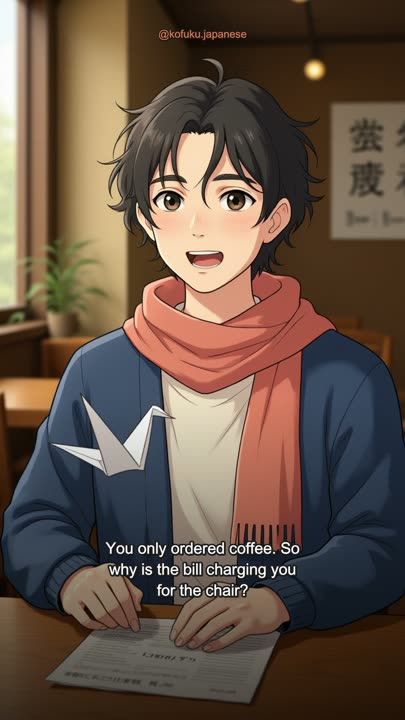
In Tokyo and most of Japan you stand on the 左側 (hidarigawa, the left side) and leave the right side open. In Osaka and much of Kansai it is exactly the opposite: you stand on the 右側 (migigawa, the right side) and leave the left open. The open lane is for people walking up or down, which is why a single person standing in it can back up an entire escalator behind them. Nobody will say anything — you'll just feel it. The safest move is the one locals use themselves when they travel: look at the person ahead of you and copy them. The reel above shows the whole thing in about twenty seconds, and if 右 (migi) and 左 (hidari) don't stick yet, here are both words.
Why does Osaka stand on the right and Tokyo on the left?
The split is an accident of history that nobody ever bothered to fix. The usual explanation traces Kansai's right-standing habit to the 1970 Osaka Expo, where escalator announcements asked riders to keep one side clear for people in a hurry, and to Hankyu's Umeda station, which had been making similar announcements a few years earlier. With millions of visitors passing through, the habit set hard and stayed. Tokyo's left-standing convention grew later and more organically, as commuter volumes climbed through the 1980s and walkers simply drifted to the right. Neither is a law, neither was ever coordinated nationally, and each city's version now feels obviously correct to the people who live there. That's why the escalator is one of the few places in Japan where "just follow the rules" isn't enough — the rule changes depending on where you're standing.
Where does Japan's escalator line fall between left and right?
Roughly speaking: Osaka and Kobe stand right, and nearly everywhere else stands left. Tokyo, Yokohama, Nagoya, Sapporo, Sendai, Hiroshima, and Fukuoka all stand on the left. Kyoto is the interesting one — geographically Kansai, but so full of visitors from Tokyo and abroad that it has drifted to left-standing in most stations, with pockets of right-standing among locals. If you're riding the Tokaido Shinkansen west, the practical switchover happens somewhere around Kyoto and Shin-Osaka: get off at Kyoto and it looks like Tokyo, get off at Shin-Osaka and the whole crowd has flipped. Nobody polices the boundary and mixed escalators are common in tourist areas, so don't overthink it. One glance at the step ahead of you settles it faster than any map of the country ever will.
Is it OK to walk up an escalator in Japan?
Officially, no — and this is where the custom and the rules now openly disagree. Every major railway operator, along with the Japan Elevator Association, has spent years running campaigns asking people to stand still on both sides and hold the handrail, because escalator injuries overwhelmingly happen to people who are moving, carrying something, or get clipped by someone rushing past. Saitama Prefecture passed Japan's first ordinance requiring riders to stand still on escalators in October 2021, and Nagoya City followed in October 2023. Neither carries a fine; they're there to give the announcements teeth. In practice, walking is still completely normal in most of the country during rush hour, and stations that genuinely want two-abreast standing will say so with staff, floor stickers, and looping announcements. As a visitor, the simple version: standing still is never wrong, and standing still in the walking lane is.
What are the escalator rules and signs in Japanese stations?
The announcements repeat four things, and they're the same everywhere. 手すりにおつかまりください (tesuri ni o-tsukamari kudasai) means "please hold the handrail" — the single most-repeated line in any Japanese station. 歩かないでください (arukanaide kudasai) is "please don't walk," often expanded to 立ち止まってご利用ください (tachidomatte go-riyō kudasai, "please ride standing still"). 黄色い線の内側に (kiiroi sen no uchigawa ni) asks you to keep your feet inside the yellow lines painted on each step, which is genuinely about loose shoes and sandal straps. And 危険 (kiken) on a sign means danger. Beyond the announcements: don't sit on the steps, don't let a rolling suitcase go untethered, and step off promptly at the top rather than stopping to check your phone. The same instinct that governs Japanese train etiquette applies here — the goal is never to be the reason someone else has to stop.
What do you say if you need to get past someone on an escalator?
Say すみません (sumimasen) and nothing more. It works as "excuse me," it's what locals use to slip past on a platform or an escalator, and a quiet one from behind is enough to make most people shift over without any awkwardness — here's how it sounds. If you're the one being squeezed past and want to wave someone through, お先にどうぞ (o-saki ni dōzo) means "after you, go ahead." When it's you standing in the wrong lane and someone politely waits behind you, just step across and say すみません again — it doubles as a light apology. Don't tap anyone on the shoulder, and don't try to squeeze through a gap that isn't there. If you're navigating a big station and need more than one word, how to ask for directions in Japanese covers the rest.
What should you do with luggage, kids, and strollers on a Japanese escalator?
Take the elevator. With a large suitcase, a stroller, or a small child, the escalator is the wrong tool, and every station of any size has an エレベーター (erebētā) signposted in English — usually at the far end of the platform. Strollers are explicitly not allowed on escalators at most operators, and the signs say so in pictures. If you're riding with a small bag anyway, hold it in front of you rather than beside you so it doesn't intrude on the walking lane, keep a child in front of you and hold their hand, and put your free hand on the handrail. Long escalators at deep subway stations pick up real speed, and the top is where people fall. It's the same logic as what to do about heat and crowds in summer — the low-drama option is the right one.
So: left in Tokyo, right in Osaka, stand still if the station says to, and copy whoever is in front of you when you can't remember which city you're in. It takes three seconds to get right and it's one of the clearest signals that you've paid attention to how the place works. For more of the small rules that make Japan easy to move through, read Japanese train etiquette or the essential words for tourists, and browse all our travel reels.