There is a particular kind of panic that only happens in Japan: you are standing at an ATM in a country famous for technology, your perfectly normal debit card has just been spat back out, and the screen has returned to a cheerful animation in a language you cannot read. Nothing is wrong with your card. You simply picked the wrong machine. Japan's ATMs are split into ones that were built to serve Japanese bank accounts and ones that were built to serve everybody, and the second group is easy to find once you know what to look for.
Which ATMs in Japan accept foreign cards?
Seven Bank ATMs inside 7-Eleven stores are the safest bet in the country. セブン銀行 (Sebun Ginkō) runs more than 25,000 machines, nearly all of them open 24 hours, and they accept cards issued abroad on Visa, Mastercard, JCB, American Express, UnionPay and Discover, plus the Cirrus, Plus and Maestro networks. ゆうちょ銀行 (Yūcho Ginkō, Japan Post Bank) is the second pillar: its ATMs sit in every post office in the country, including tiny rural ones, and take the same international networks. イオン銀行 (Ion Ginkō, AEON Bank) machines in AEON malls, Maxvalu supermarkets and Ministop stores round out the reliable three, and the ATMs in Lawson and FamilyMart generally work as well. The practical rule for a traveller: if you can see a convenience store, you can get cash.
Do Japanese bank ATMs take overseas cards?
Usually not, and this is the single fact that saves the most frustration. The machines inside branches of MUFG, SMBC, Mizuho, Resona and the regional banks were designed around Japan-issued cards and will often reject an overseas one with no useful explanation — sometimes not even an error, just your card back and a blank screen. It is not a security flag on your account and it is not worth a phone call home. A minority of branches in big-city centres and at airports keep one designated international machine, marked with the Visa or Plus logo near the card slot, but hunting for it wastes an afternoon when a 7-Eleven two blocks away will do the job in ninety seconds. Many overseas cards do also work at exchange counters and airport machines, but the fees there are worse.
How do you switch a Japanese ATM to English?
Press the language button on the very first screen, before you insert your card. Seven Bank machines display English on the idle welcome screen alongside Chinese, Korean, Portuguese, Spanish, Thai, Vietnamese and several more — roughly a dozen in total — and the whole transaction then runs in that language, receipt included. Japan Post ATMs put an English button in the corner of the standby screen. If you insert your card first and end up staring at Japanese, do not guess: press the red キャンセル (kyanseru, cancel) button, take the card back, and start again from the language screen. On a Seven Bank machine the sequence after that is short — choose Withdrawal, enter your four-digit PIN, pick the amount, and take the notes.
How much does it cost to withdraw yen in Japan?
You pay twice, and only one of the charges is Japanese. The machine adds a small handling fee — at Seven Bank this is typically about ¥110 for a withdrawal up to ¥10,000 and ¥220 above that, and it is always shown on screen for you to confirm before the cash comes out. Your own bank then applies its foreign-ATM fee and a currency-conversion margin, and that is almost always the larger number: a flat few dollars plus somewhere between one and three per cent. The obvious consequence is to withdraw one substantial amount rather than trickling out ¥5,000 at a time. It is also worth knowing where cash is genuinely required before you decide how much to take — our guide to whether you can pay by card in Japan covers which places still say no.
Should you accept the ATM's currency conversion offer?
No — always choose to be charged in yen. Partway through the withdrawal, some machines offer to bill your account in your home currency and show you the amount in dollars, pounds or euros. That is dynamic currency conversion, and the exchange rate built into it is set by the ATM operator rather than by the card networks, so it is reliably worse than what your own bank would have charged. Decline the offer, choose the yen option, and let your card issuer handle the conversion. The screen makes the convenient choice look like the safe one; it is the expensive one.
How much cash can you withdraw at once in Japan?
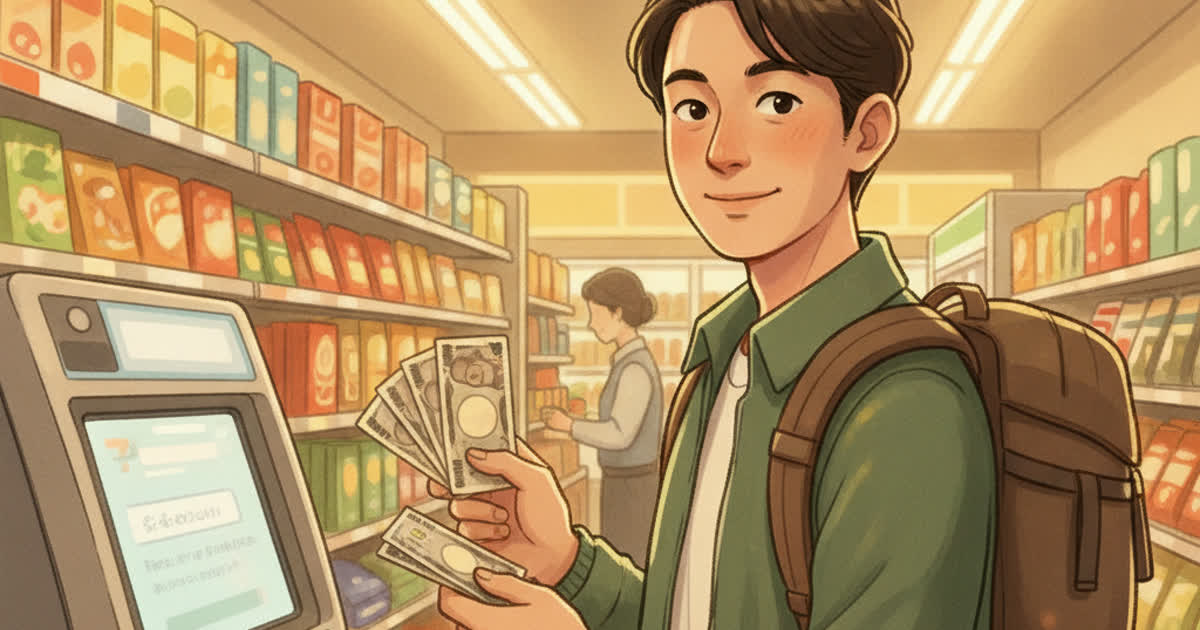
Convenience-store ATMs typically cap a single overseas withdrawal somewhere between ¥50,000 and ¥100,000, depending on your card and network, and your home bank's daily limit sits on top of that — in practice it is usually your own bank's limit that stops you first. Machines dispense ¥10,000 notes, so ask for round numbers. If you are travelling for a fortnight and would rather not repeat the exercise every other day, raise your daily withdrawal limit in your banking app before you fly. And a note on the ¥10,000 notes themselves: they are entirely normal to spend at a convenience store or restaurant, so there is no need to break one nervously — the konbini counter routine takes about twenty seconds either way.
What should you do if the ATM rejects your card?
Walk to a Seven Bank machine before you assume anything is wrong with your account, because most refusals are the machine rather than the card. If it fails there too, work through four things. Your PIN must be four digits — Japanese ATMs expect exactly four, and a six-digit PIN will not be accepted. Choose the credit or savings account when the screen asks; a lot of overseas cards fail on "checking." Check that your bank has not blocked the transaction as unusual foreign activity, which is the most common silent cause and often fixable from the app in a minute. And confirm your card is enabled for overseas cash withdrawal at all, which is a separate switch from overseas spending on many accounts. The 55-second version of this problem is in the reel above, and if you would rather not keep hunting for machines, our guide to why Japan still runs on cash explains how much to carry.
How do you ask if a machine takes a foreign card in Japanese?
One sentence solves it: 海外のカードは使えますか? (kaigai no kaado wa tsukaemasu ka) — "can I use a foreign card?" Say it to the clerk at the convenience-store counter or the post-office window, gesture toward the machine, and you will get a clear yes or no. 海外のカード (kaigai no kaado) means a card from abroad, and 使えますか (tsukaemasu ka) means "can it be used?" — the same ending you can attach to almost anything. To find a machine in the first place, ask ATMはどこですか? (ATM wa doko desu ka), "where is the ATM?" And when you are paying rather than withdrawing, the same construction becomes the question about paying by card that you will use at half the restaurants you visit.
Once you know the split, cash in Japan stops being a problem and becomes a two-minute errand. Withdraw a chunk at a 7-Eleven when you land, decline the currency conversion, keep the ¥10,000 notes in a wallet rather than a pocket, and refill at the next konbini when you are down to your last note. From there the rest is spending it — at a ramen ticket machine, which really is cash-first at most shops, or at a tax-free counter, where your passport matters more than your card does.