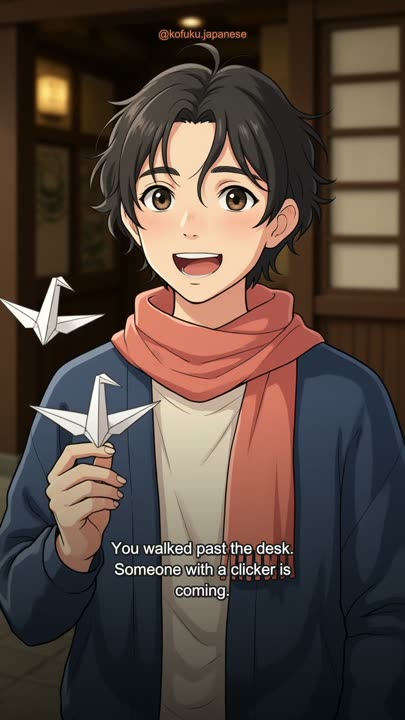
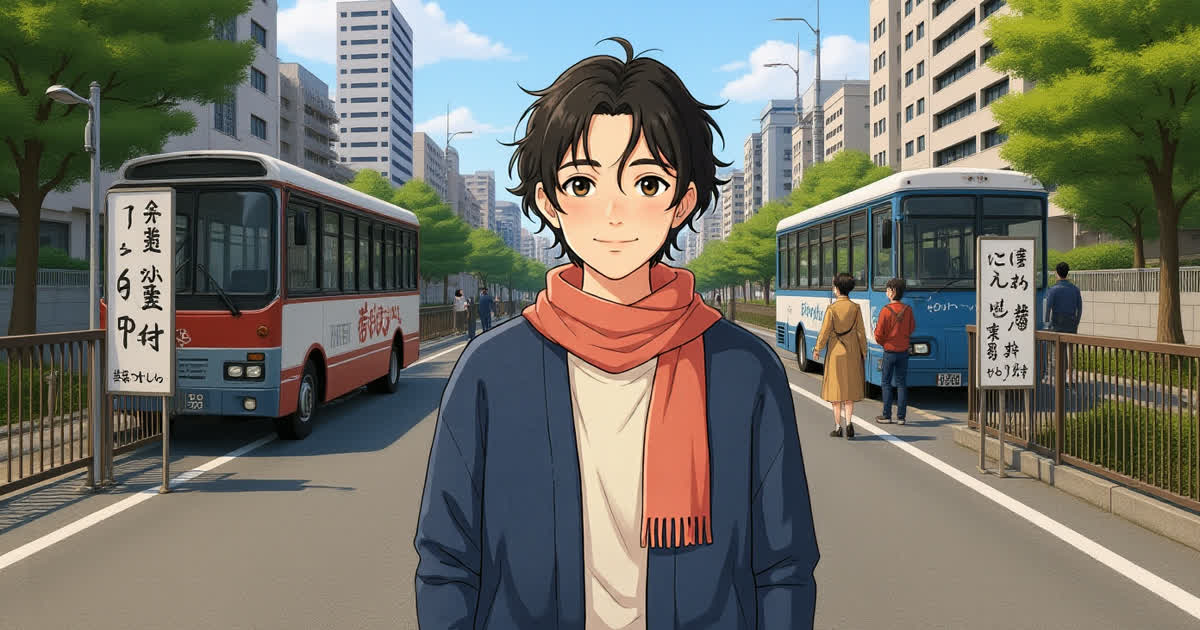
Two buses pull into the same Kyoto stop with the same number on the front. One of them is going the long way round the loop. The reel above is thirty seconds of that freeze: you are about to board, and the digits on the glass are not enough. This page is the sentence that settles it, how to read the destination board, and what the driver says when you have the wrong one.
How do you ask if this Japanese bus is going to your destination?
Stand at the door, catch the driver's eye, and ask このバスは金閣寺に行きますか? (kono basu wa Kinkaku-ji ni ikimasu ka), "does this bus go to Kinkaku-ji?" Swap the place name for wherever you are actually going: a temple, a station, a hotel. Lead with すみません (sumimasen). The frame is always the same: このバスは〜に行きますか (kono basu wa ~ ni ikimasu ka). Do this before you step on. Once you are on a Kyoto loop, the other direction is not a short correction — it is the scenic hour. Point at the name on your map if the pronunciation wobbles. Drivers on tourist routes hear this sentence all day and will answer it in one beat.
Why do two Kyoto buses have the same number?
Because Kyoto's loop routes — 循環 (junkan) — run clockwise and counter-clockwise under a single route number. A 205 or a 206 on the glass names the loop, not the way around it. Two buses can sit at the same pole, both showing that number, and one of them is going toward your temple while the other will get there after the long half of the city. The number is a family, not a destination. That is the trap the reel is built on. City-centre Kyoto buses are a flat fare, which makes it even easier to board the first matching number and sit down. The fix is the board and the sentence, not a better guess. Paying once you are on is a separate problem; how to pay on a Japanese bus covers the fare box and the ticket. This page is only "is this the one."
How do you read a Japanese bus destination board?
Read the 行先 (yukisaki, destination) panel on the front and the side, not the route number. Look for a place name plus 行き (yuki, "bound for"), or 方面 (hōmen, "toward"). On a loop, those names are the only honest signal: the same digits can sit above two different place names. Tourist-area buses often cycle the board in English as well, so wait for the flip if the first pass is all kanji. If the board names a place you are not going, it is the other bus, even when the number matches. The same discipline — read the header, then the rest — is how you pick the right column on a Japanese bus timetable at the pole before the bus even arrives.
What does the driver say if it is the wrong bus?
You will hear いいえ (iie, no), often as いいえ、反対側です (iie, hantaigawa desu), "no, the opposite side," with a nod toward the other stop or the pole across the street. はい means board this one. That pair is the whole conversation. Do not argue, do not mime a bigger question, and do not get on "just to see." Step back, thank them with すみません, and take the nod as the answer. If you missed the Japanese, the nod is enough: the other curb, or the next bus at this pole. The ask-for-directions pattern uses the same opener, and the same small bow, when you are not at a bus door.
Where should you stand when two loop buses share a stop?
Follow the nod, not the number. Some Kyoto loop stops put both directions at one pole; others put them on opposite sides of the road, each with its own 行先 sheet under the stop name. 反対側 (hantaigawa) means cross and wait there. If both buses are at the same curb, stay on the pavement until you have asked, then board the one the driver confirmed. Do not split the difference by hovering in the door. The next matching number is not a retry of the same bus — it may be the other direction again. Watch the board as it pulls in, ask, then commit. A wrong board is cheaper to refuse at the curb than to ride for forty minutes.
Can you use this phrase outside Kyoto?
Yes. このバスは〜に行きますか works on any local bus in Japan — Tokyo, Osaka, a mountain village. The loop-number trap is a Kyoto special, but the sentence is the same anywhere a number is not enough: a branch, a short working, a bus that terminates early. Rural poles make the stakes higher, because the next departure may be an hour away, which is why reading the printed timetable on the pole matters as much as the spoken check. Ask before you board, every time the destination is not obvious from the glass. The frame does not change. Only the place name does.
How do you ask which stop to get off at?
Once you are on the right bus, ask 金閣寺は次ですか? (Kinkaku-ji wa tsugi desu ka), "is Kinkaku-ji next?" or say 金閣寺で降ります (Kinkaku-ji de orimasu), "I'll get off at Kinkaku-ji." Press the 降車ボタン (kōsha botan, stop button) when the stop is announced — not as the bus is already pulling in. If you cannot hear the announcement, the driver already has your stop from the question, and a second すみません at the front as you walk up is enough. Getting off is the easy half; boarding the wrong loop is the expensive one. If the next bus is not yours and you are done waiting, telling a taxi where to stop is the two-word backup.
Carry three habits to a Japanese bus stop. Read the destination board before the number. Ask このバスは〜に行きますか before your foot hits the step. Treat 反対側です as a gift, not a scolding. Do that and Kyoto's loops stop being a coin toss and start being what locals already treat them as — two products that share a number, and a driver who will tell you which one you are looking at. Watch the 60-second version of the question before your first ride, and keep the seiriken fare-box rule for the moment after the doors close.