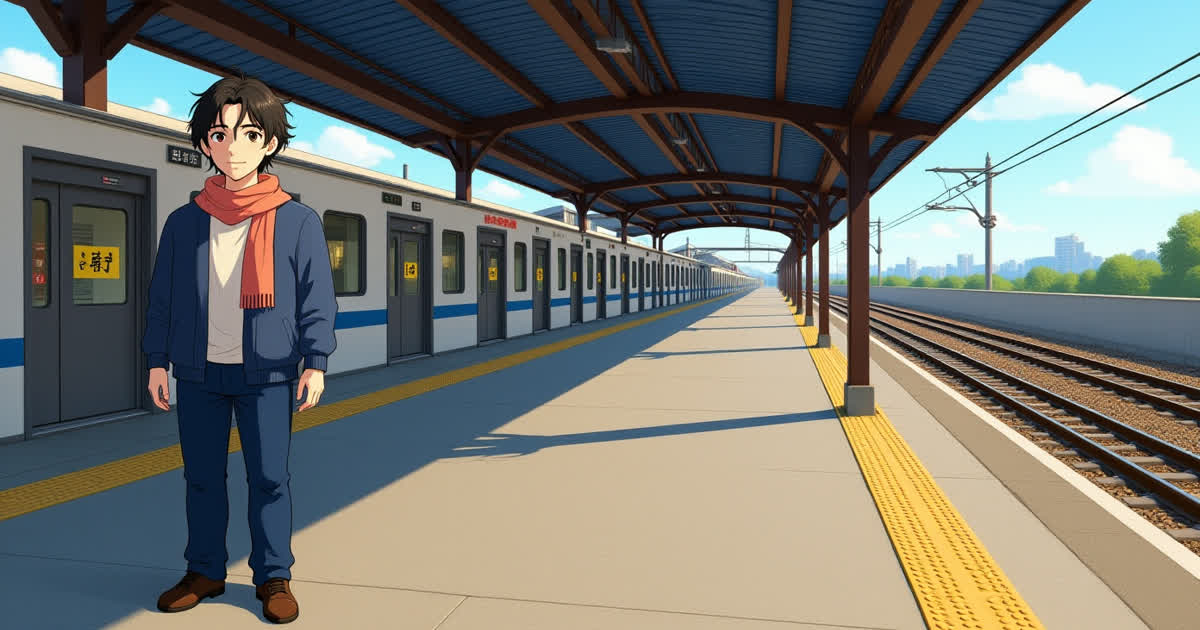
The reel above, published 17 October 2026, is the all-clear on a Japanese platform. You bought a spare ticket because the line had stopped. Then the speaker says 平常運転に戻っております, and the train you already meant to take is the one that moves. This page is that sentence: what the words mean, how to hear 平常 and not 非常, and why trains that have started again can still be late.
What does 平常運転に戻っております mean on a Japanese train?
平常運転に戻っております (heijō unten ni modotte orimasu) means service has returned to running the way it usually runs. Shogakukan's Digital Daijisen, on Kotobank, checked 25 October 2026, reads 平常 as へい‐じょう〔‐ジヤウ〕 and defines it as being the same as always, the ordinary state. The same entry's examples are 脈拍が平常に戻る, a pulse returning to its ordinary state, and 平常通り運行する, a service running as usual. Daijisen defines 運転 as operating a train or a car so that it runs. に marks the state the service returns to. 戻っております is the polite announcement form of 戻っている: the return has happened, and that is the state now. The railway is speaking about its own trains. The reel's English for the line is the same claim: service is back to normal. You do not say this line. You catch it. When you hear it, the pause is over, and the train you were already waiting for is the one to board.
How do you pronounce 平常運転に戻っております?
Say he-i-jō u-n-te-n ni mo-do-t-te o-ri-ma-su, seventeen beats: へ, い, じょ, う, う, ん, て, ん, に, も, ど, っ, て, お, り, ま, す. Daijisen's headword is へい‐じょう〔‐ジヤウ〕. The small ょ does not add a beat. じょ is one, and the う after it is the second, the long ō. A short heijo drops that beat. 平 here is hei. The name reading taira, and hira in 平仮名 (hiragana), are other readings of the same kanji. 常 is jō. 運転 is unten, four beats, う, ん, て, ん, and both ん count. No vowel in 運転 is long. に is the particle ni. 戻って is modotte: も, ど, っ, て. The small っ doubles the t, and it does count as a beat. That small っ belongs to 戻る, to return. The other verb, 戻す, to put something back, would be 戻して, with し and no small っ. おります is four beats, and the final す stays. There is no か. The line is a statement. The railway is telling you. You are not being asked.
How is 平常 different from 非常?
平常 (heijō) and 非常 (hijō) share 常 and a long ō. The first mora is the difference you can hear. 平 starts with へ (he). 非 starts with ひ (hi). Daijisen, checked 25 October 2026, reads 非常 as ひ‐じょう〔‐ジヤウ〕. It is a noun and a na-adjective. The emergency sense, the one that contrasts with 平常, is 緊急の事態, an urgent situation. A separate sense is 普通でないこと, something out of the ordinary, which is why 非常に means extremely. 平常 is the same as always. On a platform, 非常停止 (hijō teishi) means emergency stop. The button is 非常停止ボタン (hijō teishi botan), and that page is a different problem. The button asks the railway to stop trains. 平常運転 is the speaker telling you the trains are back on their ordinary run. If the first syllable was hi, you heard the emergency word. If it was hei, you heard the all-clear. Do not walk toward a red button because the speaker said the trains are fine.
Is 平常運転 the same as 運転再開?
No. 運転再開 (unten saikai) means operation has started again. It does not say the timetable is back to ordinary. JR East's official limited-express operations account, on 12 October 2026, posted that Hitachi 19, 20, and 21, ひたち, had been held for a 人身事故 (jinshin jiko), a person struck by a train, on the 常磐線 (Jōban Line). Around 17:38 Japan time the same post said 運転を再開し遅れがでています: operation had resumed, and those trains were still late. 再開 means start again. Daijisen's examples for 平常 are a return to the usual state, including 平常通り運行する, a service running as usual. A status line from the public-transit open-data center, reported by The HEADLINE on 24 June 2024, said the Tokyo Metro Hanzomon Line had delays from crowding and had then 平常運転に戻っている, returned to normal operation. Hear 再開 and you may still be waiting out a delay. Hear 平常運転に戻っております and the ordinary run is what the speaker is announcing.
What do you do with the spare ticket?
The reel is the spare ticket. You paid for a second ride because you thought the first line was finished. This announcement says that line is back to its ordinary run, so the spare is the ride you did not need. Stay with the ticket you already meant to use. If the spare is still unused, take it to a staffed window before you board and ask whether it can be returned. Ticket types differ, and this page does not set the fee. A ticket you have already ridden is spent. Do not board the spare train only to make the purchase feel useful. The better moment is the one before you pay. Catch 平常運転に戻っております, and leave the spare unbought. The reel is that moment in 23 seconds.
How is this different from 運転見合わせ and a delay?
運転見合わせ (unten miawase) is the pause. The suspension guide is that word: the trains have stopped, and the operator is waiting. 遅れ (okure) means a train is late and still coming. Boards also print 遅延 (chien) for that same delay, which is the word on a delay certificate. A ten-minute 遅れ still ends with your train. 運転見合わせ means nothing on that section is moving yet. 平常運転に戻っております is the sentence after those. The hold is over, and the run is the ordinary one. If the speaker is still saying 見合わせ, do not treat the line as clear. If the only news is a number of minutes, you are in a delay, and the certificate is a later step once you have arrived. If you caught 平常, board the train you already had.
平常運転に戻っております。 Service is back to normal. The short reel is that all-clear.