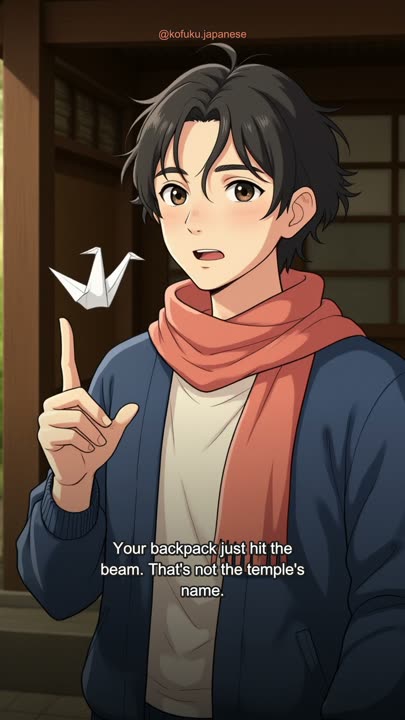
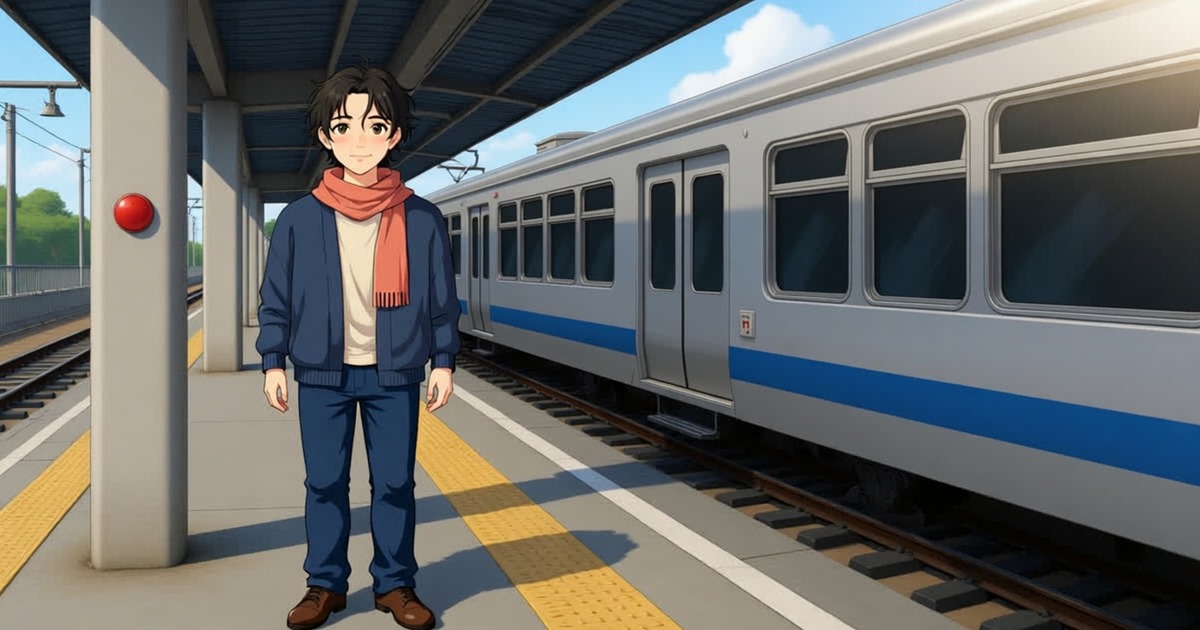
The red button on the platform is not a door opener. The reel above, published 9 October 2026, stops on the label 非常停止. The line in the reel is これは非常停止ボタンです。押すと、電車が止まります。 (Kore wa hijō teishi botan desu. Osu to, densha ga tomarimasu): this is an emergency-stop button, and the press is how the trains get stopped. This page is what the four characters mean, when that press is the right one, and why your feet stay on the platform.
What does 非常停止 mean on a Japanese train platform?
非常停止 (hijō teishi) means emergency stop. 非常 (hijō) is the emergency itself. Shogakukan's Digital Daijisen, on Kotobank, checked 12 October 2026, defines it as an abnormal, pressing state, and also as an unexpected emergency. 停止 (teishi) is that dictionary's word for a moving thing coming to a halt partway, and also for stopping it. The example it prints is 車を停止する (kuruma o teishi suru), to stop a car. On a platform the four characters name one control. The Ministry of Land, Infrastructure, Transport and Tourism, Railway Bureau, calls that control a 列車非常停止装置 (ressha hijō teishi sōchi), a train emergency-stop device, and the button a 非常停止押しボタン, in the handbook 鉄道の安全利用に関する手引き, dated March 2010 and checked on mlit.go.jp on 12 October 2026. Equipment and handling can differ by railway. Where a platform prints 非常停止, those characters mean emergency stop.
How do you pronounce 非常停止?
Say hi-jō, then te-i-shi. In kana the word is ひじょうていし, six beats: ひ, じょ, う, て, い, し. The ō in hijō is long. It is the う after じょ, and it is its own beat. A short hijo drops that beat and is not the reading. 停止 is te-i-shi. Keep the い. Folding it into "teshi" is a different shape. The reel adds ボタン (botan), button, and 押す (osu), to press. 押すと (osu to) means when you press it. 電車が止まります (densha ga tomarimasu) means the trains come to a stop. You write は in これは and you say wa. The line is a statement. It does not end in か. To ask a person, say これは非常停止ボタンですか。 (Kore wa hijō teishi botan desu ka.)
What happens when you press the red 非常停止 button?
The press asks that station to stop trains. JR East safety-planning section chief Matsumura Akihiko told Toyo Keizai, in the article published 22 December 2020, what his railway's button does. On ATC lines, including the Yamanote and the Keihin-Tōhoku, the brakes come on by themselves right after the press. A train still some way off can stop before it arrives. On JR East lines that are not ATC, a red lamp on the platform lights when you press, the driver sees it, and the driver applies the emergency brake. He said the lag is almost none, and the button sounds a beep. The national handbook adds that a train cannot stop immediately. The reel's 電車が止まります is the result the signal is there to get. Which trains stop, and whether a computer or a driver brakes, belongs to that railway.
When should you press 非常停止, and when should you leave it alone?
Press it when a train has to stop now. The March 2010 handbook says that when you see a person who has fallen from the platform onto the tracks, or another case where a train must be stopped in a hurry, and that station has a 列車非常停止装置, use it without hesitating, or tell a nearby staff member at once. The button is only for that hurry. When you need to reach the staff, use the 連絡装置 (renraku sōchi), the intercom. A phone or a wallet on the tracks is that call. A door that will not open is a different control. 半自動 (hanjidō) means semi-automatic, and the door guide is that sticker. A press made as a prank, or for anything that is not an emergency, makes trains late while staff confirm it is safe, bothers the people around you, and can be punished by law. See the label, and leave the button alone, unless someone is in danger on the tracks.
What do you do after you press the button?
Stay on the platform. The handbook says that after you press the device you still must not go down onto the tracks. A train cannot stop at once, and climbing down can put you in front of it. JR East's official account, on 18 December 2024, gives its passengers the same order for a fall: press 非常停止ボタン, staff come running, and you do not enter the tracks. That post is JR East. The ban on climbing down is the handbook's line for every railway that uses the device. Tell the first staff member what you saw. Say すみません、人がホームから落ちました。 (Sumimasen, hito ga hōmu kara ochimashita.) Point at the spot. If you pressed the button, add 非常停止ボタンを押しました。 (Hijō teishi botan o oshimashita.) Then do what the staff say. The yellow strip at the edge is a separate order to step back before a train arrives. That announcement is the yellow-line page.
How is 非常停止 different from a train door button?
A door button opens a door. 非常停止 (hijō teishi) asks the railway to stop trains. The reel opens on that mix-up, because both can be a button beside a train and they do opposite jobs. 半自動 (hanjidō) is the sticker on a door you open yourself when its lamp is lit. A lamp by a door is permission to board. A lamp that lights because you pressed 非常停止, on the JR East lines Matsumura described, is a signal the driver uses to brake. The handbook files the platform button under platform safety equipment, not under doors. The semi-automatic door page stays on the door. This page stays on the stop.
What do you say to the station staff?
Lead with すみません (sumimasen). For a person on the tracks, say 人がホームから落ちました。 (Hito ga hōmu kara ochimashita.) For the press you already made, say 非常停止ボタンを押しました。 (Hijō teishi botan o oshimashita.) When you need a person and not a stopped train, say 係員を呼んでください。 (Kakariin o yonde kudasai), please call a staff member, or ask インターホンはどこですか。 (Intāhon wa doko desu ka), where is the intercom? 係員 (kakariin) is the handbook's word for the staff. The intercom is the 連絡装置 it tells you to use when the job is contact, not a stop. For a medical emergency or a crime, call 119 for an ambulance or a fire and 110 for the police. That call is the emergency-number page. Neither number replaces this button when someone is on the tracks.
非常停止 means emergency stop. Press the button when a person is on the tracks or a train has to stop now, then stay on the platform. For anything less, leave it alone.