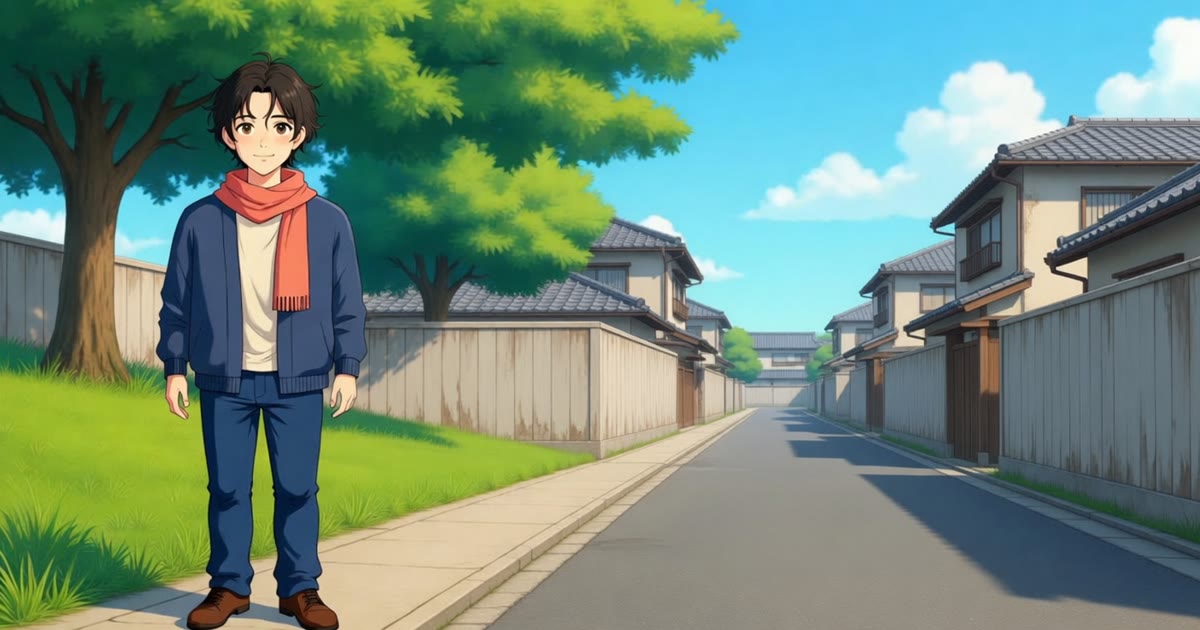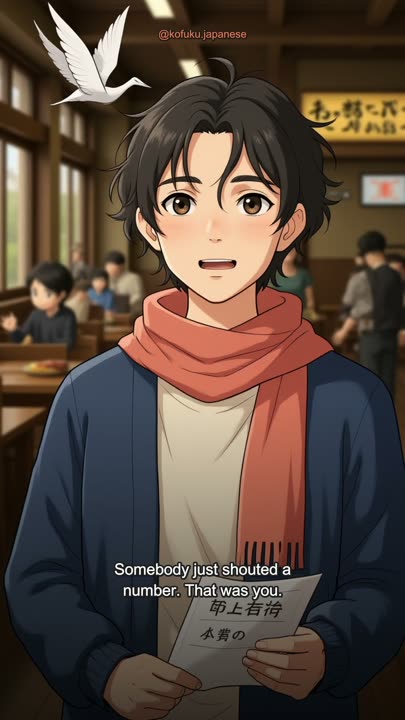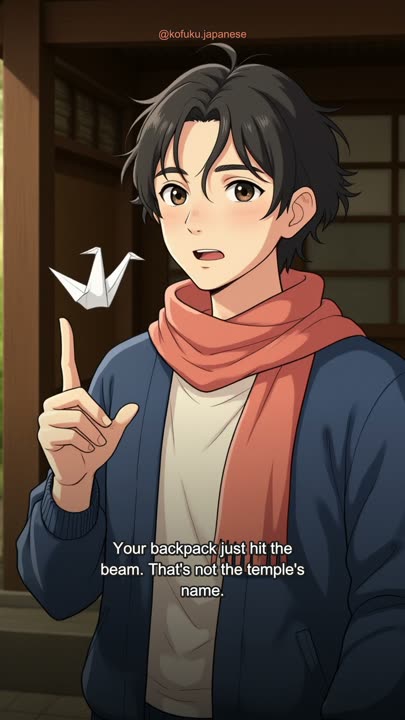
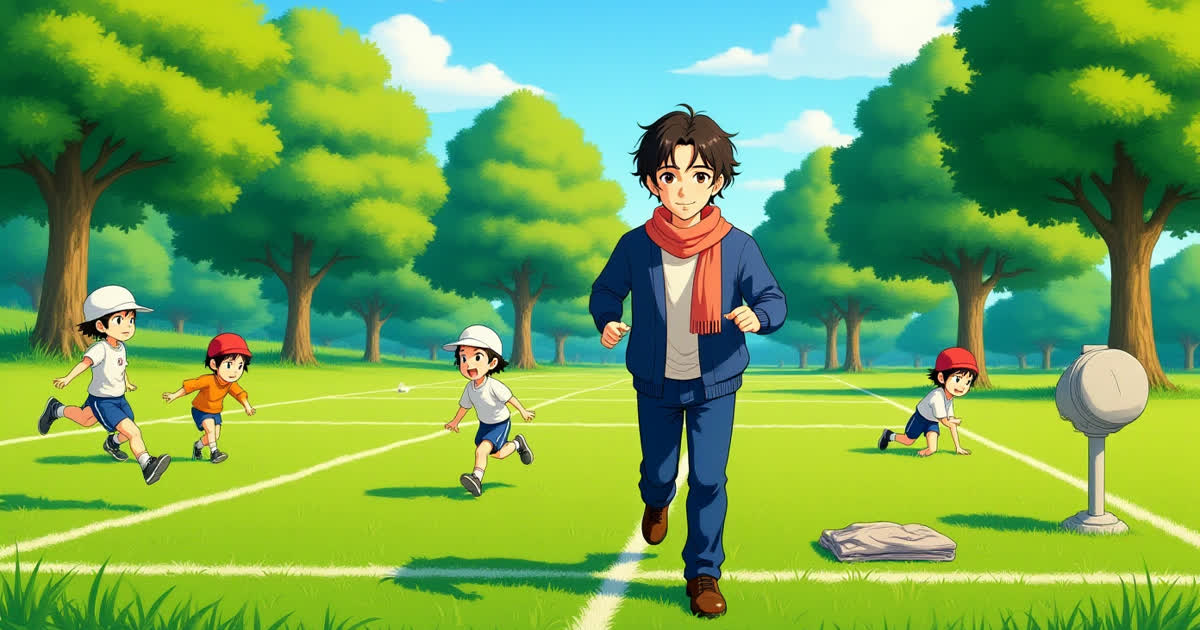
The reel above, published 8 October 2026, is a neighborhood park. The blanket is on the open grass, and a relay is about to run through it. The line in that reel is 運動会ですか? This page is that question: what the meet is, how to see that the lawn is the course, and what to say before you sit.
What does 運動会ですか mean at a Japanese park?
運動会ですか? (Undōkai desu ka?) asks if this lawn is a school sports day. Shogakukan's Digital Daijisen, on Kotobank, checked 10 October 2026, defines 運動会 (undōkai) as a gathering where many people enjoy athletic contests and games, at a school, a workplace, or in a neighborhood. The dictionary marks that sense as an autumn seasonal word. The same entry notes an older meaning, a picnic or an outing, which dropped away around 1897 as the word settled on the school meet. In the park, the current meaning is the one that matters. The grass that looked free is the course. A second dictionary sense, the athletic-club association at a university, is not what a banner in a neighborhood park means.
How do you pronounce 運動会?
Say it in six beats: u-n-do-o-ka-i. The o is long: undōkai. 運動 (undō) is exercise or movement. 会 (kai) is a gathering. Keep the long o. A short "undo-kai" sounds like the English verb undo, and it is not this word. ですか (desu ka) turns the noun into a polite yes-or-no question. The full line in the reel is 運動会ですか? (Undōkai desu ka?), "Is this a sports day?" The u in desu is quiet in ordinary speech. You still write it. Digital Daijisen prints the historical spelling クワイ beside 会. Say kai. That historical kana is not the modern pronunciation.
Why is the open grass the course?
The meet is built on the open lawn. A リレー (rirē, relay) and a 徒競走 (tokyōsō, foot race) need a straight lane, and that lane is the grass that looked empty. Britannica's entry for 運動会, on Kotobank, checked 10 October 2026, lists foot races, obstacle races, relays, 玉入れ (tamaire, ball toss), and dance among the things a meet can include. The running events are the ones that cross a picnic. The ball toss stays by a basket. If children are lined up at one end of the grass, the whole rectangle is the course, including the middle. A 校庭 (kōtei, schoolyard) behind a school gate is easy to read as closed. A 公園 (kōen, public park) looks like a picnic until the field is marked. That is the reel's case. Pick the blanket up before the first runner starts.
What do the banner, the caps, and the tape tell you?
Four things mark a lawn that is already a meet. A banner or a board that reads 運動会. Matching caps. A taped or painted line, a 白線 (hakusen). A loudspeaker on a stand. NHK's Broadcasting Culture Research Institute asked 1,748 people, from December 2006 to January 2007, what they called the two-color cap at their elementary school. The 1 June 2007 report says 60 percent answered 赤白帽 (akashiro-bō) and 29 percent answered 紅白帽 (kōhaku-bō), the second more often in eastern Japan, especially Hokkaido and Tohoku. Some schools use another color pair, or another name such as 体育帽 (taiikubō). The teams are often 紅組 (akagumi) and 白組 (shirogumi). 赤組 is the same red team with the other kanji, and it is also akagumi. You do not need the team name. Matching caps plus a line on the grass means the lawn is taken. The chairs along that line are the families' row.
When is Sports Day in 2026, and is every park a race that weekend?
スポーツの日 (Supōtsu no Hi) is Monday 12 October 2026. The Cabinet Office list, checked 10 October 2026, gives that date, and the law sets the holiday as the second Monday of October. Saturday 10 October through Monday 12 October is the three-day weekend. The holiday is not the meet. The same office says the day began in 1966 as 体育の日 (Taiiku no Hi), on 10 October, for the 1964 Tokyo Olympics opening. It moved to the second Monday in 2000, and the name became スポーツの日 in 2020. That page also records 24 July 2020 and 23 July 2021 as one-year Olympic moves. Those July dates are over. Each school sets its own meet. Gakken Kids Net, 6 October 2023, quotes Aoyama Gakuin professor Kimura Gen on that point. Their parent survey of 179 people, from 30 August to 12 September 2023, split spring 51 percent and autumn 49 percent. May was 37 percent and October was 31 percent. A banner, not the calendar, tells you this lawn is in use.
How is 運動会 different from スポーツの日 and from 体育祭?
スポーツの日 is the national holiday. Offices close, and trains fill. The three-day weekend page is that travel crush. 運動会 is the meet on a field, on a holiday or on an ordinary Saturday. Nipponica, on Kotobank, checked 10 October 2026, notes that junior-high and high schools often call the day 体育祭 (taiikusai). Elementary schools and kindergartens more often print 運動会. The split is a custom, not a second event. If the banner says 体育祭, the grass is still the course. Ask the same question, or point at the banner. Digital Daijisen includes a workplace and a neighborhood in the definition, not only schools. Adults in matching shirts and a taped lane are the same problem for a picnic.
What do you say before you spread the blanket?
Lead with すみません (sumimasen) when you need a parent or a teacher to look up. The すみません page is that opener. Then ask 運動会ですか? If the answer is yes, pick up the blanket. For the spot under your feet, say ここに座ってもいいですか? (Koko ni suwatte mo ii desu ka?), "May I sit here?" To name the lane, say コースですか? (Kōsu desu ka?), "Is this the course?" For a free spot, say どこに座ればいいですか? (Doko ni suwareba ii desu ka?), "Where should I sit?" Use the place they point to, outside the tape. Do not take a chair in the families' row. A fireworks lawn is a different case. The fireworks guide is a viewing spot, where sitting is the point. A shrine crowd is a visit, and the shrine prayer page is the bow. Matching caps on a park field are a school meet. The open grass is the course until the meet ends.
運動会ですか? means the lawn may be a course. The banner, the matching caps, the taped line, and the loudspeaker are the proof. スポーツの日 in 2026 is Monday 12 October, and a banner that says 体育祭 is the same kind of field.