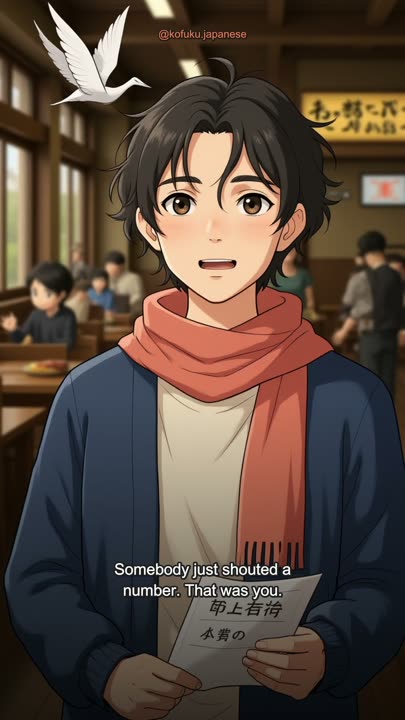
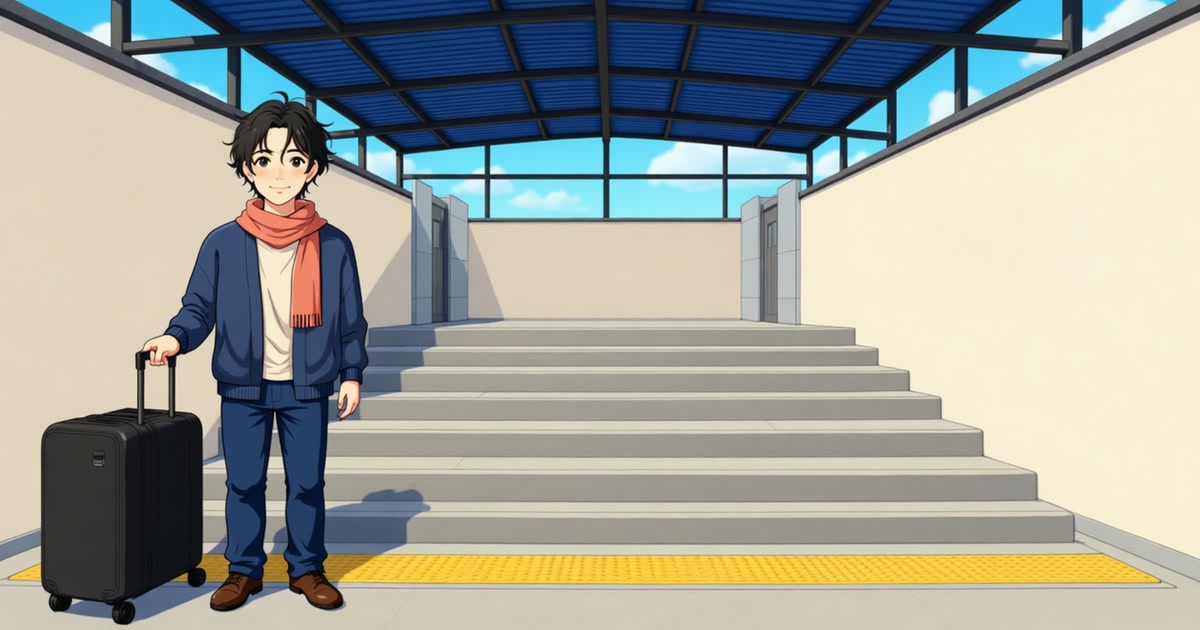
The reel above, published 19 October 2026, is one station and two doors that do not share a street. Your note says Exit 35. The staircase in front of you says Exit 3. The line is 何番出口ですか。 This page is that question: what the number names, how to say it, and the station lines people use in its place.
What does 何番出口ですか mean at a Japanese station?
何番出口ですか (nanban deguchi desu ka) means "Which exit number?" That is the reel's English. 何 asks which, and in this compound it is nan, not nani. 番 (ban) is the counter. Digital Daijisen, on Kotobank, checked 25 October 2026, gives the suffix 番 the job of marking order or rank among many things. The examples are 成績は一番だ and 二番目. Other senses in that entry are a turn and a watch, as in 荷物の番をする. The sign uses the counter. 出口 (deguchi) is the door. Daijisen's headword is で‐ぐち, and the definition is 内から外へ出る口, the opening you use to go from inside to outside. The opposite in that entry is 入り口 (iriguchi). The Seisen Nihon Kokugo Daijiten, on the same Kotobank page, defines 出口 as the opening made so you can go outside, and it also records the form でくち. The station word, and Daijisen's headword, is でぐち. 字通 reads these two kanji しゅっこう, spelled しゆつこう in that entry, and glosses them as 出言, an utterance. That is a different word. Do not say shukkō for the door. ですか makes the line a polite question. The reel's next line puts the apology in front: すみません、何番出口ですか。 (Sumimasen, nanban deguchi desu ka.) Excuse me, which exit number? Ask it before you pick a staircase. The number on the sign is that door's own label. It is not a count of how many doors you have already passed.
How do you pronounce 何番出口ですか?
Say na-n-ba-n de-gu-chi de-su ka, ten beats: な, ん, ば, ん, で, ぐ, ち, で, す, か. 何 before this counter is なん. "Nani-ban" adds a vowel the word does not have. 番 is ばん. The ん before ば sounds like an m, and the kana is still ん. Both ん are their own beats. Drop either one and the line comes out short. 出口 is three beats. The 口 voices to gu, which is why Daijisen writes ぐち. "Dekuchi" keeps the k the compound drops. Every vowel in 何番出口ですか is short. There is no macron. です is two beats, and the う in す still counts when it is only a whisper. か is the question particle. Leave it off and 何番出口です is not a question, and it still names no number. The fuller line adds すみません in front, five beats: す, み, ま, せ, ん. That ん is a third one. Keep it.
Why are Exit 3 and Exit 35 not neighbors?
The digits are labels, not a walking order. Tokyo Metro's Ikebukuro station map, revision dated March 2026, lists Exit 3 with 池袋西口公園 (the west-exit park), Tokyo Metropolitan Theatre, Hotel Metropolitan, and Lumine Ikebukuro. The same map lists Exit 35 with 池袋駅東口交番 (the east-exit police box) and Sunshine City, and it marks an elevator from that exit up to the street. The park name and the police-box name put the two doors on opposite sides of the station. JR East's JRE Media guide, page updated 25 September 2026, says its walk figures are as of December 2025. Sunshine City is about an 8-minute walk from Exit 35. From JR Ikebukuro's central gates 1 and 2, the same guide puts about 3 minutes to reach Exit 35, and about 11 minutes to Sunshine City by that path. Exit 35 connects underground from the JR, Tokyo Metro, Seibu, and Tobu gates. A sign that says 3 is not a shorter door to 35. The same March 2026 map also lists doors such as 1a, 2b, C8, and C9. A letter before the number, or a small letter after it, is a different staircase. On that list, an asterisk marks a door with limited hours. Exit 1a and Exit 2a carry the mark. Exit 3 and Exit 35 do not.
How is 何番出口ですか different from 何番線ですか?
何番線ですか (nan-ban-sen desu ka) asks which platform number. That question is the which-platform reel. 線 (sen) is the track. 出口 is the door out to the street. Both lines use 番, and they number different things. Staff who hear 何番線 point along the platform. Staff who hear 何番出口 point at a staircase that leaves the station. 方面 (hōmen) is a third label, and the direction page is the header over the platform you are already standing on. 新宿方面 can still be your train when Shinjuku is not your stop. It does not name a street door. 反対側です (hantai-gawa desu) means "It's the other side." The other-side page is that sentence. Staff point across the tracks. The words do not carry an exit number. When a hotel message names a number, ask 何番出口ですか before you climb.
How is a numbered exit different from 東口で待っています?
東口で待っています (higashi-guchi de matte imasu) means "I'll be waiting at the east exit." A friend texts it so the two of you pick one side of a large station. 東口 (higashi-guchi) is the east exit as a compass name. 口 voices to guchi, the same change as in 出口, and 東 is higashi, not azuma. で marks the place. 待っています is the polite "I am waiting." 西口 (nishi-guchi) is the west exit. Exit 3 on the March 2026 map is listed with the west-exit park. Exit 35 is listed with the east-exit police box, so that door is on the east side of Ikebukuro. It is still not every door on that side. The east side has many numbers. Walking to "the east exit" because the note said 35 can leave you at a different staircase on the same side. If the answer you get is only 東口です (higashi-guchi desu), "it's the east exit," ask the number again: 35番出口はどこですか。 (Sanjūgo-ban deguchi wa doko desu ka.) Where is exit 35? 三十五 is sanjūgo. The う in じゅう is its own beat. "Sanjugo" drops it. 番 stays ban.
What do you do once staff give you the number?
Follow the sign that matches, not the busiest staircase. Repeat it back: 35番出口ですね。 (Sanjūgo-ban deguchi desu ne.) Exit 35, right? Then walk until the sign shows that same mark, letter included. At Ikebukuro, Exit 3 and Exit 35 open on opposite sides of the station, so the nearer staircase can be the wrong street. A starred door on the March 2026 map has limited hours, so read the plate before you count on it. 非常口 (hijōguchi) is the emergency exit. Daijisen lists it among the words that sit near 出口. It is the door for getting out in an emergency, not a numbered street exit. The ō in 非常 is long: ひ, じょ, う, then ぐ, ち. The character 口 on that sign does not make it Exit 3.
何番出口ですか。 means which exit number. The digits are labels, and Exit 35 is not the door next to Exit 3. The 30-second version is the same question, asked before you pick a staircase.