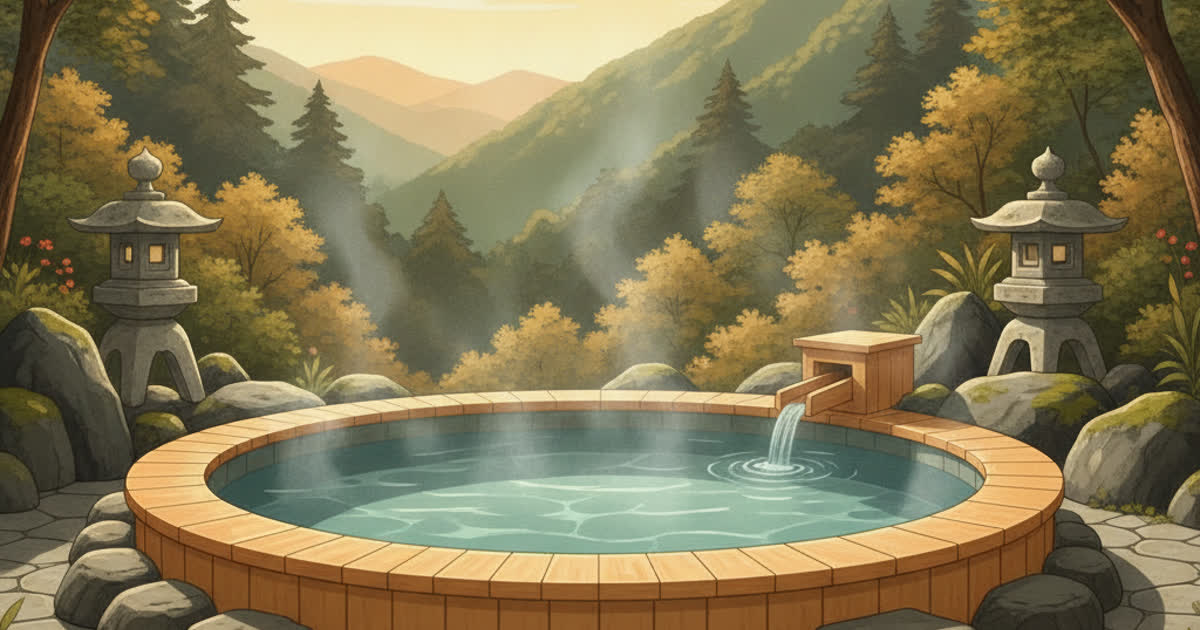
The best baths in Japan are attached to inns you probably cannot afford to sleep in. A room at a famous ryokan (traditional inn) can run 40,000 yen a night, and travellers look at that number, sigh, and scroll past the photo of the steaming open-air bath. They should not: the bath itself is usually on sale separately for about a thousand yen, in the afternoon, to anyone who walks in and asks the right question.
Can you use a ryokan or hotel onsen without staying the night?
Usually yes, and it is an ordinary transaction rather than a favour you are extracting. Between checkout in the morning and check-in in the late afternoon, an inn has hot water, empty baths and staff on duty, so most of them sell that gap to the public. Small municipal bathhouses, big spa complexes and the majority of hot-spring hotels all do it. The exceptions are worth knowing: some very exclusive inns reserve their baths for room guests, some suspend day-use entirely on weekends, holidays and through the New Year rush, and a few take day visitors by reservation only. That means a quick check — the property's website, a phone call, or simply asking at the desk — before you plan an afternoon around one specific bath.
What does 日帰り入浴 (higaeri nyūyoku) mean?
It means "day-trip bathing" — soaking without sleeping over. 日帰り (higaeri) is the standard word for a there-and-back day trip and 入浴 (nyūyoku) is bathing, so 日帰り入浴 (higaeri nyūyoku) is the term you will see on signs, banners and booking sites. Three other phrasings mean the same thing to a traveller: 立ち寄り湯 (tachiyori-yu, "drop-in bath"), 外来入浴 (gairai nyūyoku, "outside-visitor bathing"), and 日帰り温泉 (higaeri onsen) for places built for day guests in the first place. Any of those words on a board outside an inn is an open invitation to walk in.
How much does day-use of a Japanese onsen cost?
Budget 500 to 1,500 yen per adult, in cash, at the front desk. A neighbourhood or municipal bath sits at the bottom of that band; a well-known inn with a river-view 露天風呂 (rotenburo, open-air bath) will ask 2,000 to 3,000 yen, and a 貸切風呂 (kashikiri-buro, private bath) booked by the hour costs more again — often 2,000 to 5,000 yen for the room rather than per person. The bathing fee is called 入浴料 (nyūyokuryō), and it is the whole price: no service charge, no tipping, no minimum spend. Say 大人一人です (otona hitori desu, "one adult") when they ask, and hand over the coins.
What hours can you use an onsen for the day?
The typical window is about 11:00 to 15:00, and the number that really governs your afternoon is the 最終受付 (saishū uketsuke, last admission) — usually 30 to 60 minutes before the stated closing time. An inn shuts its baths in the afternoon so staff can drain, scrub and refill them before evening guests arrive, which is why a 15:00 sign can mean a 14:00 cut-off at the desk. Purpose-built day-use spas are far more relaxed, often running to 21:00 or later. When you phone or arrive, the useful question is 何時まで入れますか? (nanji made hairemasu ka?, "Until what time can I go in?"). Then work backwards: you want an unhurried hour inside, not a sprint.
What do you need to bring if you are not staying in the room?
A towel, mainly — you have no room stocked with one. Japanese bathing uses two: a small one you carry to wash with, and a larger one to dry off with afterwards. Almost every place rents or sells both for a few hundred yen, and some advertise a 手ぶら (tebura, "empty-handed") set that bundles them into the fee. Shampoo and body soap are usually already at the washing stations. Beyond that, bring coins for the changing-room lockers, cash for the fee because plenty of desks still do not take cards, and a bag you are happy to leave in a locker. Wear something you can get in and out of quickly; wet hair and a complicated outfit are a poor match.
Do onsen etiquette and tattoo rules still apply to day visitors?
Yes, in full, and being a visitor makes the details matter more rather than less. Undress completely in the changing room, wash and rinse thoroughly at a seated shower first, keep your small towel out of the water, and leave your phone in the locker — those rules are the same ones we walk through in the guide to onsen etiquette and in this reel on the rules tourists break. Tattoo policies are unchanged too: if a bath refuses ink for guests, it refuses it for day visitors, so raise it at the desk before you pay, the way our tattoo guide sets out. Asking while you are dressed costs nothing; discovering the rule in the changing room costs your afternoon.
So the plan is small and it works almost anywhere with hot water: pick an inn you cannot afford, arrive early in the afternoon, and say 日帰り入浴、できますか? (higaeri nyūyoku, dekimasu ka?) at the desk — the exact phrase in the reel above. If the answer is yes you get the same mountain view, the same mineral water and the same silence as the guest paying forty times more, for the price of a coffee and a train ticket. If it is no, the next inn down the road almost certainly says yes. More phrases for moments like this are in the full phrase-video catalog.