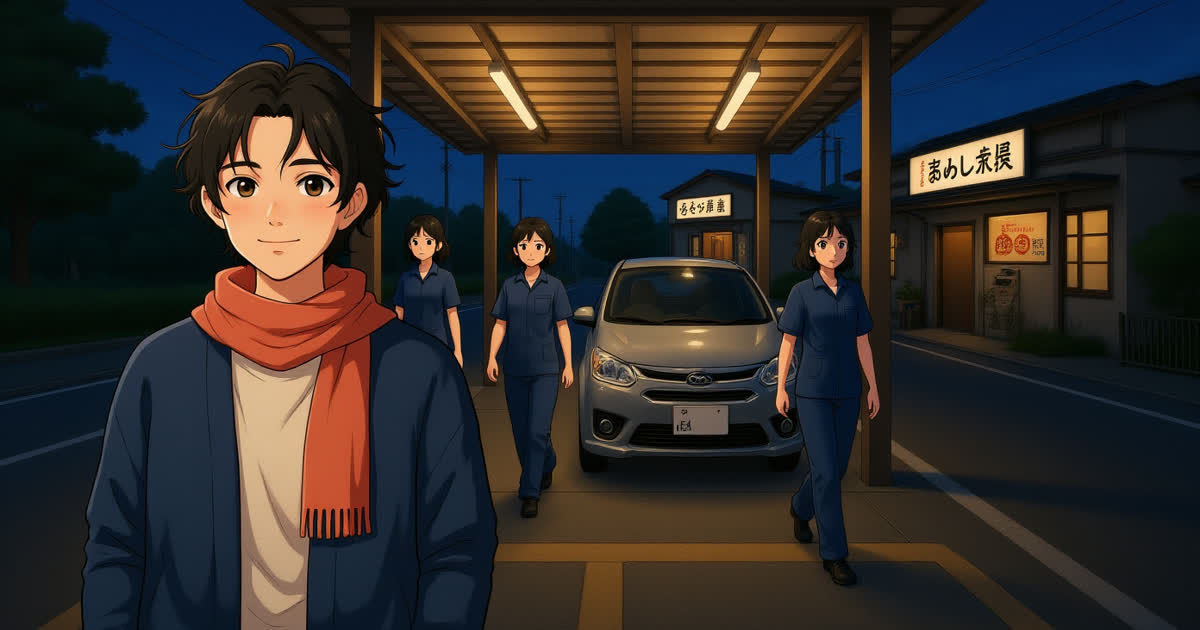
You pull into a rural Japanese petrol stand and three people in matching jumpsuits sprint at the car before the handbrake is on. That is not a problem — it is フルサービス (furu sābisu, full-service), and they are racing to greet you. Roll the window down, stay in your seat, and say one sentence. The reel above teaches レギュラー満タンでお願いします (regyurā mantan de onegai shimasu), "regular, fill it up, please." This page expands that line into the fuel types, the payment, and the self-service version you will meet in cities.
How do you ask for a full tank of regular gas in Japanese?
Say レギュラー満タンでお願いします (regyurā mantan de onegai shimasu) through the open window — that is the whole order, and it is the sentence in the reel above. The attendant usually opens with いらっしゃいませ。何をお入れしましょうか? (irasshaimase. nani o oire shimashō ka?), "welcome, what shall I put in?" You do not have to wait for the question: volunteering the line as they arrive is what locals do. Stay in the car. At a full-service stand the staff open the fuel flap, pump the tank, and often wipe the windscreen while you sit. If you only want a fixed amount instead of a fill-up, swap 満タン for a yen figure: レギュラー三千円分お願いします (regyurā sanzen-en bun onegai shimasu), "3,000 yen of regular, please."
What does レギュラー満タンでお願いします mean?
Word by word it is "regular" + "full tank" + "please." レギュラー (regyurā) is regular unleaded gasoline. 満タン (mantan) blends 満 ("full") with タン from the English word tank, and it is the word staff actually use at the pump — they do not say いっぱい (ippai) for a fill-up. でお願いします (de onegai shimasu) is the polite request ending you already know from every shop counter in Japan. Put the three pieces in that order and you have a complete, natural order. The same frame takes any fuel: ハイオク満タンでお願いします (haioku mantan de onegai shimasu) or 軽油満タンでお願いします (keiyu mantan de onegai shimasu).
What are the fuel types at a Japanese gas station?
Three fuels go in cars, and the nozzle colour is the safety net. レギュラー is regular unleaded, around 91 RON, and it is the red nozzle — most Japanese compact cars and almost every standard rental take it. ハイオク (haioku, short for high-octane) is premium, around 100 RON, usually a yellow nozzle, and it is for sports cars, some imports, and engines that say so on the fuel-flap sticker. 軽油 (keiyu) is diesel, the green nozzle; putting it in a petrol car will stop the engine. A fourth tap at many stands is 灯油 (tōyu, kerosene) for heaters, not cars — never put that in the tank. Open the fuel flap before you order if you are unsure, and show the attendant the sticker. Putting ハイオク in a レギュラー car is only expensive; putting 軽油 in a petrol car is a tow.
How do you tell full-service from self-service in Japan?
Look for the word セルフ (serufu) in huge letters on the canopy — that is self-service, you pump it yourself, and the litre price is a few yen cheaper. If there is no セルフ sign, or you see フルサービス (furu sābisu), staff will come to the window. Full-service is still common on rural roads and older national highways, which is why a rental-car road trip is where visitors meet it. Self-service dominates in cities. If you cannot read the canopy, wait three seconds after you stop: people running at the car means full-service; a quiet forecourt with machines on the pumps means you get out. To confirm, ask ここはセルフですか? (koko wa serufu desu ka), "is this self-service?" The same "where is it" pattern you use asking for directions will also find you the next stand on the road.
How do you pay at a Japanese gas station?
Pay at the window on a full-service stand, after the tank is full, with cash or a card. When they finish, they will ask how you want to pay; say 現金でお願いします (genkin de onegai shimasu) for cash or カードでお願いします (kādo de onegai shimasu) for card. Many rural stands are still happiest with cash, so treat a country road trip like the other cash-first corners of Japan — cards work in far more city shops than they used to, but a mountain-road petrol stand is not one of them. Ask レシートをお願いします (reshīto o onegai shimasu) if you need a receipt for the rental company, or 領収書をお願いします (ryōshūsho o onegai shimasu) if you need the stamped official form. If you are heading into the mountains, withdraw yen at a 7-Eleven ATM first.
How do you use a self-service pump in Japan?
Pay first or follow the on-screen order, pick the fuel, then pump until it clicks off. The screen is often Japanese-only, so the buttons that matter are 現金 (genkin, cash), クレジットカード (kurejitto kādo, credit card), the three fuel names, and 満タン. Regular is the red nozzle, high-octane yellow, diesel green. Touch the black anti-static pad on the pump before you lift the nozzle — Japanese self-service pumps require it. Select 満タン for a fill-up, or a yen or litre amount. The pump stops itself. If you paid cash, take the change from the change machine, which is sometimes a separate box. Do not leave the nozzle in the car and walk away; stay with the pump.
Do rental cars in Japan need to be returned with a full tank?
Usually yes — the standard policy is 満タン返し (mantan-gaeshi), "return it full." Fill up on the way back to the depot, keep the receipt, and hand both over; a missing fill-up is billed at the rental company's own pump rate, which is higher than a roadside stand. Some companies now sell a prepaid "return as-is" option at pickup; if you took that, you can skip the last stop. Check the fuel-flap sticker before the first fill so you do not put diesel in a petrol rental. The last 満タン run is also the moment to use レシートをお願いします, because the paper is what proves you filled it. If you then need a space in town, the phrase for where to park is the next one to have ready.
Once the sentence is in your mouth, a Japanese gas station stops being a panic and becomes a two-minute stop. レギュラー満タンでお願いします at the window, stay in the seat, pay, go. Watch the 33-second version at the pump before you collect the keys, and keep the card-or-cash check for every other counter on the trip.