The first one is always worse than it should be. You are eating in a basement izakaya in Osaka, the glasses start to ring, the floor moves like a boat, and every phone in the room shrieks at once — and then it stops, and the room goes back to its conversation. Japan feels well over a thousand earthquakes a year and treats nearly all of them the way other countries treat rain. The gap between how alarming it feels and how calmly everyone else responds is the thing worth closing before you land.
What should you do during an earthquake in Japan?
Protect your head and stay where you are. Get under a sturdy table if there is one, or crouch low beside something solid, away from windows, glass doors, tall shelves and anything hanging. Do not run outside while the ground is moving: in Japan the danger is falling glass, roof tiles and signage on the street, not the building itself, which is engineered to sway. If you are in bed, stay in it and cover your head with a pillow. If you are already outdoors, move away from walls, vending machines and old low-rise buildings toward open ground. In an elevator, press every floor button and get out at the first door that opens. When the shaking stops, put shoes on before you walk anywhere — broken glass is the injury nobody plans for — and take the stairs, not the lift.
What is the alarm that goes off on every phone?
That is the 緊急地震速報 (kinkyū jishin sokuhō), the nationwide Earthquake Early Warning. It is a two-tone chime followed by a Japanese siren voice, sent as a cell broadcast, so it overrides silent mode and hits every handset on the network at once. The text reads 緊急地震速報。強い揺れに備えてください (kinkyū jishin sokuhō. tsuyoi yure ni sonaete kudasai) — "Earthquake Early Warning. Prepare for strong shaking." It buys you anywhere from a couple of seconds to half a minute, and if you are close to the epicentre it can arrive with the shaking or just after it. It is also issued for a forecast region, not for your exact building, so hearing it does not mean your room is about to move. If your phone is on a Japanese SIM or eSIM you will normally get it; if you are relying on pocket wifi you will not, so install the free official Safety tips app or the NHK WORLD-JAPAN app for the same alerts in English.
What does 余震 (yoshin) mean, and why does every announcement say it?
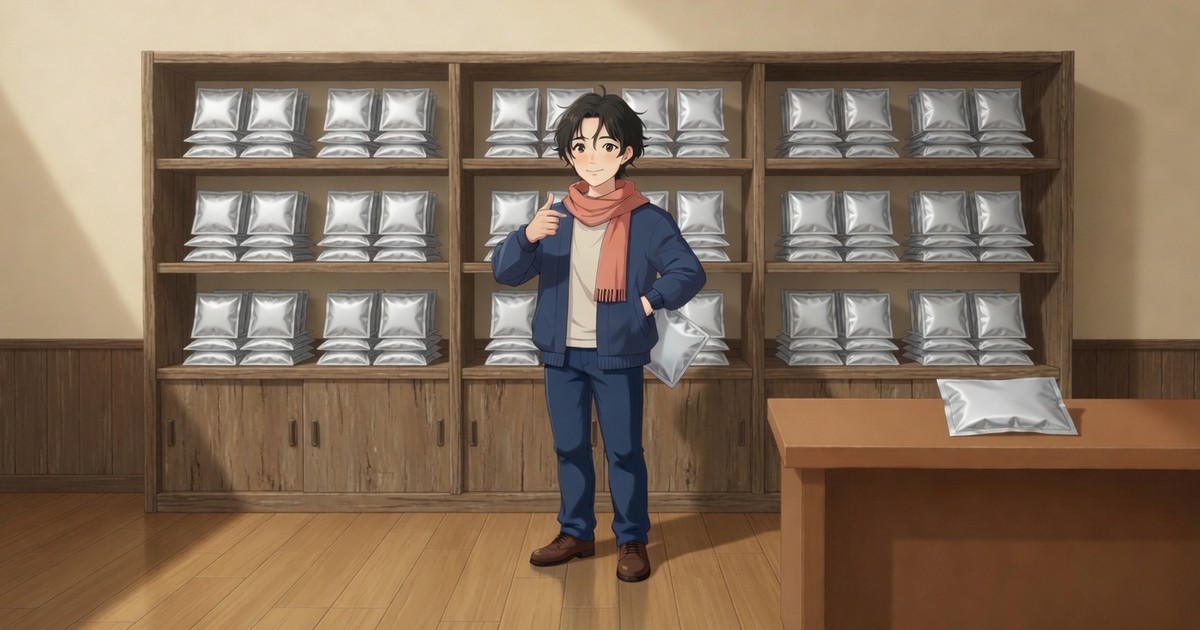
It means "aftershock", and it is the word that dominates the ten minutes after any quake. 地震 (jishin) is the earthquake itself; 余震 (yoshin) is the string of smaller ones that follow it, which can keep going for hours or days. Two lines cover almost everything staff and broadcasters say: 余震に注意してください (yoshin ni chūi shite kudasai), "please watch out for aftershocks", and 余震です。まだ揺れるかもしれません (yoshin desu. mada yureru kamo shiremasen), "it's an aftershock — it may shake again." Neither is an instruction to leave. They are a request to give the shelves, the stacked stock and the big windows some room for a while, which is exactly what the reel above is about.
What does a 震度 (shindo) number actually tell you?
震度 (shindo) tells you how hard the ground shook in one specific place, on a scale from 0 to 7 with ten steps, because 5 and 6 are each split into 弱 (jaku, "weak") and 強 (kyō, "strong"). It is not マグニチュード (magunichūdo, magnitude), which is one number for the whole quake's energy — a big magnitude far offshore can land as a barely-felt shindo 2 where you are standing. In practice: shindo 3 rattles the dishes and everyone glances up. Shindo 4 swings the light fittings and knocks over anything unsecured, and nothing closes. Shindo 5弱 is where the country changes gear — trains halt, lifts park themselves, staff start walking the building. Shindo 6弱 and above is where standing up becomes difficult and it is a real emergency. The number is announced within a few minutes, by prefecture and ward, as 震度4 (shindo yon).
What do the station and hotel announcements say when trains stop?
They are telling you the trains have paused to be inspected, not that anything is broken. Railways stop themselves automatically once shaking passes a threshold, then crews check the track before anything moves. The words to catch are ただいま地震がありました (tadaima jishin ga arimashita, "there has just been an earthquake"), 安全確認のため (anzen kakunin no tame, "for a safety check"), and 運転を見合わせています (unten o miawasete imasu, "service is suspended"). The good news comes as 運転再開 (unten saikai, "service resumed"), usually with an estimate like 6時頃 (rokuji goro, "around six o'clock"). A moderate quake typically costs you thirty to sixty minutes. If it will be longer, ask about 振替輸送 (furikae yusō), the substitute transport that lets your ticket ride a rival company's line — the same drill as any suspended train in Japan, and the reason "densha, ugoitemasu ka?" is worth memorising.
When do you actually need to evacuate?
When you are told to, or when you are near the coast and hear the word 津波 (tsunami). The instruction is 避難してください (hinan shite kudasai, "please evacuate"), and the place is a 避難場所 (hinan basho, "evacuation site"), marked by green signs showing a running figure. Coastal warnings escalate through 津波注意報 (tsunami chūihō, advisory), 津波警報 (tsunami keihō, warning) and 大津波警報 (ō-tsunami keihō, major warning). If you are by the sea and the shaking is long and slow, do not wait for any of them: walk inland or uphill to 高台 (takadai, high ground) immediately, on foot, without going back for your bags. Inland, evacuation is rare and your hotel will run it — the phrases there are 落ち着いてください (ochitsuite kudasai, "please stay calm") and エレベーターは使わないでください (erebētā wa tsukawanaide kudasai, "please don't use the elevators"). Keep your shoes and phone beside the bed and you have done the only preparation that matters.
Almost every earthquake you feel in Japan will end with nothing more than a paused train and a slightly quieter restaurant. The two words that carry you through it are 地震です (jishin desu, "it's an earthquake") — the one every phone screams first — and 余震 (yoshin), the one every announcement says afterwards. If something does go wrong, the numbers and the phrases are in our guide to calling for help in Japan. Everything else is in the phrase-video catalog.